


Question: Please answer all questions, I'll definitely give an upvote!! B. Consider a queueing system having two servers and no queue. There are two types of

Please answer all questions, I'll definitely give an upvote!!
Please answer all questions, I'll definitely give

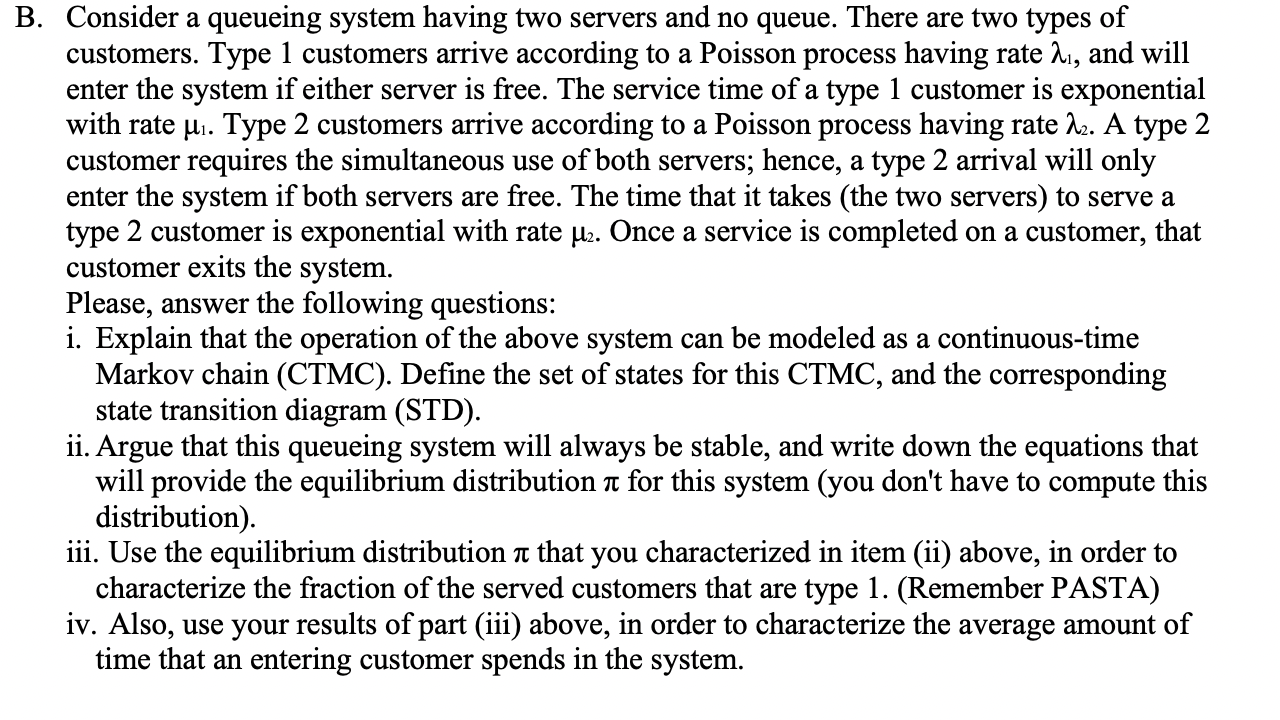
B. Consider a queueing system having two servers and no queue. There are two types of customers. Type 1 customers arrive according to a Poisson process having rate 21, and will enter the system if either server is free. The service time of a type 1 customer is exponential with rate ui. Type 2 customers arrive according to a Poisson process having rate 22. A type 2 customer requires the simultaneous use of both servers; hence, a type 2 arrival will only enter the system if both servers are free. The time that it takes (the two servers) to serve a type 2 customer is exponential with rate uz. Once a service is completed on a customer, that customer exits the system. Please, answer the following questions: i. Explain that the operation of the above system can be modeled as a continuous-time Markov chain (CTMC). Define the set of states for this CTMC, and the corresponding state transition diagram (STD). ii. Argue that this queueing system will always be stable, and write down the equations that will provide the equilibrium distribution n for this system (you don't have to compute this distribution) iii. Use the equilibrium distribution a that you characterized in item (ii) above, in order to characterize the fraction of the served customers that are type 1. (Remember PASTA) iv. Also, use your results of part (iii) above, in order to characterize the average amount of time that an entering customer spends in the system

Step by Step Solution

There are 3 Steps involved in it

1 Expert Approved Answer
Step: 1 Unlock blur-text-image

Question Has Been Solved by an Expert!

Get step-by-step solutions from verified subject matter experts

Step: 2 Unlock
Step: 3 Unlock

Students Have Also Explored These Related General Management Questions!