



Question: *Please answer all questions in a-d in an easy format *Round A & C answers to the nearest cent. *Round B answers to two decimals

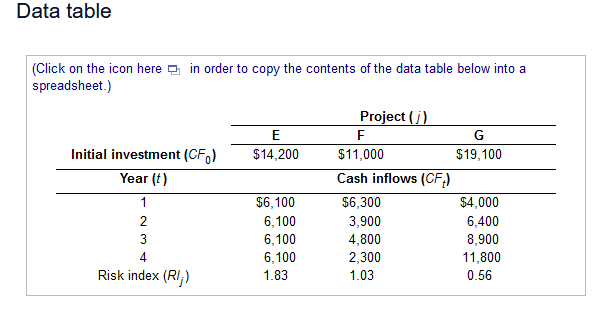
*Please answer all questions in a-d in an easy format
*Round A & C answers to the nearest cent.
*Round B answers to two decimals places.
Risk-adjusted discount ratesBasic Country Wallpapers is considering investing in one of three mutually exclusive projects, E, F, and G. The firm's cost of capital, r, is 14.9%, and the risk-free rate, RF, is 9.6%. The firm has gathered the following basic cash flow and risk index data for each project a. Find the net present value (NPV) of each project using the firm's cost of capital. Which project is preferred in this situation? b. The firm uses the following equation to determine the risk-adjusted discount rate, RADR;, for each project j: RADR; =RE+RI,* (r-RF) where Re = risk-free rate of return, RI; = risk index for project, and r = cost of capital. Substitute each project's risk index into this equation to determine its RADR. c. Use the RADR for each project to determine its risk-adjusted NPV. Which project is preferable in this situation? d. Compare and discuss your findings in parts (a) and (c). Which project do you recommend that the firm accept? Data table (Click on the icon here e in order to copy the contents of the data table below into a spreadsheet.) Project (1) E F G Initial investment (CF) $14,200 $11,000 $19,100 Year (t) Cash inflows (CF) $6,100 $6,300 $4,000 2 6,100 3,900 6,400 3 6,100 4,800 8,900 4 6,100 2,300 11,800 Risk index (R!;) 1.83 1.03 0.56 1
Step by Step Solution
There are 3 Steps involved in it

Get step-by-step solutions from verified subject matter experts