







Question: ( Please answer all questions in this exercise, thanks! ) Analytics Exercise: Inventory Control at Sebastian River Farms Sebastian River Farms ( SRF ) is
Please answer all questions in this exercise, thanks!
Analytics Exercise: Inventory Control at
Sebastian River Farms
Sebastian River Farms SRF is a wholesale tree farm with
approximately acres on Floridas east coast near Vero Beach
USA Forecasting yearly sales at this company was discussed in
Chapter In this exercise, the decisions related to planting new
trees and managing inventory are covered. The farm grows over
different varieties of trees and shrubs. The farm has approximately
trees. About are mature trees that are available for
sale. The other are growing which can take from two to three
years, depending on the type.
Although some of the trees are planted in the ground and grown
from small twigs, most are grown in and gallon pots. Potgrown trees are much more convenient for selling to the over
landscaping and tree supply companies that SRF sells to throughout
Florida. On an ongoing basis, the company evaluates current
inventory and makes decisions about what to plant. The farm has a
team of hardworking people who prepare the planting pots, plant the
trees, and then set up the irrigation pipes that are needed to water
each tree every day. Maintaining and pruning shaping over the
growth period is a daily task that is needed to grow topquality trees.
Much of the cost associated with growing and maintaining involves
the workers employed by the farm. The team operates like a big
family. First priority is loading trucks that deliver trees to customers,
and much of this work is done in the early morning during the week.
Planting is generally done during slack periods and on weekends by
the team. From a cost view, it would be possible to allocate the labor
cost to different activities, but this is not currently done by the farm
accountant.
Other than labor, another major cost is running the irrigation
system. Water is supplied by a lake located on the farm. Electrically
operated pumps draw water from the lake and feed a network of
pipes that supply water to each individual tree. Since the pumps need
to run virtually every day, the cost of the electricity to run them does
not vary much from month to month.
Trees generally grow from to inches each year. The
desirable trees are between and feet in height. It generally takes
at least two years for a tree to mature to where it can be sold. If a
tree gets too large, it can be difficult to sell due to the problem of
transporting it to the customer. The inside joke between farm
managers is that old trees become boards Managing the
growthsell cycle is important to the success of the farm.
The decision about when a type of tree should be planted and
how many trees to plant is made by management based on
experience and some guidelines that have been learned over time. In
general, the fastmoving, highvolume trees are generally planted
every other year. Slowermoving, lowdemand trees are planted
every three years. The cutoff for high versus lowvolume trees is
demand of per year. This is certainly not an exact science since
there is much variability in the demand and in the growing time for the
trees. Trees for landscape projects are generally specified by
landscape architects and designers. Their selections depend on the
location where the trees will be planted.
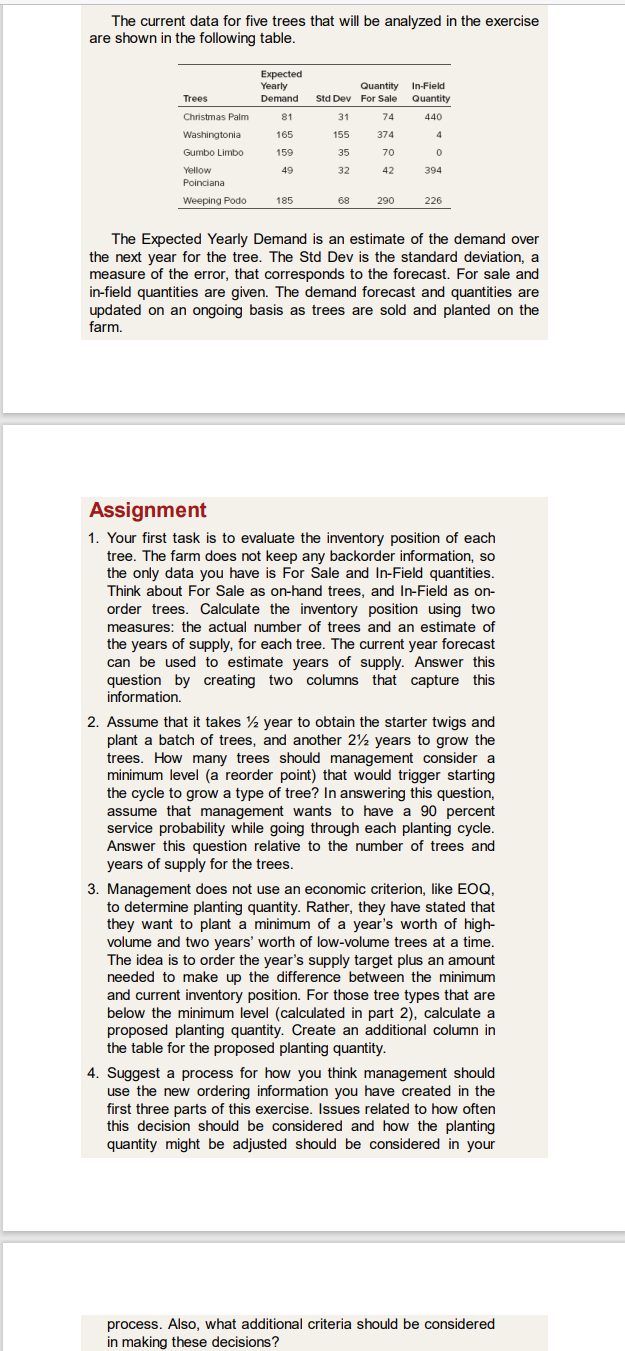
This exercise is designed to help structure the timing and quantity
of planting decisions using data from the inventory control
spreadsheet that the farm has recently developed. The inventory
system at the farm tracks the number of each type of tree, such as
Christmas Palm and Rosetta. Trees are tracked in fields where they
are planted and by row within the field. Trees of the same type are
often located in different fields on the farm, and the inventory system
aggregates the status of each type over the locations.
When a tree is initially planted, it is categorized as infield with a
projected ready date. When the tree matures, categorization is
changed to for sale. Batches of trees are planted at the same time,
typically in consecutive rows in a field, making it easier to identify
trees that are for sale to customers.
When a tree is sold, the salesperson goes into the field and tags
the tree for removal from the field and pickup by the customer
typically multiple trees are included in an order Tags are colored
ribbons that are tied around the tree. A unique color is used for each
order. Tagging is a ritual done by the salesperson to ensure that the
appropriate quality of tree is selected. Trees that are identified as not
saleable are tagged with a special black ribbon and are periodically
removed from the field.
Step by Step Solution
There are 3 Steps involved in it
1 Expert Approved Answer
Step: 1 Unlock

Question Has Been Solved by an Expert!
Get step-by-step solutions from verified subject matter experts
Step: 2 Unlock
Step: 3 Unlock
 Study Help