







Question: Please answer all questions or none at all. Thank you in advance. Let p,q, and r be the propositions. p : You get an A
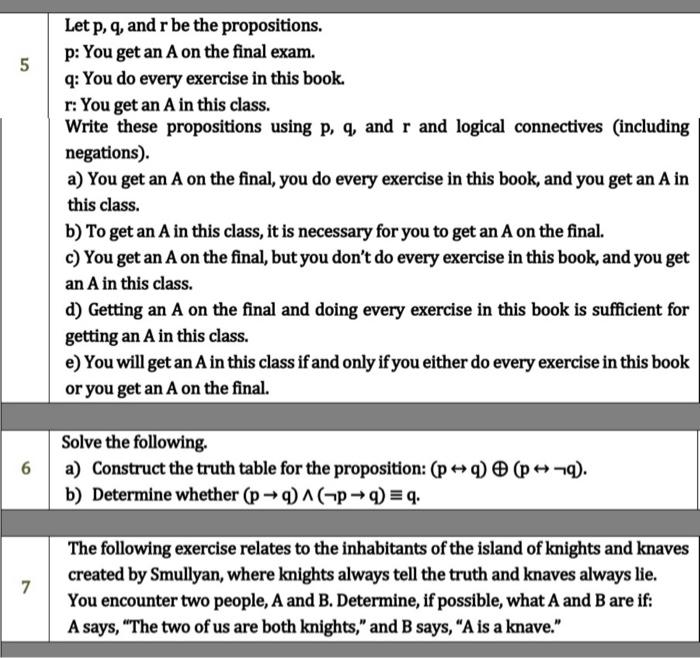
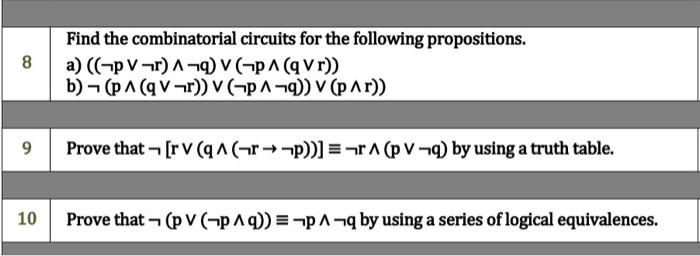
Let p,q, and r be the propositions. p : You get an A on the final exam. q: You do every exercise in this book. r : You get an A in this class. Write these propositions using p,q, and r and logical connectives (including negations). a) You get an A on the final, you do every exercise in this book, and you get an A in this class. b) To get an A in this class, it is necessary for you to get an A on the final. c) You get an A on the final, but you don't do every exercise in this book, and you get an A in this class. d) Getting an A on the final and doing every exercise in this book is sufficient for getting an A in this class. e) You will get an A in this class if and only if you either do every exercise in this book or you get an A on the final. Solve the following. a) Construct the truth table for the proposition: (pq)(pq). b) Determine whether (pq)(pq)q. The following exercise relates to the inhabitants of the island of knights and knaves created by Smullyan, where knights always tell the truth and knaves always lie. You encounter two people, A and B. Determine, if possible, what A and B are if: A says, "The two of us are both knights," and B says, "A is a knave." Find the combinatorial circuits for the following propositions. a) ((pr)q)(p(qr)) b) (p(qr))(pq))(pr)) Prove that [r(q(rp))]r(pq) by using a truth table. Prove that (p(pq))pq by using a series of logical equivalences
Step by Step Solution
There are 3 Steps involved in it

Get step-by-step solutions from verified subject matter experts
 Study Help