



Question: Please answer all questions. Thank you Advertising Doesn't Work Joyce Evans, Administrator of Brookwood Vision Center, is excited about a new idea. Specifically, she believes
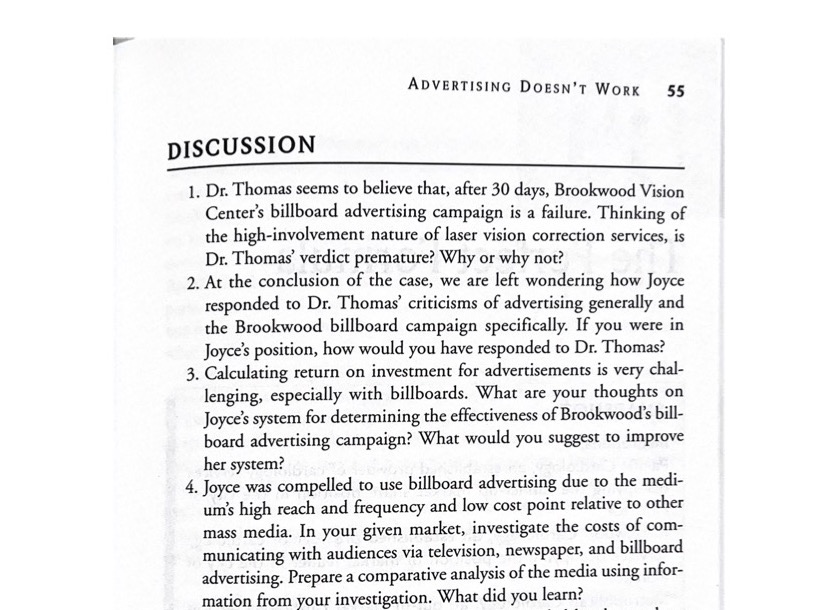
Please answer all questions. Thank you
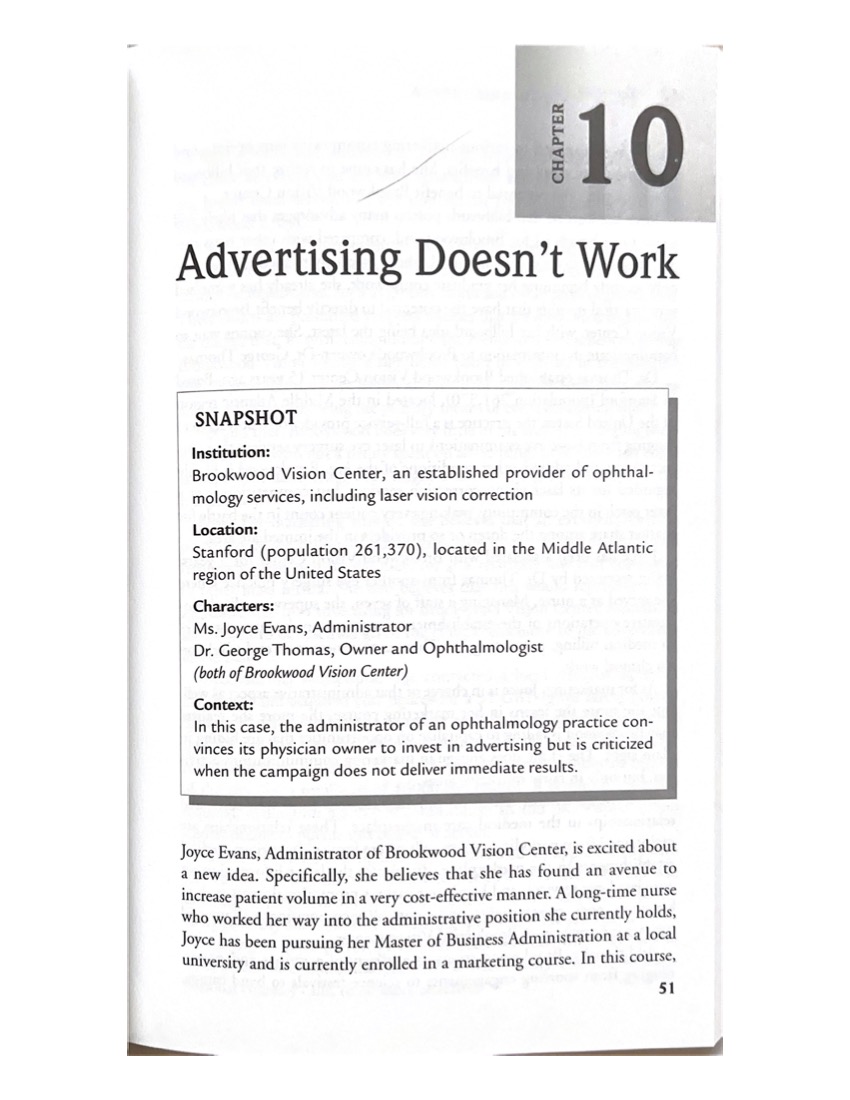
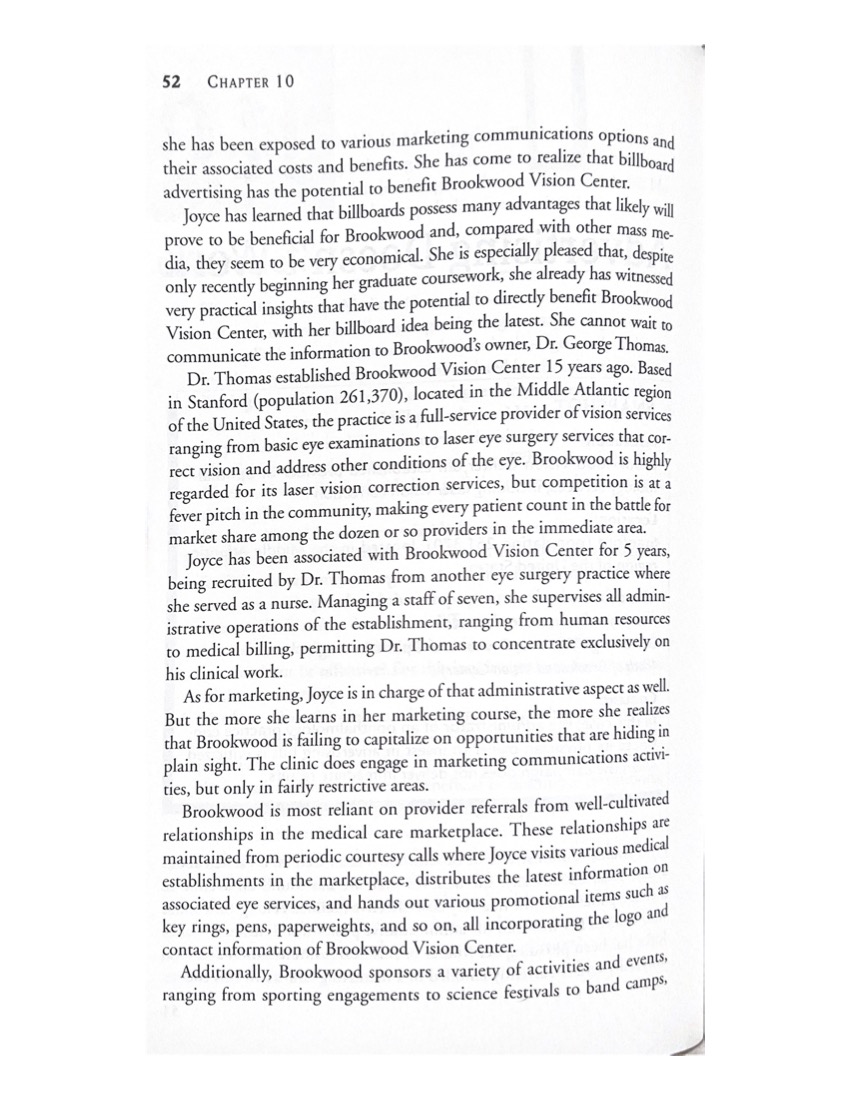
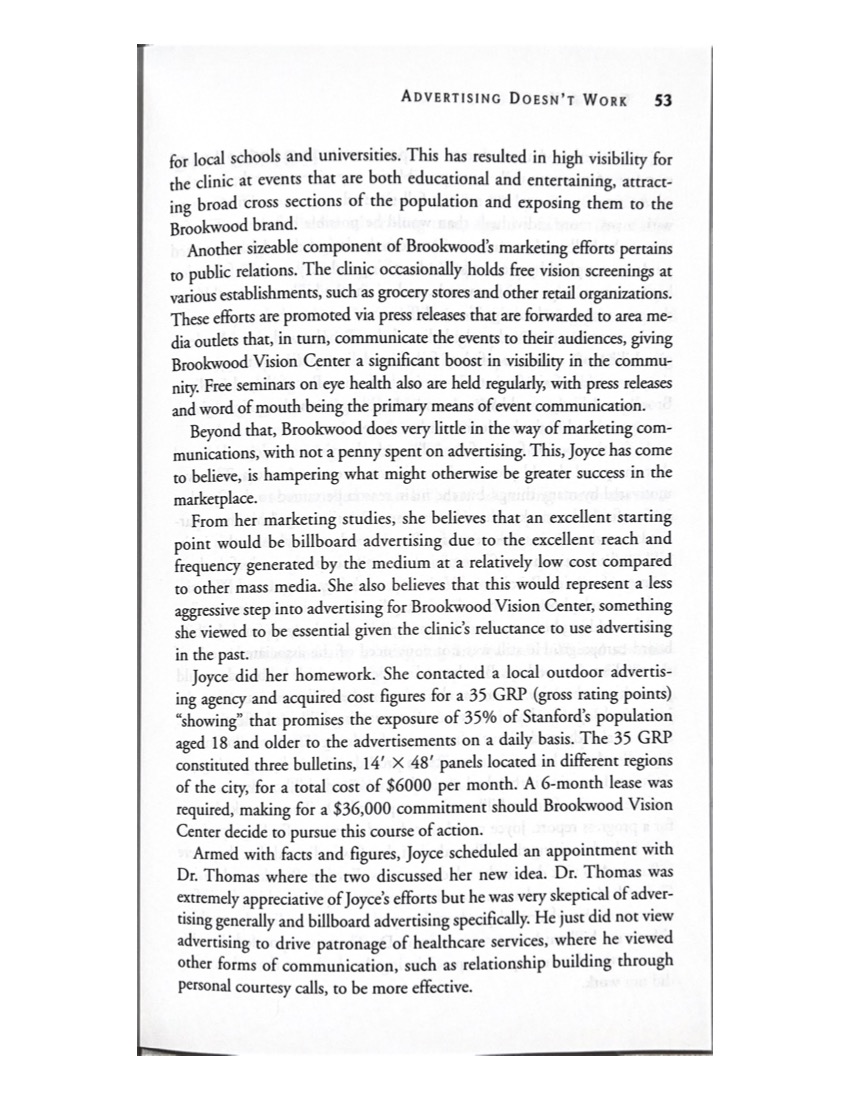
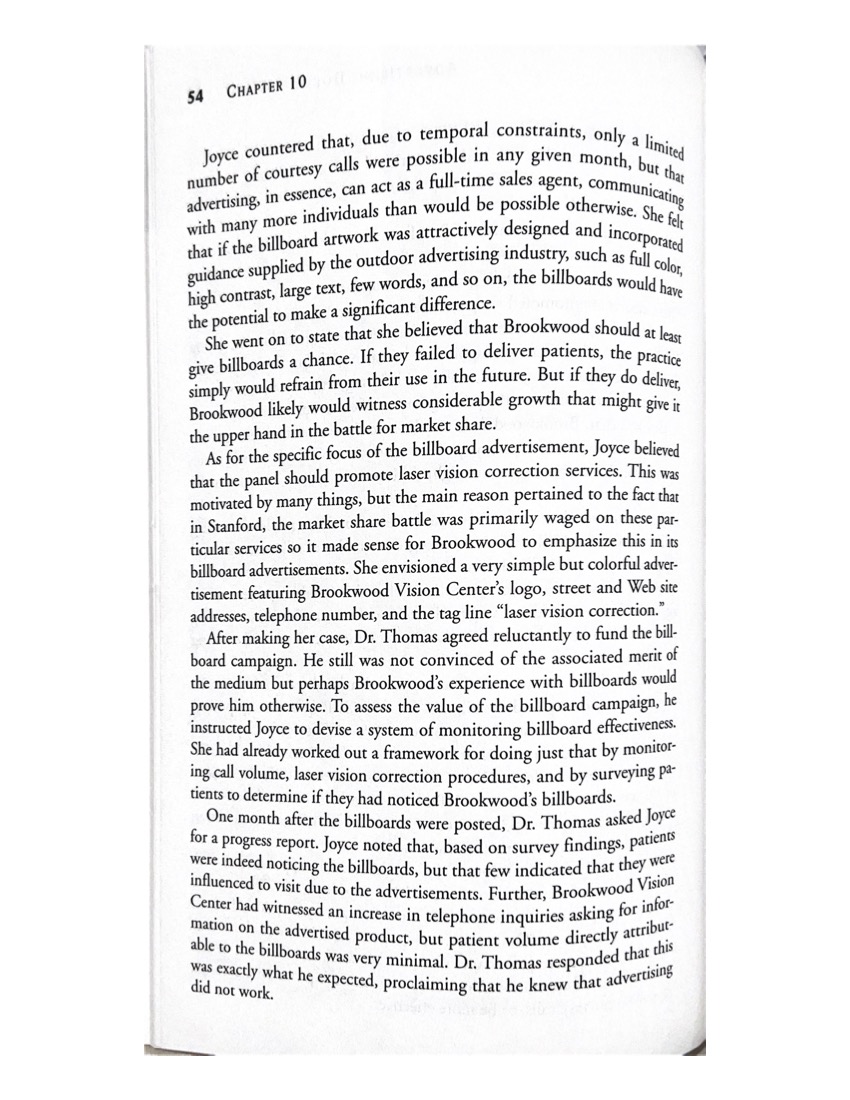
Advertising Doesn't Work Joyce Evans, Administrator of Brookwood Vision Center, is excited about a new idea. Specifically, she believes that she has found an avenue to increase patient volume in a very cost-effective manner. A long-time nurse who worked her way into the administrative position she currently holds, Joyce has been pursuing her Master of Business Administration at a local university and is currently enrolled in a marketing course. In this course, 51 she has been exposed to various marketing communications options and their associated costs and benefits. She has come to realize that billboard advertising has the potential to benefit Brookwood Vision Center. Joyce has learned that billboards possess many advantages that likely will prove to be beneficial for Brookwood and, compared with other mass media, they seem to be very economical. She is especially pleased that, despite only recently beginning her graduate coursework, she already has witnessed very practical insights that have the potential to directly benefit Brookwood Vision Center, with her billboard idea being the latest. She cannot wait to communicate the information to Brookwood's owner, Dr. George Thomas. Dr. Thomas established Brookwood Vision Center 15 years ago. Based in Stanford (population 261,370), located in the Middle Atlantic region of the United States, the practice is a full-service provider of vision services ranging from basic eye examinations to laser eye surgery services that correct vision and address other conditions of the eye. Brookwood is highly regarded for its laser vision correction services, but competition is at a fever pitch in the community, making every patient count in the battle for market share among the dozen or so providers in the immediate area. Joyce has been associated with Brookwood Vision Center for 5 years, being recruited by Dr. Thomas from another eye surgery practice where she served as a nurse. Managing a staff of seven, she supervises all administrative operations of the establishment, ranging from human resources to medical billing, permitting Dr. Thomas to concentrate exclusively on his clinical work. As for marketing, Joyce is in charge of that administrative aspect as well. But the more she learns in her marketing course, the more she realizes that Brookwood is failing to capitalize on opportunities that are hiding in plain sight. The clinic does engage in marketing communications activities, but only in fairly restrictive areas. Brookwood is most reliant on provider referrals from well-cultivated relationships in the medical care marketplace. These relationships are maintained from periodic courtesy calls where Joyce visits various medical establishments in the marketplace, distributes the latest information on associated eye services, and hands out various promotional items such as key rings, pens, paperweights, and so on, all incorporating the logo and contact information of Brookwood Vision Center. Additionally, Brookwood sponsors a variety of activities and events, ranging from sporting engagements to science festivals to band camps, for local schools and universities. This has resulted in high visibility for the clinic at events that are both educational and entertaining, attracting broad cross sections of the population and exposing them to the Brookwood brand. Another sizeable component of Brookwood's marketing efforts pertains to public relations. The clinic occasionally holds free vision screenings at various establishments, such as grocery stores and other retail organizations. These efforts are promoted via press releases that are forwarded to area media outlets that, in turn, communicate the events to their audiences, giving Brookwood Vision Center a significant boost in visibility in the community. Free seminars on eye health also are held regularly, with press releases and word of mouth being the primary means of event communication. Beyond that, Brookwood does very little in the way of marketing communications, with not a penny spent on advertising. This, Joyce has come to believe, is hampering what might otherwise be greater success in the marketplace. From her marketing studies, she believes that an excellent starting point would be billboard advertising due to the excellent reach and frequency generated by the medium at a relatively low cost compared to other mass media. She also believes that this would represent a less aggressive step into advertising for Brookwood Vision Center, something she viewed to be essential given the clinic's reluctance to use advertising in the past. Joyce did her homework. She contacted a local outdoor advertising agency and acquired cost figures for a 35 GRP (gross rating points) "showing" that promises the exposure of 35% of Stanford's population aged 18 and older to the advertisements on daily basis. The 35 GRP constituted three bulletins, 1448 panels located in different regions of the city, for a total cost of $6000 per month. A 6-month lease was required, making for a $36,000 commitment should Brookwood Vision Center decide to pursue this course of action. Armed with facts and figures, Joyce scheduled an appointment with Dr. Thomas where the two discussed her new idea. Dr. Thomas was extremely appreciative of Joyce's efforts but he was very skeptical of advertising generally and billboard advertising specifically. He just did not view advertising to drive patronage of healthcare services, where he viewed other forms of communication, such as relationship building through personal courtesy calls, to be more effective. Joyce countered that, due to temporal constraints, only a limited number of courtesy calls were possible in any given month, but that advertising, in essence, can act as a full-time sales agent, communicating with many more individuals than would be possible otherwise. She felt that if the billboard artwork was attractively designed and incorporated guidance supplied by the outdoor advertising industry, such as full color, high contrast, large text, few words, and so on, the billboards would have the potential to make a significant difference. She went on to state that she believed that Brookwood should at least give billboards a chance. If they failed to deliver patients, the practice simply would refrain from their use in the future. But if they do deliver, Brookwood likely would witness considerable growth that might give it the upper hand in the battle for market share. As for the specific focus of the billboard advertisement, Joyce believed that the panel should promote laser vision correction services. This was motivated by many things, but the main reason pertained to the fact that in Stanford, the market share battle was primarily waged on these particular services so it made sense for Brookwood to emphasize this in its billboard advertisements. She envisioned a very simple but colorful advertisement featuring Brookwood Vision Center's logo, street and Web site addresses, telephone number, and the tag line "laser vision correction." After making her case, Dr. Thomas agreed reluctantly to fund the billboard campaign. He still was not convinced of the associated merit of the medium but perhaps Brookwood's experience with billboards would prove him otherwise. To assess the value of the billboard campaign, he instructed Joyce to devise a system of monitoring billboard effectiveness. She had already worked out a framework for doing just that by monitoring call volume, laser vision correction procedures, and by surveying patients to determine if they had noticed Brookwood's billboards. One month after the billboards were posted, Dr. Thomas asked Joyce for a progress report. Joyce noted that, based on survey findings, patients were indeed noticing the billboards, but that few indicated that they were influenced to visit due to the advertisements. Further, Brookwood Vision Center had witnessed an increase in telephone inquiries asking for information on the advertised product, but patient volume directly attributable to the billboards was very minimal. Dr. Thomas responded that this was exactly what he expected, proclaiming that he knew that advertising did not work. 1. Dr. Thomas seems to believe that, after 30 days, Brookwood Vision Center's billboard advertising campaign is a failure. Thinking of the high-involvement nature of laser vision correction services, is Dr. Thomas' verdict premature? Why or why not? 2. At the conclusion of the case, we are left wondering how Joyce responded to Dr. Thomas' criticisms of advertising generally and the Brookwood billboard campaign specifically. If you were in Joyce's position, how would you have responded to Dr. Thomas? 3. Calculating return on investment for advertisements is very challenging, especially with billboards. What are your thoughts on Joyce's system for determining the effectiveness of Brookwood's billboard advertising campaign? What would you suggest to improve her system? 4. Joyce was compelled to use billboard advertising due to the medium's high reach and frequency and low cost point relative to other mass media. In your given market, investigate the costs of communicating with audiences via television, newspaper, and billboard advertising. Prepare a comparative analysis of the media using information from your investigation. What did you learn
Step by Step Solution
There are 3 Steps involved in it

Get step-by-step solutions from verified subject matter experts