







Question: Please answer all questions with explainatiom Chapter 3 (1) (2 + 2 + 2 = 6 points.) Assume for simplicity that you have only one
Please answer all questions with explainatiom
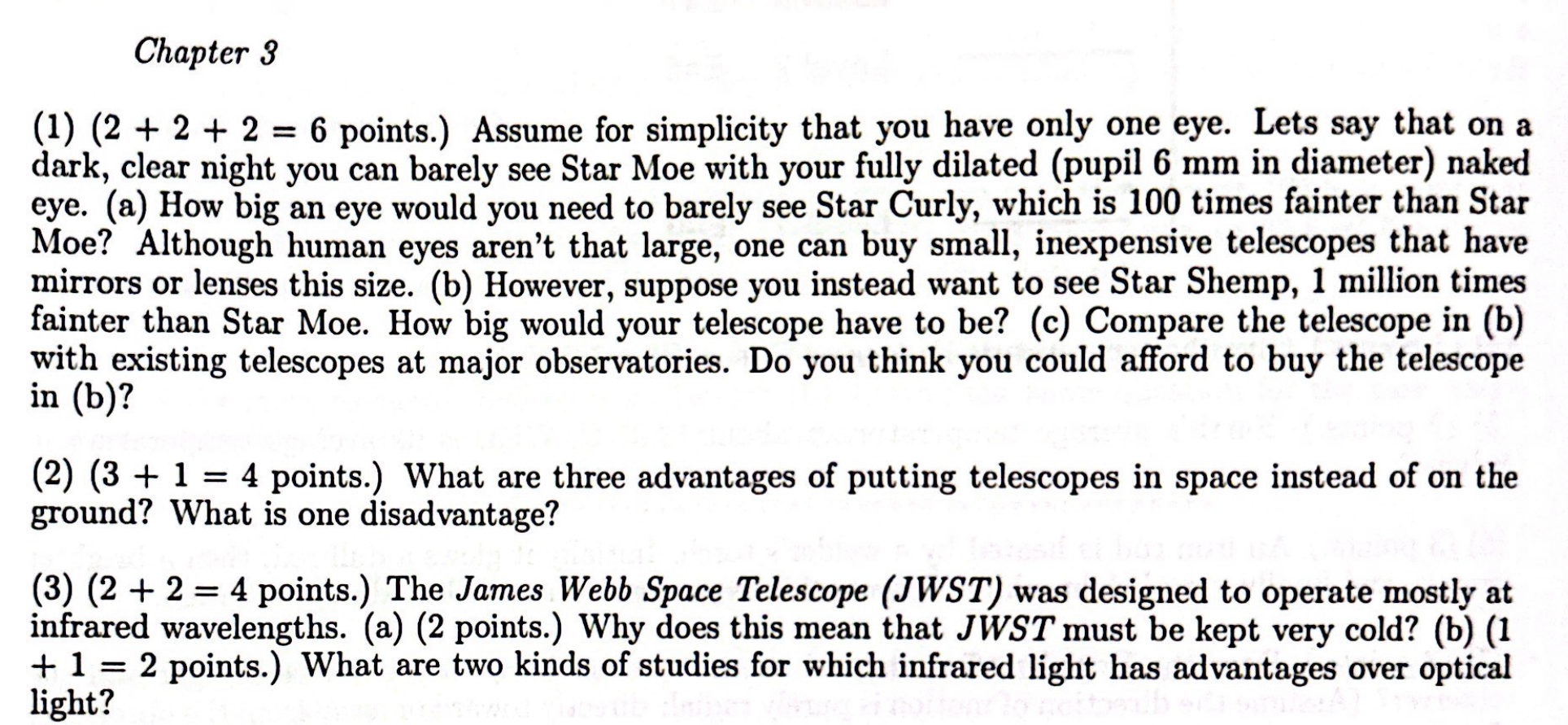
Chapter 3 (1) (2 + 2 + 2 = 6 points.) Assume for simplicity that you have only one eye. lets say that on a dark, clear night you can barely see Star Moe with your fully dilated (pupil 6 mm m diameter) naked eye. (a) How big an eye would you need to barely see Star Curly, which is 100 times fainter than Star Moe? Although human eyes aren't that large, one can buy small, inexpensive telescopes that have mirrors or lenses this size. (b) However, suppose you instead want to see Star Shemp, 1 million times fainter than Star Moe. How big would your telescope have to be? (c) Compare the telescope in (b) with existing telescopes at major observatories. Do you think you could afford to buy the telescope in (b)? (2) (3 + 1 = 4 points.) What are three advantages of putting telescopes in space instead of on the ground? What is one disadvantage? (3) (2 + 2 = 4 points.) The James Webb Space Telescope (J WS T) was designed to operate mostly at infrared wavelengths. (a) (2 points.) Why does this mean that J WST must be kept very cold? (b) (l + 1 = 2 points.) What are two kinds of studies for which infrared light has advantages over optical light
Step by Step Solution
There are 3 Steps involved in it

Get step-by-step solutions from verified subject matter experts
 Study Help