







Question: Please answer all questions with explanations Consumer Choice Model 1. Elizabeth has the following utility function for goods X and Y: U =X Y. Her
Please answer all questions with explanations
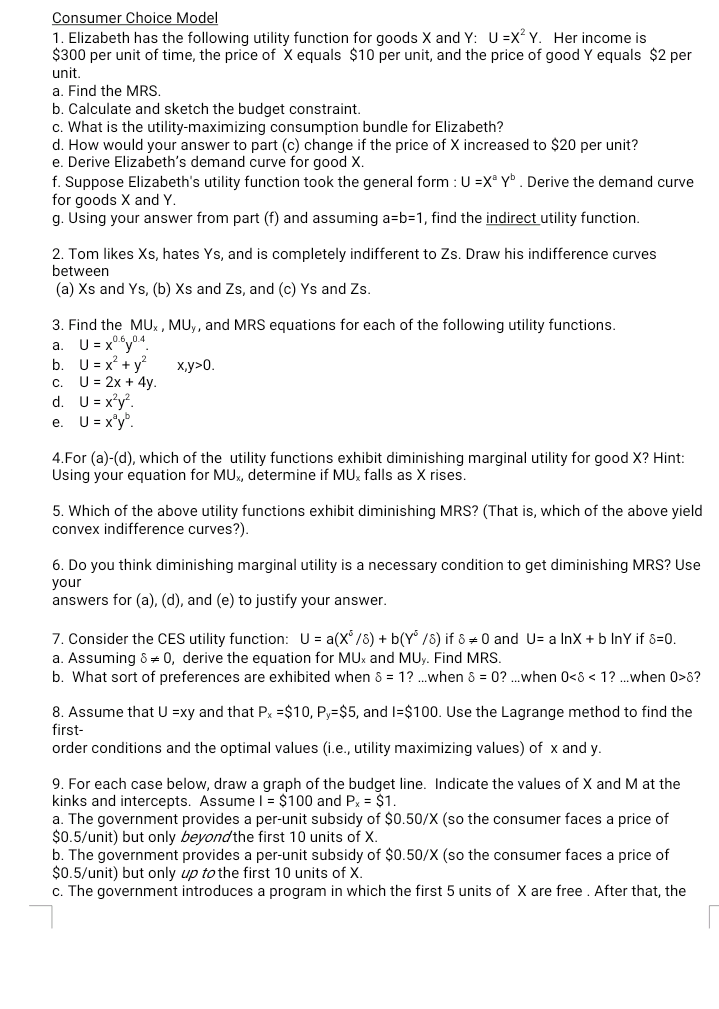
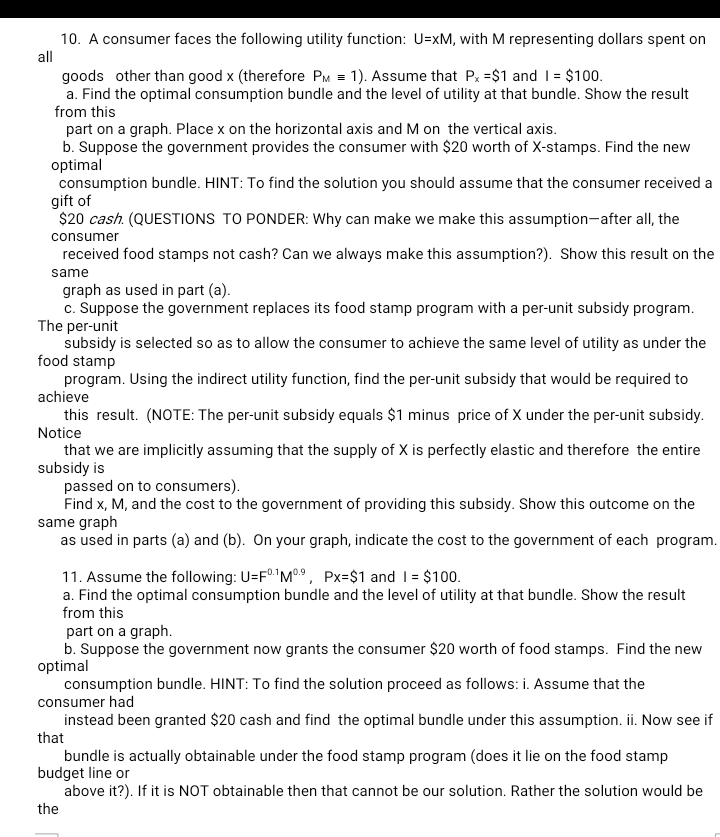
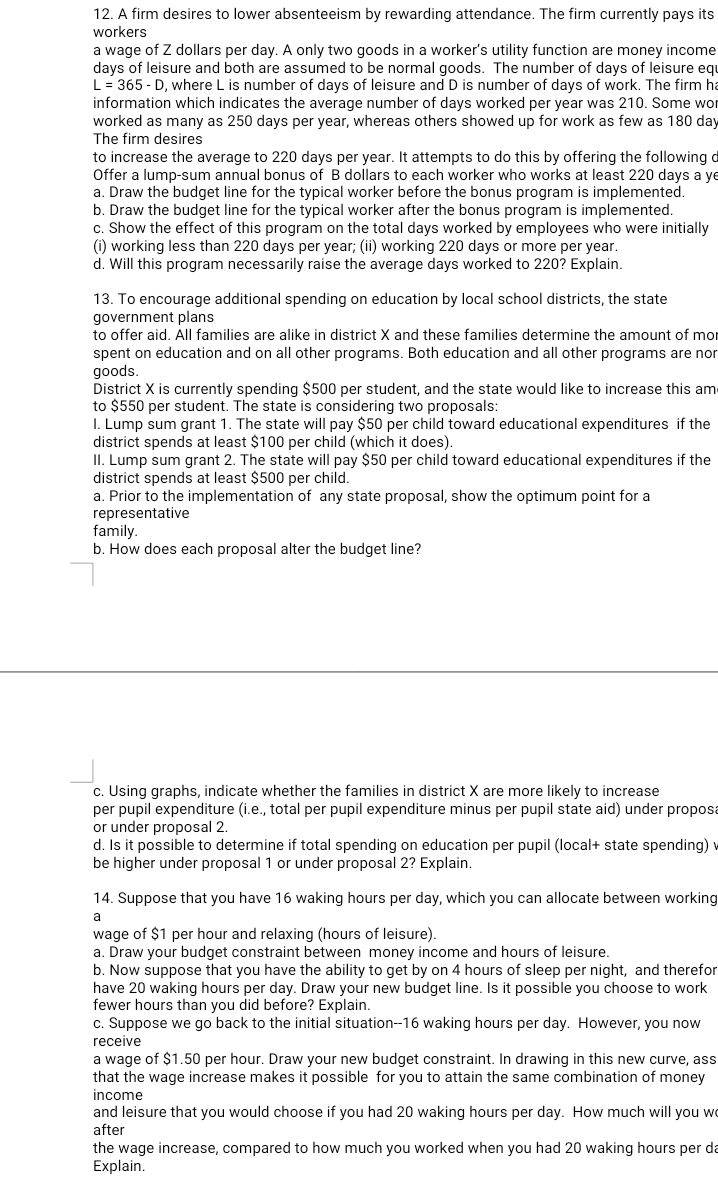
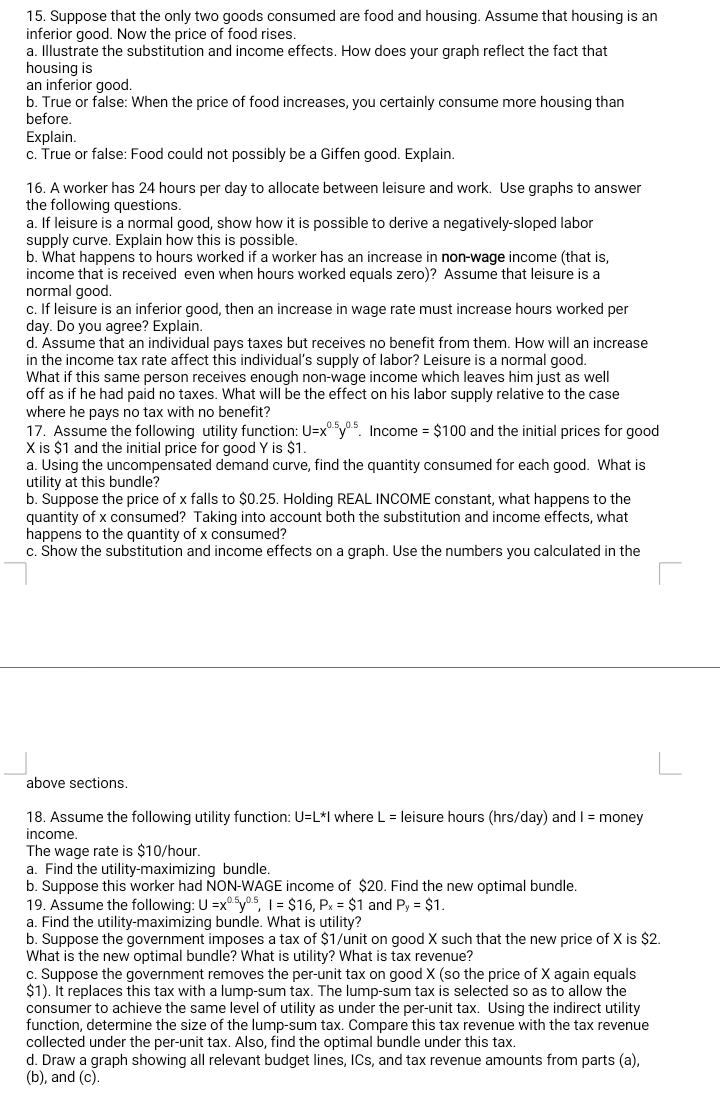
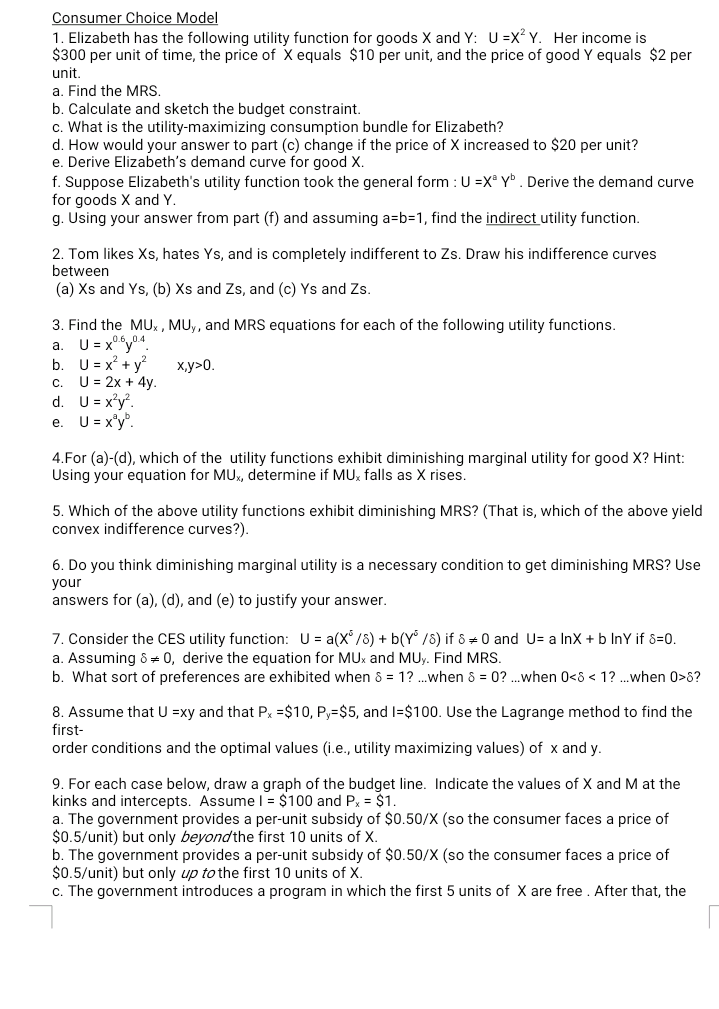
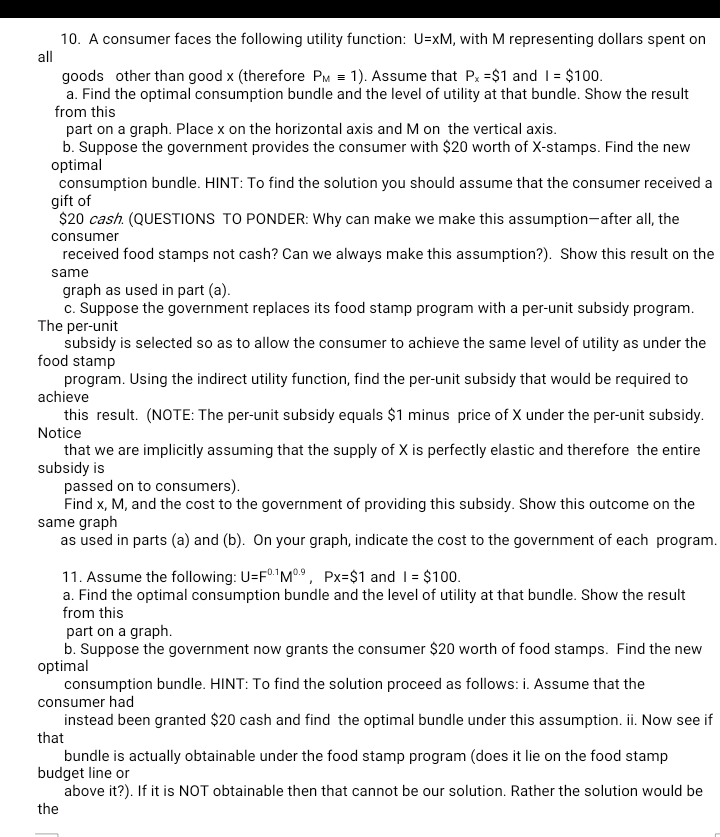
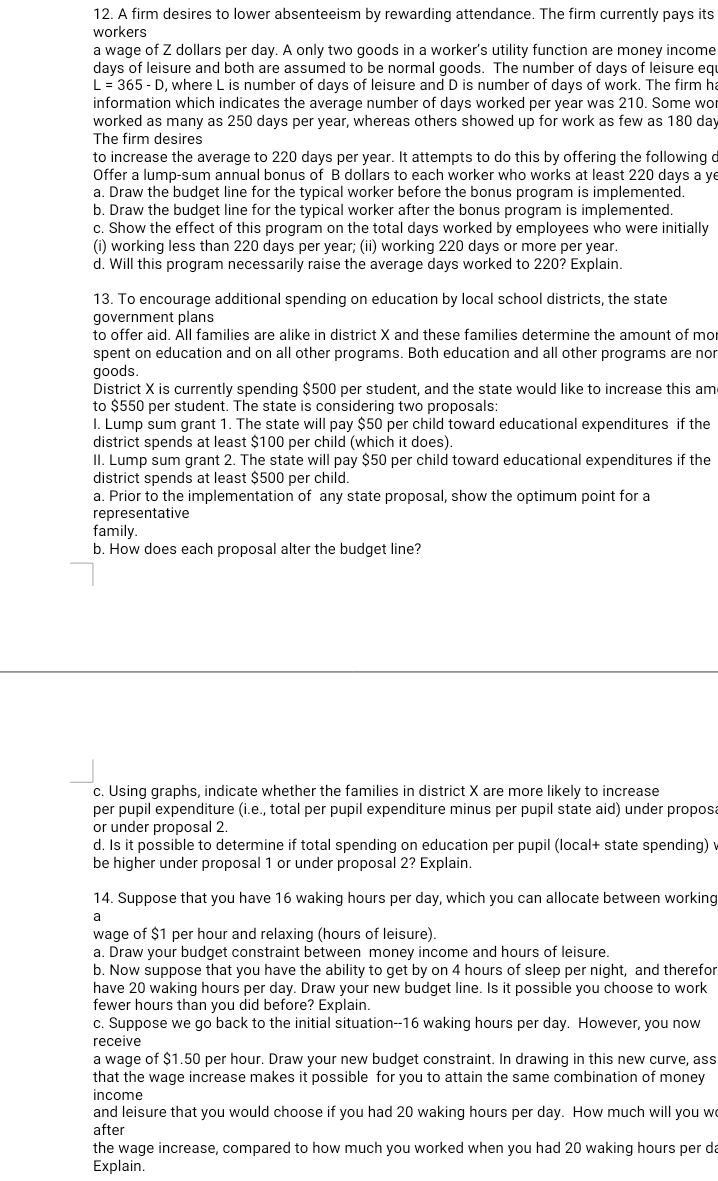
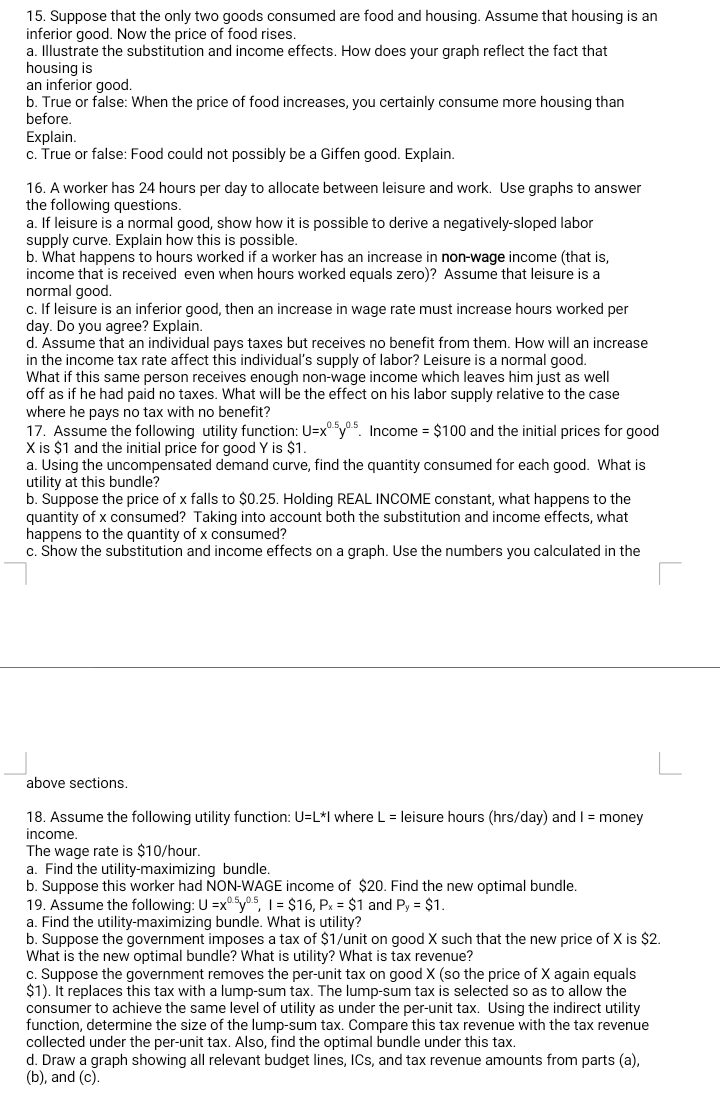
Consumer Choice Model 1. Elizabeth has the following utility function for goods X and Y: U =X Y. Her income is $300 per unit of time, the price of X equals $10 per unit, and the price of good Y equals $2 per unit. a. Find the MRS. b. Calculate and sketch the budget constraint. c. What is the utility-maximizing consumption bundle for Elizabeth? d. How would your answer to part (c) change if the price of X increased to $20 per unit? e. Derive Elizabeth's demand curve for good X. f. Suppose Elizabeth's utility function took the general form : U =X Y . Derive the demand curve for goods X and Y. g. Using your answer from part (f) and assuming a=b=1, find the indirect utility function. 2. Tom likes Xs, hates Ys, and is completely indifferent to Zs. Draw his indifference curves between (a) Xs and Ys, (b) Xs and Zs, and (c) Ys and Zs. 3. Find the MUx , MUy, and MRS equations for each of the following utility functions. a. U = x0604 b. U =x'+ y x, y>0. C. U = 2x + 4y. d. U=xy. e. U = xy. 4.For (a)-(d), which of the utility functions exhibit diminishing marginal utility for good X? Hint: Using your equation for MU,, determine if MU, falls as X rises. 5. Which of the above utility functions exhibit diminishing MRS? (That is, which of the above yield convex indifference curves?). 6. Do you think diminishing marginal utility is a necessary condition to get diminishing MRS? Use your answers for (a), (d), and (e) to justify your answer. 7. Consider the CES utility function: U = a(X" /8) + b(Y /8) if 6 =0 and U= a InX + b InY if 6=0. a. Assuming 6 = 0, derive the equation for MUx and MUy. Find MRS. b. What sort of preferences are exhibited when 5 = 1? ..when 8 = 0? ..when 06? 8. Assume that U =xy and that Px =$10, Py=$5, and I=$100. Use the Lagrange method to find the first- order conditions and the optimal values (i.e., utility maximizing values) of x and y. 9. For each case below, draw a graph of the budget line. Indicate the values of X and M at the kinks and intercepts. Assume | = $100 and Px = $1. a. The government provides a per-unit subsidy of $0.50/X (so the consumer faces a price of $0.5/unit) but only beyond the first 10 units of X. b. The government provides a per-unit subsidy of $0.50/X (so the consumer faces a price of $0.5/unit) but only up to the first 10 units of X. c. The government introduces a program in which the first 5 units of X are free . After that, the1D. A consumer faces the following utility function: U=IM, with M representing dollars spent on all goods otherthan good it [therefore PM a 1}. Assume that PI =$'l and l = $1 DID. a. Find the optimal consumption bundle and the level of utility at that bundle. Show the result from this part on a graph. Place 1-: on the horizontal axis and M on the vertical axis. b. Suppose the government provides the consumer with $20 worth of IIIstamps. Find the new optimal consumption bundle. HINT: To find the solution you should assume that the consumer received a gift of $212) cash [QUESTIONS TD PDNDER: Why can make we make this assumptionafter all, the consumer received food stamps not cash? Can we always make this assumption?) Show this result on the same graph as used in part [a]. c. Suppose the government replaces its food stamp program with a per-unit subsidy program. The perunit subsidy is selected so as to allow the consumer to achieve the same level of utility as under the food stamp program. Using the indirect utility functionJ find the perunit subsidy that would be required to achieve this result. (NOTE: The perunit subsidy eguals $1 minus price of X under the perunit subsidy. Notice that we are implicitly assuming that the supply of X is perfectly elastic and therefore the entire subsidy is passed on to consumers}. Find I, M, and the cost to the government of providing this subsidy. Show this outcome on the same graph as used in parts [a] and {b}. On your graph] indicate the cost to the government of each program. 11. Assume the following: u=I=\"-1 M\". Px=$1 and | =31no. a. Find the optimal consumption bundle and the level of utility at that bundle. Show the result from this part on a graph. b. Suppose the government now grants the consumer SEE: worth of food stamps. Find the new optimal consumption bundle. HINT: To find the solution proceed as follows: i. Assume that the consumer had instead been granted $20 cash and find the optimal bundle under this assumption. ii. Now see if that bundle is actually obtainable under the food stamp program (does it lie on the food stamp budget line or above it?}. If it is NOT obtainable then that cannot be our solution. Ratherthe solution would be the 12. A firm desires to lower absenteeism by rewarding attendance. The firm currently pays its workers a wage of 2 dollars per day. A only two goods in a worker's utility function are money income days of leisure and both are assumed to be normal goods. The number of days of leisure eql. L = 355 - D. where L is number of days of leisure and D is number of days of work. The firm hi information which indicates the average number of days worked per year was 21!]. Some wor worked as many as 250 days per year, whereas others showed up for work as few as 130 day The firm desires to increase the average to 22D days per year. It attempts to do this by offering the following d Offer a lump-sum annual bonus of B dollars to each worker who works at least 22D days a ye a. Draw the budget line for the typical worker before the bonus program is implemented. b. Draw the budget line for the typical worker afterthe bonus program is implemented. c. Show the effect of this program on the total days worked by employees who were initially (i) working less than 22!] days per year". {ii} working 22!] days or more per year. d. Will this program necessarily raise the average days worked to 22D? Explain. 13. To encourage additional spending on education by local school districts, the state government plans to offer aid. All families are alike in district \"X and these families determine the amount of mm spent on education and on all other programs. Both education and all other programs are nor goods. District X is currently spending $5DD per student and the state would like to increase this am: to $550 per student. The state is considering two proposals: l. Lump sum grant 1. The state will pay $50 per child toward educational expenditures if the district spends at least S'lDD per child [which it does}. ll. Lump sum grant 2. The state will pay 55D per child toward educational expenditures ifthe district spends at least SEED per child. a. Prior to the implementation of any state proposal, show the optimum point for a representative family. b. How does each proposal alter the budget line? c. Using graphs. indicate whether the families in district X are more likely to increase per pupil expenditure (i.e., total per pupil expenditure minus per pupil state aid) under proposz or under proposal 2. d. Is it possible to determine if total spending on education per pupil (local+ state spending] it be higher under proposal 1 or under proposal 2? Explain. 14. Suppose that you have '16 waking hours per day, which you can allocate between working a wage of $1 per hour and relaxing (hours of leisure). a. Draw your budget constraint between money income and hours of leisure. b. Now suppose that you have the ability to get by on 4 hours of sleep per night, and therefor have 20 waking hours per day. Draw your new budget line. Is it possible you choose to work fewer hours than you did before? Explain. c. Suppose we go back to the initial situation1 5 waking hours per day. However. you now receive a wage of $1 .50 per hour. Draw your new budget constraint. ln drawing in this new curvel ass that the wage increase makes it possible for you to attain the same combination of money income and leisure that you would choose if you had 2D waking hours per day. How much will you w: after the wage increase. compared to how much you worked when you had 20 waking hours per dz Explain. 15. Suppose that the only two goods consumed are food and housing. Assume that housing is an inferior good. Now the price of food rises. a. Illustrate the substitution and income effects. Howr does your graph reflect the fact that housing is an inferior good. b. True or false: When the price of food increases. you certainly consume more housing than before. Explain. c. True or false: Food could not possibly be a Giffen good. Explain. 16. A worker has 24 hours per day to allocate between leisure and work. Use graphs to answer the following questions. a. If leisure is a normal good] show hDW it is possible to derive a negativelysloped labor supply curve. Explain how this is possible. b. What happens to hours worked if a worker has an increase in non-wage income {that is] income that is received even when hours worked equals zero]? Assume that leisure is a normal good. c. If leisure is an inferior good. then an increase in wage rate must increase hours worked per day. Do you agree? Explain. d. Assume that an individual pays taxes but receives no benet from them. How will an increase in the income tax rate affect this individual's supply of labor? Leisure is a normal good. What if this same person receives enough nonwage income which leaves himjust as well off as if he had paid no taxes. What will be the effect on his labor supply relative to the case where he pays no tax with no benefit? as as 1?. Assume the following utility function: U=x y . Income = $1 DD and the initial prices for good it is $1 and the initial price for good 'r' is $1. a. Using the uncompensated demand curve. find the quantity consumed for each good. What is utility at this bundle? b. Suppose the price of x falls to $0.25. Holding REAL INCOME constant. what happens to the quantity of x consumed? Taking into account both the substitution and income effects] what happens to the quantity of x consumed? c. Show the substitution and income effects on a graph. Use the numbers you calculated in the above sections. 18. Assume the following utility function: U=L*I where L = leisure hours [hrsr'dayj and l = money income. The wage rate is $1Eifhour. a. Find the utilymaximizing bundle. b. Suppose this worker had NONWAGE income of $20. Find the new optimal bundle. 1s. Assume the following: o =x'isy0-5, |= $16. P: = $1 and e. = $1. a. Find the utility-maximizing bundle. What is utility? b. Suppose the government imposes a tax of S'U'unit on good it such that the new price of it is 32. What is the new optimal bundle? What is utility? What is tax revenue? c. Suppose the government removes the perunit tax on good it [so the price of it again equals $1). It replaces this tax with a lump-sum tax. The lump-sum tax is selected so as to allow the consumer to achieve the same level of utility as under the perunit tax. Using the indirect utility function. determine the size of the lumpsum tax. Compare this tax revenue with the tax revenue collected under the perunit tax. Also] find the optimal bundle under this tax. d. Draw a graph showing all relevant budget lines. IGs. and tax revenue amounts from parts (a). {b}, and {c}
Step by Step Solution
There are 3 Steps involved in it

Get step-by-step solutions from verified subject matter experts
 Study Help