







Question: ***please answer all RED answers as they are not correct*** ALSO, listing the column decimals for 9% for discount factor column is NOT correct either***
***please answer all RED answers as they are not correct***
ALSO, listing the column decimals for 9% for discount factor column is NOT correct either***
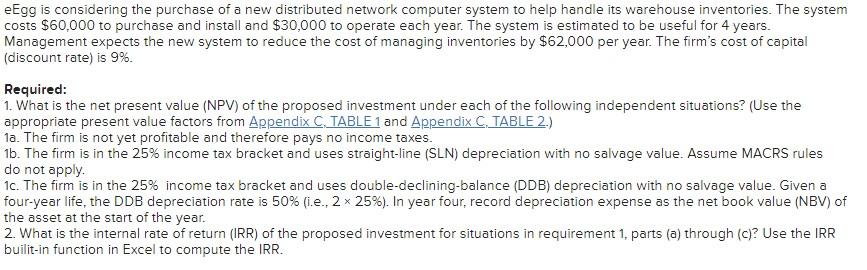
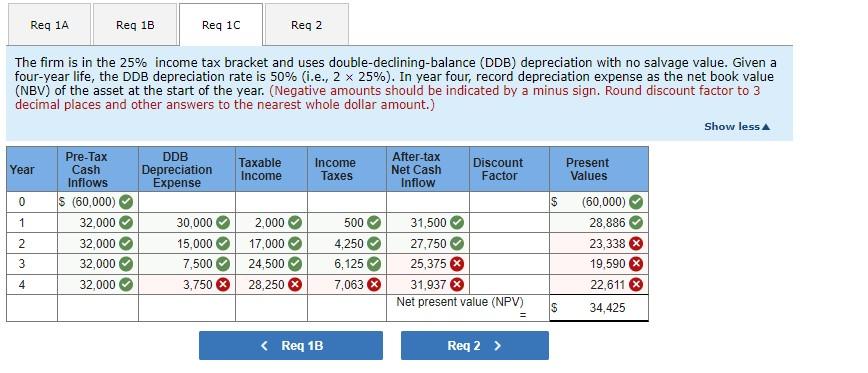
eEgg is considering the purchase of a new distributed network computer system to help handle its warehouse inventories. The system costs $60,000 to purchase and install and $30,000 to operate each year. The system is estimated to be useful for 4 years. Management expects the new system to reduce the cost of managing inventories by $62,000 per year. The firm's cost of capital (discount rate) is 9%. Required: 1. What is the net present value (NPV) of the proposed investment under each of the following independent situations? (Use the appropriate present value factors from Appendix C. TABLE 1 and Appendix C. TABLE 2.) 1a. The firm is not yet profitable and therefore pays no income taxes. 15. The firm is in the 25% income tax bracket and uses straight-line (SLN) depreciation with no salvage value. Assume MACRS rules do not apply. 10. The firm is in the 25% income tax bracket and uses double-declining-balance (DDB) depreciation with no salvage value. Given a four-year life, the DDB depreciation rate is 50% (i.e., 2 x 25%). In year four, record depreciation expense as the net book value (NBV) of the asset at the start of the year. 2. What is the internal rate of return (IRR) of the proposed investment for situations in requirement 1, parts (a) through (c)? Use the IRR builit-in function in Excel to compute the IRR. Reg 1A Reg 1B Reg 10 Reg 2 The firm is in the 25% income tax bracket and uses double-declining-balance (DDB) depreciation with no salvage value. Given a four-year life, the DDB depreciation rate is 50% (i.e., 2 x 25%). In year four, record depreciation expense as the net book value (NBV) of the asset at the start of the year. (Negative amounts should be indicated by a minus sign. Round discount factor to 3 decimal places and other answers to the nearest whole dollar amount.) Show less Year DDB Depreciation Expense Taxable Income Income Taxes After-tax Net Cash Inflow Discount Factor Present Values 0 $ 1 Pre-Tax Cash Inflows $ 60,000) 32,000 32,000 32,000 32,000 500 2 30,000 2,000 15,000 17,000 7,500 24,500 3,750 % 28,250 % 4,250 6,125 7,063 X 3 (60,000) 28,886 23,338 % 19,590 22,611 > 34,425 31,500 27,750 25,375 % 31,937 % Net present value (NPV) 4 A
Step by Step Solution
There are 3 Steps involved in it

Get step-by-step solutions from verified subject matter experts
 Study Help