







Question: Please Answer all the parts 29: In this problem we will will describe bases for the four fundamental subspaces using an SVD, A = UEV
Please Answer all the parts
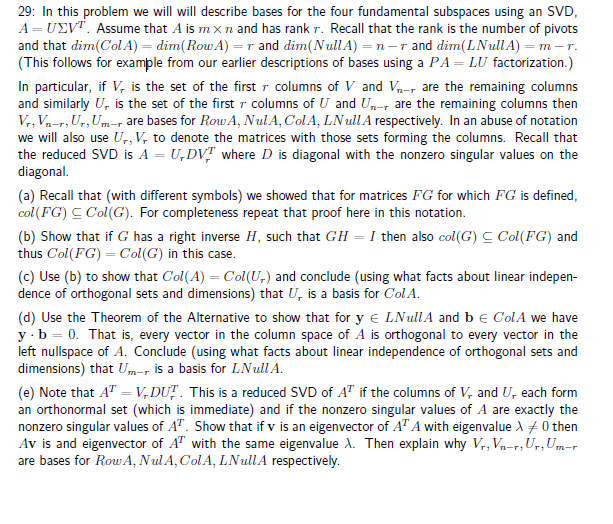
29: In this problem we will will describe bases for the four fundamental subspaces using an SVD, A = UEV . Assume that A is m x n and has rank r. Recall that the rank is the number of pivots and that dim(ColA) = dim( RowA) = r and dim( NullA) = n -r and dim(LNullA) = m -r. (This follows for example from our earlier descriptions of bases using a PA = LU factorization.) In particular, if V, is the set of the first r columns of V and Vn-, are the remaining columns and similarly U, is the set of the first + columns of U and Un-, are the remaining columns then Vr, Vn-r, Ur, Um-r are bases for RowA, NulA, ColA, LNull A respectively. In an abuse of notation we will also use U., V, to denote the matrices with those sets forming the columns. Recall that the reduced SVD is A = U. DV where D is diagonal with the nonzero singular values on the diagonal. (a) Recall that (with different symbols) we showed that for matrices FG for which FG is defined, col(FG) C Col(G). For completeness repeat that proof here in this notation. (b) Show that if G has a right inverse H, such that GH = I then also col(G) C Col(FG) and thus Col(FG) = Col(G) in this case. (c) Use (b) to show that Col(A) = Col(U,) and conclude (using what facts about linear indepen dence of orthogonal sets and dimensions) that U, is a basis for ColA. (d) Use the Theorem of the Alternative to show that for y e LNullA and be ColA we have y . b = 0. That is, every vector in the column space of A is orthogonal to every vector in the left nullspace of A. Conclude (using what facts about linear independence of orthogonal sets and dimensions) that Um-, is a basis for LNullA. (e) Note that A" = V. DU. . This is a reduced SVD of A" if the columns of V, and U, each form an orthonormal set (which is immediate) and if the nonzero singular values of A are exactly the nonzero singular values of A . Show that if v is an eigenvector of A" A with eigenvalue A / 0 then Av is and eigenvector of A with the same eigenvalue A. Then explain why Vr, Va-, Ur, Um-. are bases for RowA, NulA, ColA, LNullA respectively
Step by Step Solution
There are 3 Steps involved in it

Get step-by-step solutions from verified subject matter experts
 Study Help