



Question: Please answer all the question parts as soon as possible. Thank u A company has a choice between two mutually exclusive projects, A and B.
Please answer all the question parts as soon as possible. Thank u
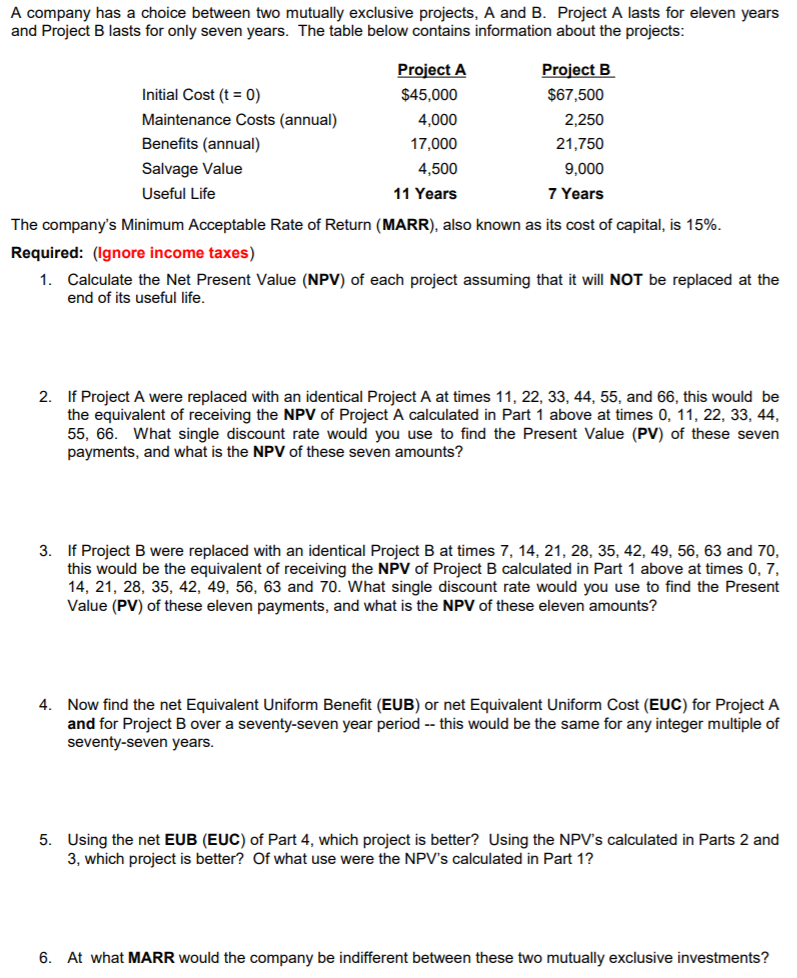
A company has a choice between two mutually exclusive projects, A and B. Project A lasts for eleven years and Project B lasts for only seven years. The table below contains information about the projects: Project A Project B Initial Cost (t = 0) $45,000 $67,500 Maintenance Costs (annual) 4,000 2,250 Benefits (annual) 17,000 21,750 Salvage Value 4,500 9,000 Useful Life 11 Years 7 Years The company's Minimum Acceptable Rate of Return (MARR), also known as its cost of capital, is 15%. Required: (Ignore income taxes) 1. Calculate the Net Present Value (NPV) of each project assuming that it will NOT be replaced at the end of its useful life. 2. If Project A were replaced with an identical Project A at times 11, 22, 33, 44, 55, and 66, this would be the equivalent of receiving the NPV of Project A calculated in Part 1 above at times 0, 11, 22, 33, 44, 55, 66. What single discount rate would you use to find the Present Value (PV) of these seven payments, and what is the NPV of these seven amounts? 3. If Project B were replaced with an identical Project B at times 7, 14, 21, 28, 35, 42, 49, 56, 63 and 70, this would be the equivalent of receiving the NPV of Project B calculated in Part 1 above at times 0, 7, 14, 21, 28, 35, 42, 49, 56, 63 and 70. What single discount rate would you use to find the Present Value (PV) of these eleven payments, and what is the NPV of these eleven amounts? 4. Now find the net Equivalent Uniform Benefit (EUB) or net Equivalent Uniform Cost (EUC) for Project A and for Project B over a seventy-seven year period -- this would be the same for any integer multiple of seventy-seven years. 5. Using the net EUB (EUC) of Part 4, which project is better? Using the NPV's calculated in Parts 2 and 3, which project is better? Of what use were the NPV's calculated in Part 1? 6. At what MARR would the company be indifferent between these two mutually exclusive investments? A company has a choice between two mutually exclusive projects, A and B. Project A lasts for eleven years and Project B lasts for only seven years. The table below contains information about the projects: Project A Project B Initial Cost (t = 0) $45,000 $67,500 Maintenance Costs (annual) 4,000 2,250 Benefits (annual) 17,000 21,750 Salvage Value 4,500 9,000 Useful Life 11 Years 7 Years The company's Minimum Acceptable Rate of Return (MARR), also known as its cost of capital, is 15%. Required: (Ignore income taxes) 1. Calculate the Net Present Value (NPV) of each project assuming that it will NOT be replaced at the end of its useful life. 2. If Project A were replaced with an identical Project A at times 11, 22, 33, 44, 55, and 66, this would be the equivalent of receiving the NPV of Project A calculated in Part 1 above at times 0, 11, 22, 33, 44, 55, 66. What single discount rate would you use to find the Present Value (PV) of these seven payments, and what is the NPV of these seven amounts? 3. If Project B were replaced with an identical Project B at times 7, 14, 21, 28, 35, 42, 49, 56, 63 and 70, this would be the equivalent of receiving the NPV of Project B calculated in Part 1 above at times 0, 7, 14, 21, 28, 35, 42, 49, 56, 63 and 70. What single discount rate would you use to find the Present Value (PV) of these eleven payments, and what is the NPV of these eleven amounts? 4. Now find the net Equivalent Uniform Benefit (EUB) or net Equivalent Uniform Cost (EUC) for Project A and for Project B over a seventy-seven year period -- this would be the same for any integer multiple of seventy-seven years. 5. Using the net EUB (EUC) of Part 4, which project is better? Using the NPV's calculated in Parts 2 and 3, which project is better? Of what use were the NPV's calculated in Part 1? 6. At what MARR would the company be indifferent between these two mutually exclusive investments
Step by Step Solution
There are 3 Steps involved in it

Get step-by-step solutions from verified subject matter experts