







Question: Please answer all the questions and ASAP!!! Will give a thumbs up. Grand theater case The case should be analyzed as of the time of
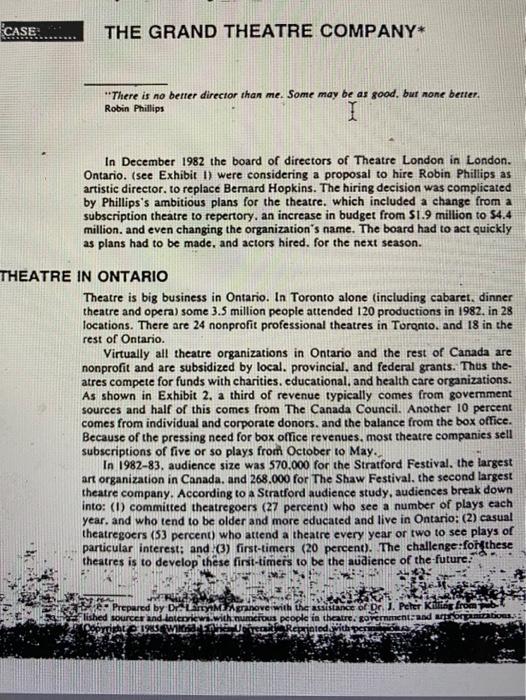





ASE: THE GRAND THEATRE COMPANY* "There is no better director than me. Some may be as good, but nome better. Robin Phillips In December 1982 the board of directors of Theatre London in London. Ontario. (see Exhibit I) were considering a proposal to hire Robin Phillips as artistic director. to replace Bernard Hopkins. The hiring decision was complicated by Phillips's ambitious plans for the theatre. which included a change from a subscription theatre to repertory. an increase in budget from 51.9 million to 54.4 million. and even changing the organization's name. The board had to act quickly as plans had to be made, and actors hired. for the next season. HEATRE IN ONTARIO Theatre is big business in Ontario. In Toronto alone (including cabaret, dinner theatre and opera) some 3.5 million people attended 120 productions in 1982 , in 28 locations. There are 24 nonprofit professional theatres in Toranto. and 18 in the rest of Ontario. Virtually all theatre organizations in Ontario and the rest of Canada are nonprofit and are subsidized by local. provincial, and federal grants. Thus theatres compete for funds with charities, educational, and health care organizations. As shown in Exhibit 2, a third of revenue typically comes from govemment sources and half of this comes from The Canada Council. Another 10 percent comes from individual and corporate donors, and the balance from the box office. Because of the pressing need for box office revenues, most theatre companies sell subseriptions of five or so plays from October to May. In 1982-83, audience size was 570,000 for the Stratford Festival, the largest art organization in Canada, and 268.000 for The Shaw Festival. the second largest theatre company. According to a Stratford audience study, audiences break down into: (1) committed theatregoers (27 percent) who see a number of plays each year, and who tend to be older and more educated and live in Ontario: (2) casual theatregoers ( 53 percent) who attend a theatre every year or two to see plays of particular interest: and:(3) first-timers (20 percent). The challenge:forthese theatres is to develop these firsit-timeris to be the audience of the future
Step by Step Solution
There are 3 Steps involved in it

Get step-by-step solutions from verified subject matter experts
 Study Help