



Question: Please answer all the questions, so I can check the answers I handed in. Question 2 (16 marks) a. Consider the polynomial function g(x) =
Please answer all the questions, so I can check the answers I handed in.
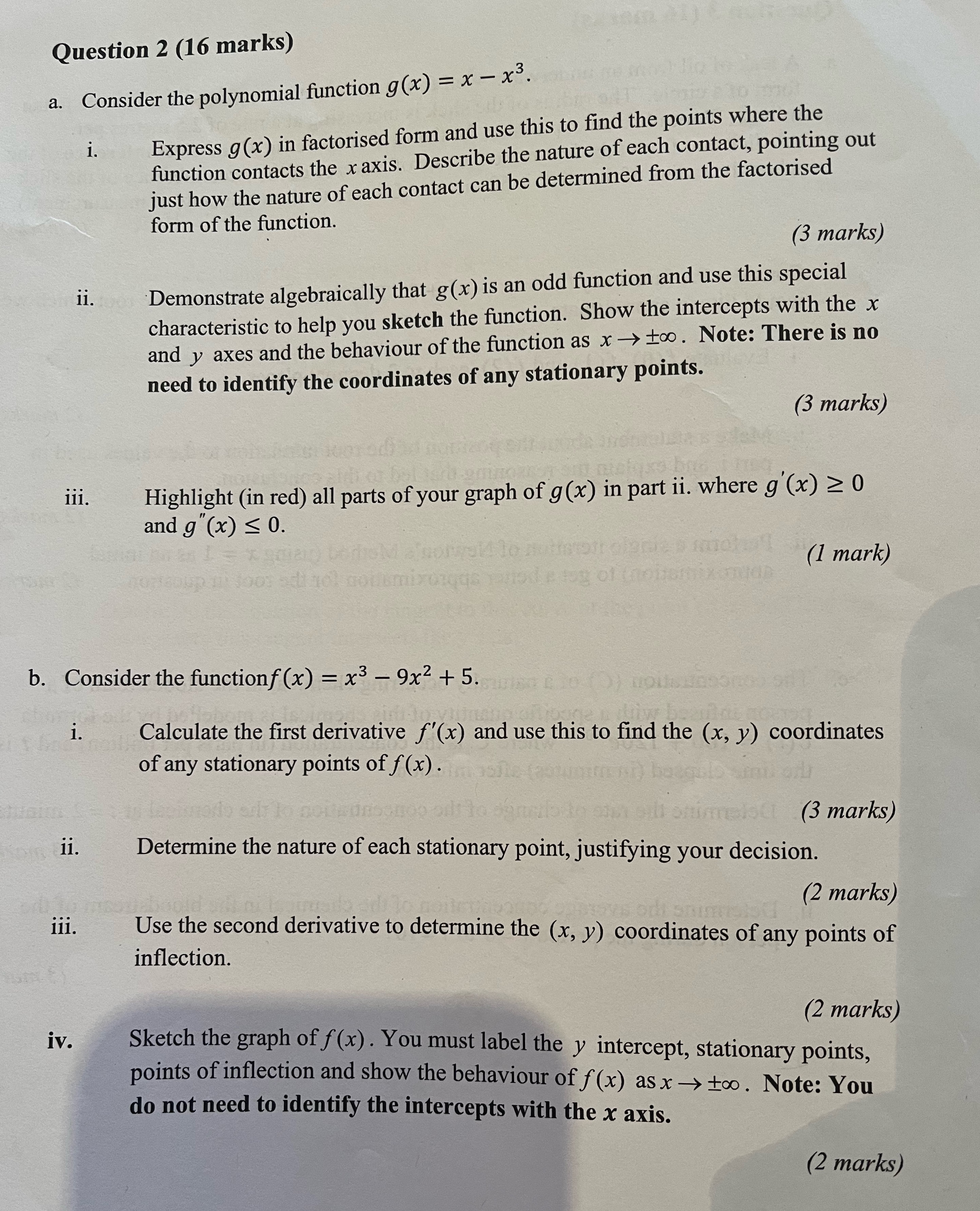
Question 2 (16 marks) a. Consider the polynomial function g(x) = x -x3. 1. Express g(x) in factorised form and use this to find the points where the function contacts the x axis. Describe the nature of each contact, pointing out just how the nature of each contact can be determined from the factorised form of the function. (3 marks) ii. Demonstrate algebraically that g(x) is an odd function and use this special characteristic to help you sketch the function. Show the intercepts with the x and y axes and the behaviour of the function as x -> too . Note: There is no need to identify the coordinates of any stationary points. (3 marks) iii. Highlight (in red) all parts of your graph of g (x) in part ii. where g (x) 2 0 and g (x) 50. (1 mark) b. Consider the functionf (x) = x3 - 9x2 + 5. i . Calculate the first derivative f'(x) and use this to find the (x, y) coordinates of any stationary points of f(x) . whonine (3 marks) ii. Determine the nature of each stationary point, justifying your decision. iii. (2 marks) Use the second derivative to determine the (x, y) coordinates of any points of inflection. iv. (2 marks) Sketch the graph of f(x) . You must label the y intercept, stationary points, points of inflection and show the behaviour of f(x) as x -> too . Note: You do not need to identify the intercepts with the x axis. (2 marks)
Step by Step Solution
There are 3 Steps involved in it

Get step-by-step solutions from verified subject matter experts