







Question: please answer all the questions, there is also additonal information attached. thank you! what part is unclear? 3. An assessment of a centralized versus decentralized
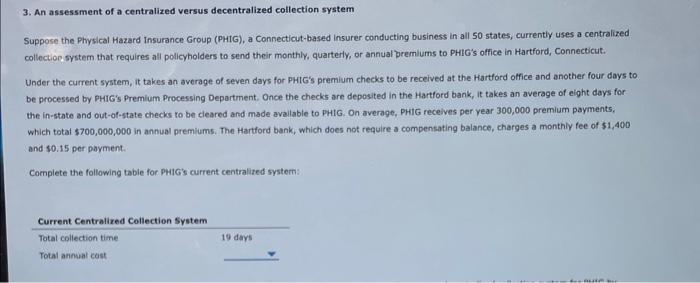
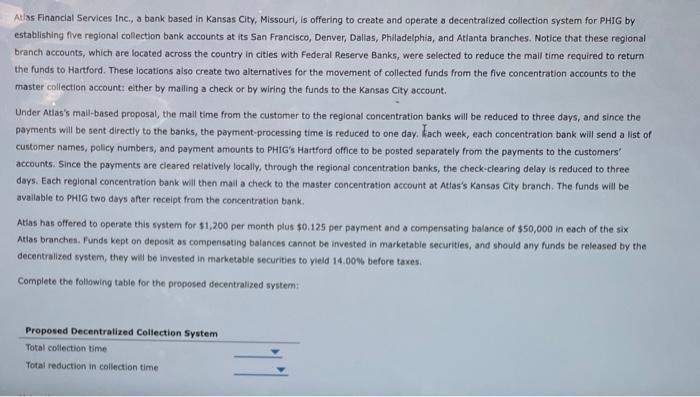
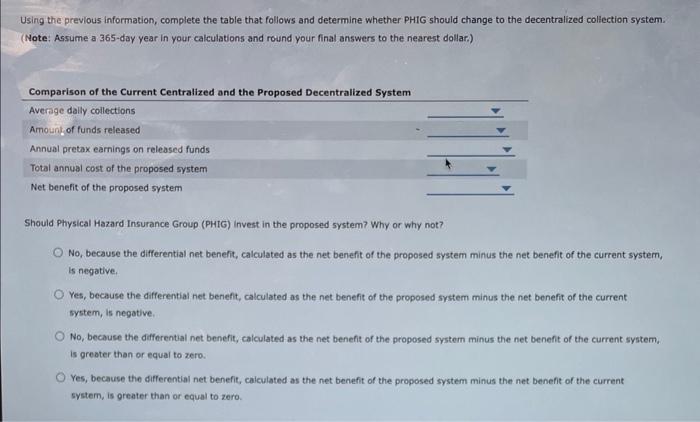
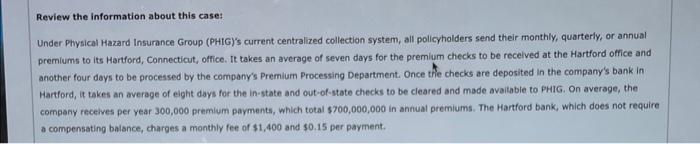
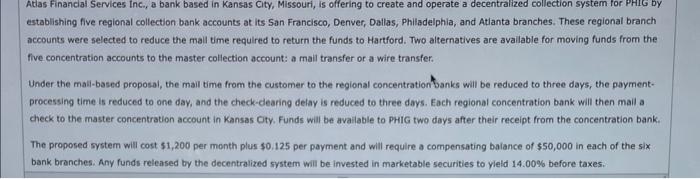
3. An assessment of a centralized versus decentralized collection system Suppose the Physical Hazard insurance Group (PHIG), a Connecticut-based insurer conducting business in all 50 states, currently uses a centralized collection. system that requires all policyholders to send their monthly, quarterly, or annual jpremlums to PHiG's office in Hartford, Connecticut. Under the current system, it takes an average of seven days for PHIG's premium checks to be received at the Hartford office and another four days to be processed by PhiG's Premlum Processing Department. Once the checks are deposited in the Hartford bank, it takes an average of eight days for the in-state and out-of-state checks to be cleared and made avaliable to PHIG. On average, PHiG receives per year 300,000 premium payments, which total $700,000,000 in annual premiums. The Hartford bank, which does not require a compensating balance, charges a monthly fee of $1,400 and $0.15 per payment. Complete the following table for PHIG's current centralized systern: Atias Financial Services Inci, a bank based in Kansas City, Missouri, is offering to create and operate a decentralized collection system for PHIG by establishing five regional collection bank accounts at its San Francisco, Denver, Dallas, Philadelphia, and Atianta branches. Notice that these regional branch accounts, which are located across the country in cities with Federal Reserve Banks, were selected to reduce the mail time required to return the funds to Hartford. These jocations also create two alternatives for the movement of collected funds from the five concentration accounts to the master collection account: either by mailing a check or by wiring the funds to the Kansas City account. Under Atias's mail-based proposal, the mail time from the customer to the regional concentration banks will be reduced to three days, and since the payments will be sent directly to the banks, the payment-processing time is reduced to one day, tach week, each concentration bank wial send a list of customer names, policy numbers, and payment amounts to PHIG's Hartford office to be posted separately from the payments to the customers' accounts. Since the payments are cleared relatively locally, through the regional concentration banks, the check-clearing delay is reduced to three days. Each regional concentration bank wil then mail a check to the master concentration account at Atias's Kansas City branch. The funds will be available to PHiG two days after receipt from the concentration bank. Atlas has offered to operate this system for $1,200 per month plus $0.125 per payment and a compensating balance of $50,000 in each of the six Atias branches. Funds kept on deposit as compensating balances cannot be invested in marketable securities, and should any funds be released by the decentralized system, they will be invested in marketable securities to yield 14.00% before taxes. Complete the following table for the proposed decentralized system: Using the previous information, complete the table that follows and determine whether PHIG should change to the decentralized collection system. (Note: Assume a 365 -day year in your calculations and round your final answers to the nearest dollar) Should Physical Hazard Insurance Group (PHIG) Invest in the proposed system? Why or why not? No, because the differential net benefit, calculated as the net benefit of the proposed system minus the net benefit of the current system, is neqative. Yes, because the differential net benefit, calculated as the net benefit of the proposed system minus the net benefit of the current system, is negative. No, because the diferential net benefit, calculated as the net benefit of the proposed system minus the net beneft of the current system, is greater than or equal to zero. Yes, because the differential net benefit, caiculated as the net benefit of the proposed system minus the net benefit of the current system, is greater than or equal to zero. Review the information about this case: Under Physical Hazard Insurance Group (PHIG)'s current centralized collection system, all policyhalders send their monthly, quarterly, or annual premiums to its Hartford, Connecticut, office. It takes an average of seven days for the premlum checks to be received at the Hartford office and another four days to be processed by the company's Premlum Processing Department. Once thie checks are deposited in the company's bank in Hartford, it takes an average of elght days for the in-state and out-of-state checks to be cleared and made available to PHIG. On average, the company recelves per year 300,000 premium payments, which total 5700,000,000 in annual premiums. The Hartford bank, which does not require a compensating balance, charges a monthly fee of $1,400 and $0.15 per payment. Atas Financai Services Inc., a bank based in Kansas City, Missouri, is offering to create and operate a decentralized collection system ror FHil by establishing five regional collection bank accounts at its San Francisco, Denver, Dallas, Philadelphia, and Atianta branches. These regional branch accounts were selected to reduce the mall time required to return the funds to Hartford. Two alternatives are available for moving funds from the five concentration accounts to the master collection account: a mail transfer or a wire transfer. Under the mail-based proposal, the mail time from the customer to the regional concentrationtoanks will be reduced to three days, the paymentprocessing time is reduced to one day, and the check-dearing delay is reduced to three days. Each regional concentration bank will then mail a check to the master concentration account in Kansas Cty. Funds will be available to PHIG two days after their receipt from the concentration bank. The proposed system will cost $1,200 per month plus $0.12.5 per payment and will require a compensating balance of $50,000 in each of the six bank branches. Any funds released by the decentralized system will be invested in marketable securities to yleld 14.00% before taxes
Step by Step Solution
There are 3 Steps involved in it

Get step-by-step solutions from verified subject matter experts
 Study Help