







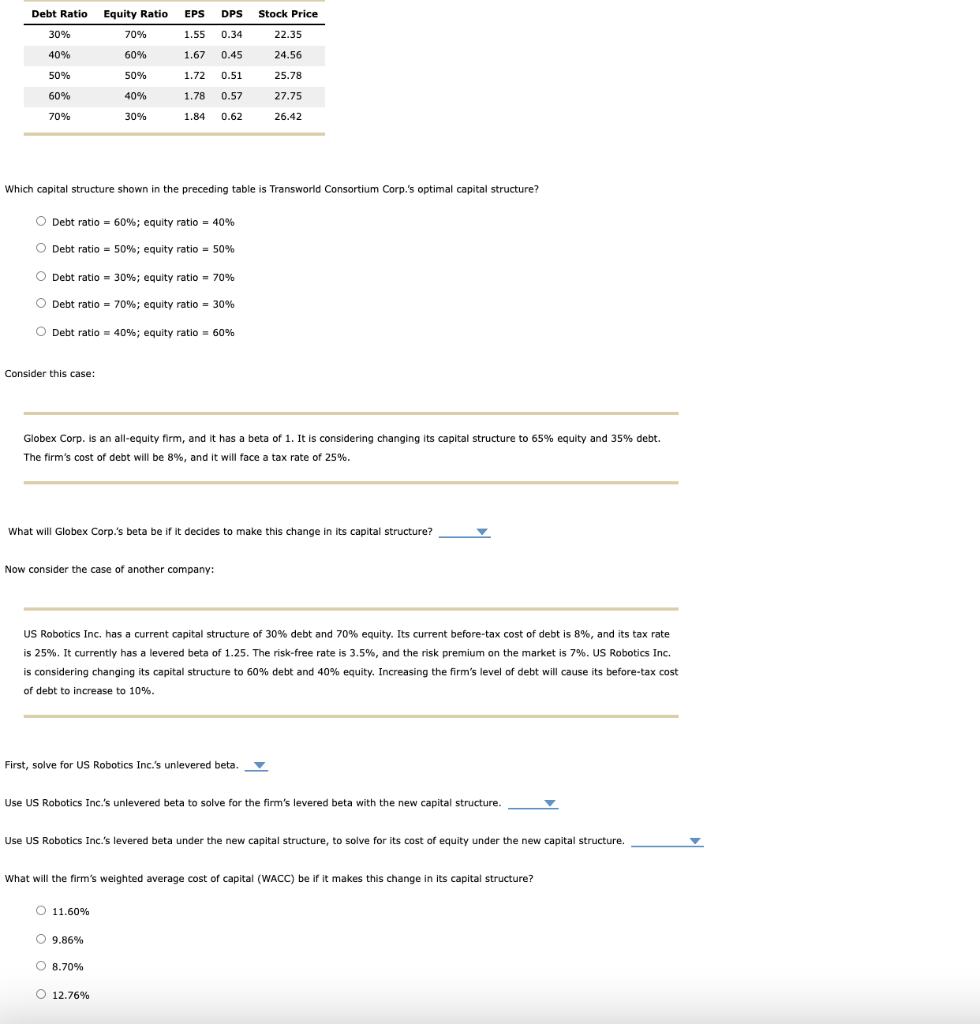
Question: please answer and label each question.ty 1. 2. Debt Ratio Equity Ratio EPS DPS Stock Price 30% 70% 1.55 0.34 22.35 40% 60% 1.67 0.45
please answer and label each question.ty
1.
2.
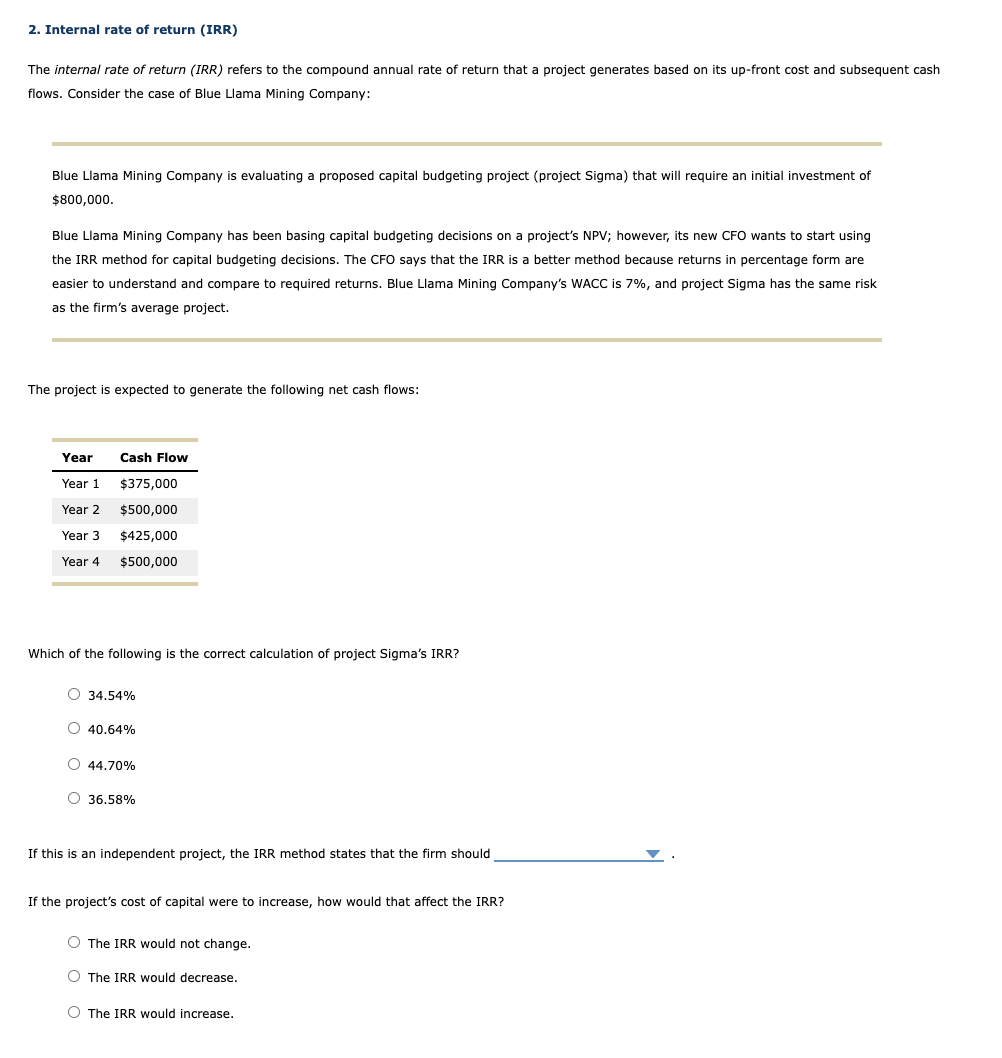
Debt Ratio Equity Ratio EPS DPS Stock Price 30% 70% 1.55 0.34 22.35 40% 60% 1.67 0.45 24.56 50% 50% 1.72 0.51 25.78 60% 40% 1.78 0.57 27.75 70% 30% 1.84 0.62 26.42 Which capital structure shown in the preceding table is Transworld Consortium Corp.'s optimal capital structure? O Debt ratio -60%; equity ratio = 40% Debt ratio = 50%; equity ratio = 50% O %, Debt ratio = 30%; equity ratio = 70% Debt ratio = 70%; equity ratio = 30% O Debt ratio = 40%, equity ratio -60% Consider this case: : . Globex Corp. is an all-equity firm, and it has a beta of 1. It is considering changing its capital structure to 65% equity and 35% debt. The firm's cost of debt will be 8%, and it will face a tax rate of 25%. What will Globex Corp.'s beta be if it decides to make this change in its capital structure? Now consider the case of another company: : US Robotics Inc. has a current capital structure of 30% debt and 70% equity. Its current before-tax cost of debt is 8%, and its tax rate is 25%. It currently has a levered beta of 1.25. The risk-free rate is 3.5%, and the risk premium on the market is 7%. US Robotics Inc. is considering changing its capital structure to 60% debt and 40% equity. Increasing the firm's level of debt will cause its before-tax cost of debt to increase to 10%. . First, solve for US Robotics Inc.'s unlevered beta. . Use US Robotics Inc.'s unlevered beta to solve for the firm's levered beta with the new capital structure. Use US Robotics Inc.'s levered beta under the new capital structure, to solve for its cost of equity under the new capital structure. What will the firm's weighted average cost of capital (WACC) be if it makes this change in its capital structure? O 11.60% O 9.86% % O 8.70% O 12.76% 2. Internal rate of return (IRR) The internal rate of return (IRR) refers to the compound annual rate of return that a project generates based on its up-front cost and subsequent cash flows. Consider the case of Blue Llama Mining Company: Blue Llama Mining Company is evaluating a proposed capital budgeting project (project Sigma) that will require an initial investment of $800,000. Blue Llama Mining Company has been basing capital budgeting decisions on a project's NPV; however, its new CFO wants to start using the IRR method for capital budgeting decisions. The CFO says that the IRR is a better method because returns in percentage form are easier to understand and compare to required returns. Blue Llama Mining Company's WACC is 7%, and project Sigma has the same risk as the firm's average project. The project is expected to generate the following net cash flows: Year Cash Flow Year 1 $375,000 Year 2 Year 3 $500,000 $425,000 $500,000 Year 4 Which of the following is the correct calculation of project Sigma's IRR? O 34.54% O 40.64% O 44.70% O 36.58% If this is an independent project, the IRR method states that the firm should If the project's cost of capital were to increase, how would that affect the IRR? The IRR would not change. O The IRR would decrease. O The IRR would increase
Step by Step Solution
There are 3 Steps involved in it

Get step-by-step solutions from verified subject matter experts
 Study Help