







Question: Please answer as soon as possible Anna started making monthly deposits of $500 into her savings account when she turned exactly age 16. The savings
Please answer as soon as possible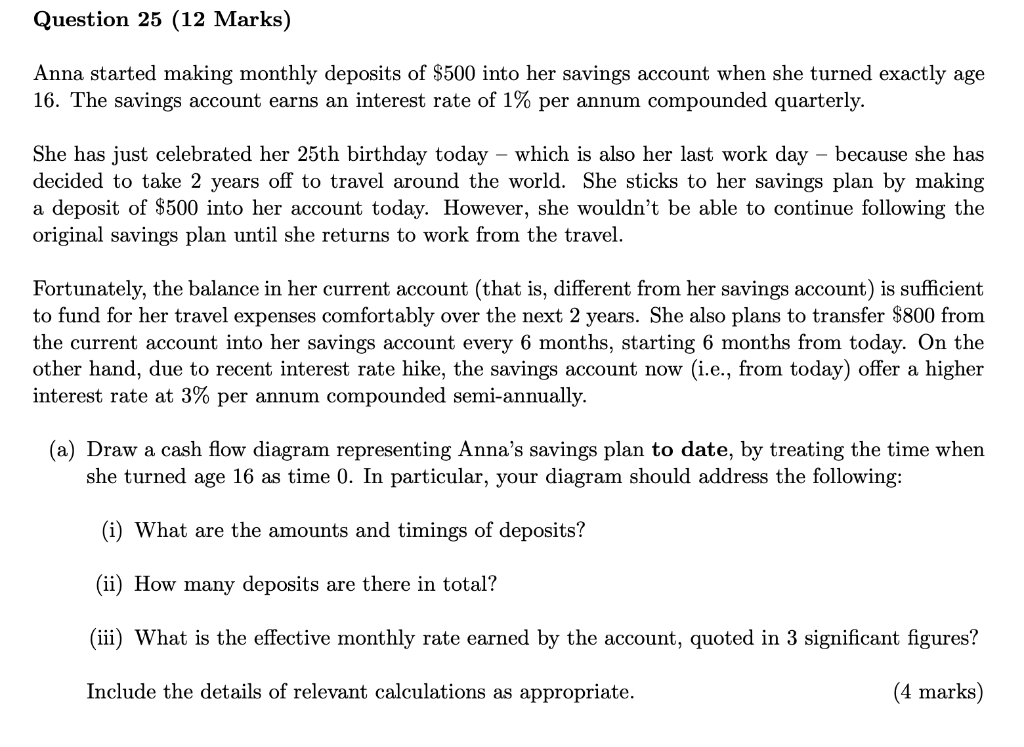
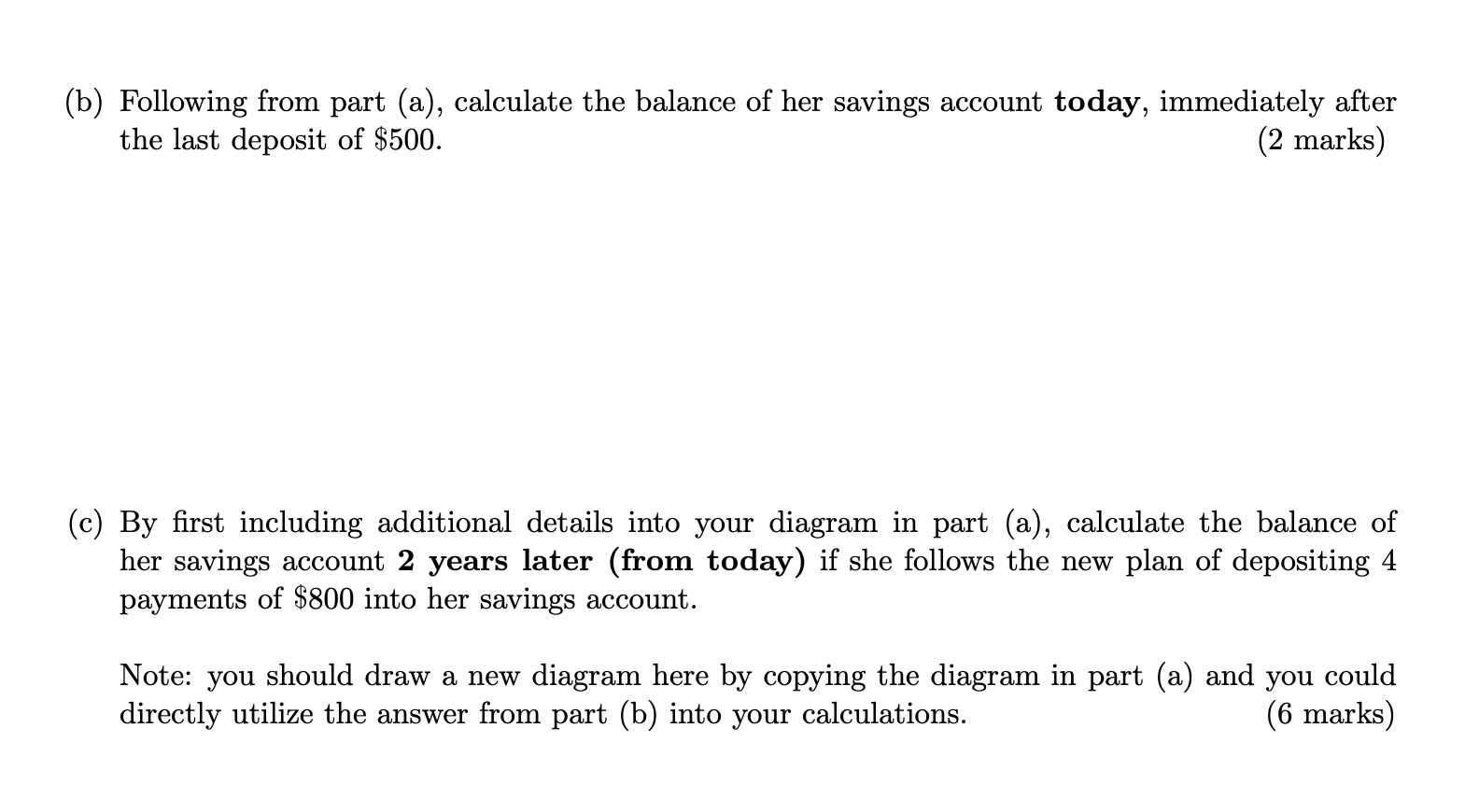
Anna started making monthly deposits of $500 into her savings account when she turned exactly age 16. The savings account earns an interest rate of 1% per annum compounded quarterly. She has just celebrated her 25th birthday today - which is also her last work day - because she has decided to take 2 years off to travel around the world. She sticks to her savings plan by making a deposit of $500 into her account today. However, she wouldn't be able to continue following the original savings plan until she returns to work from the travel. Fortunately, the balance in her current account (that is, different from her savings account) is sufficient to fund for her travel expenses comfortably over the next 2 years. She also plans to transfer $800 from the current account into her savings account every 6 months, starting 6 months from today. On the other hand, due to recent interest rate hike, the savings account now (i.e., from today) offer a higher interest rate at 3% per annum compounded semi-annually. (a) Draw a cash flow diagram representing Anna's savings plan to date, by treating the time when she turned age 16 as time 0 . In particular, your diagram should address the following: (i) What are the amounts and timings of deposits? (ii) How many deposits are there in total? (iii) What is the effective monthly rate earned by the account, quoted in 3 significant figures? Include the details of relevant calculations as appropriate. (4 marks) (b) Following from part (a), calculate the balance of her savings account today, immediately after the last deposit of $500. (2 marks) (c) By first including additional details into your diagram in part (a), calculate the balance of her savings account 2 years later (from today) if she follows the new plan of depositing 4 payments of $800 into her savings account. Note: you should draw a new diagram here by copying the diagram in part (a) and you could directly utilize the answer from part (b) into your calculations. (6 marks) Anna started making monthly deposits of $500 into her savings account when she turned exactly age 16. The savings account earns an interest rate of 1% per annum compounded quarterly. She has just celebrated her 25th birthday today - which is also her last work day - because she has decided to take 2 years off to travel around the world. She sticks to her savings plan by making a deposit of $500 into her account today. However, she wouldn't be able to continue following the original savings plan until she returns to work from the travel. Fortunately, the balance in her current account (that is, different from her savings account) is sufficient to fund for her travel expenses comfortably over the next 2 years. She also plans to transfer $800 from the current account into her savings account every 6 months, starting 6 months from today. On the other hand, due to recent interest rate hike, the savings account now (i.e., from today) offer a higher interest rate at 3% per annum compounded semi-annually. (a) Draw a cash flow diagram representing Anna's savings plan to date, by treating the time when she turned age 16 as time 0 . In particular, your diagram should address the following: (i) What are the amounts and timings of deposits? (ii) How many deposits are there in total? (iii) What is the effective monthly rate earned by the account, quoted in 3 significant figures? Include the details of relevant calculations as appropriate. (4 marks) (b) Following from part (a), calculate the balance of her savings account today, immediately after the last deposit of $500. (2 marks) (c) By first including additional details into your diagram in part (a), calculate the balance of her savings account 2 years later (from today) if she follows the new plan of depositing 4 payments of $800 into her savings account. Note: you should draw a new diagram here by copying the diagram in part (a) and you could directly utilize the answer from part (b) into your calculations. (6 marks)
Step by Step Solution
There are 3 Steps involved in it

Get step-by-step solutions from verified subject matter experts
 Study Help