



Question: please answer as soon as possible Financing Your Dream House Problem Statement: Purchasing a house is probably the largest single financial commitment the average person

please answer as soon as possible
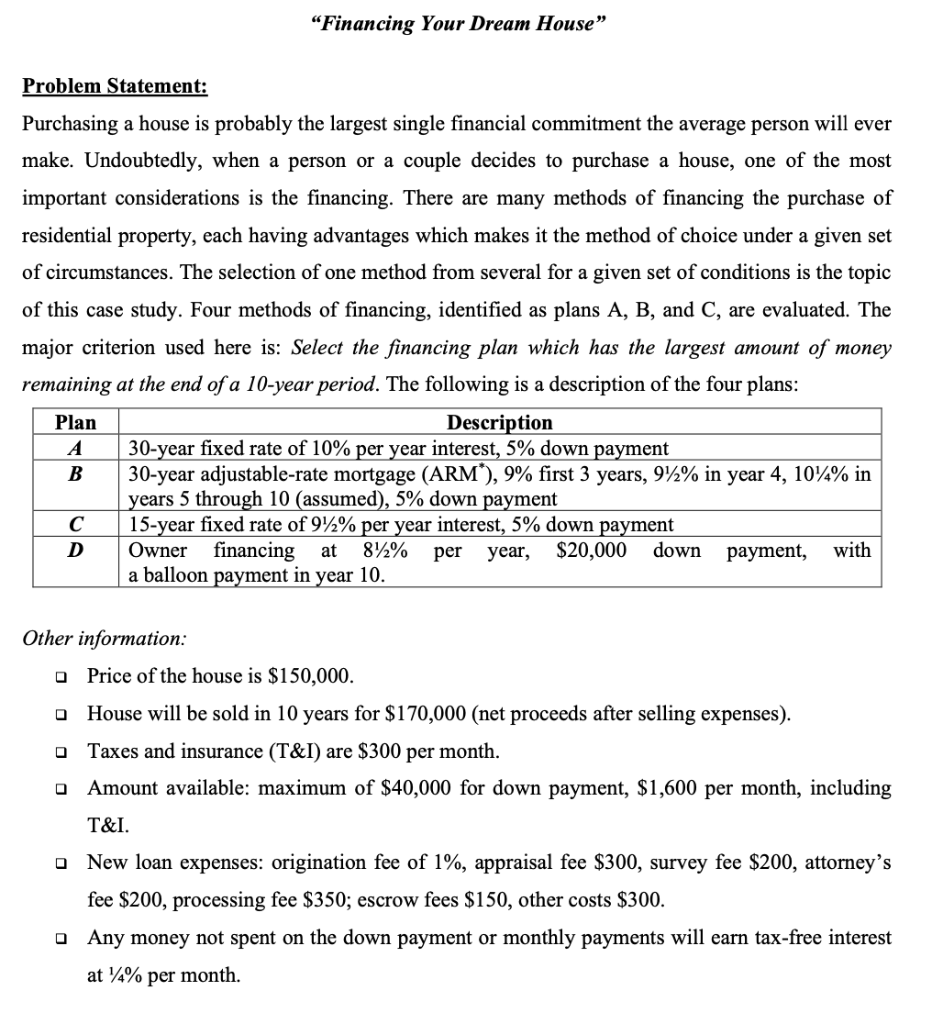
"Financing Your Dream House Problem Statement: Purchasing a house is probably the largest single financial commitment the average person will ever make. Undoubtedly, when a person or a couple decides to purchase a house, one of the most important considerations is the financing. There are many methods of financing the purchase of residential property, each having advantages which makes it the method of choice under a given set of circumstances. The selection of one method from several for a given set of conditions is the topic of this case study. Four methods of financing, identified as plans A, B, and C, are evaluated. The major criterion used here is: Select the financing plan which has the largest amount of money remaining at the end of a 10-year period. The following is a description of the four plans: Plan Description 30-year fixed rate of 10% per year interest, 5% down payment 30-year adjustable-rate mortgage (ARM"), 9% first 3 years, 972% in year 4, 107% in years 5 through 10 (assumed), 5% down payment 15-year fixed rate of 97% per year interest, 5% down payment D Owner financing at 872% per year, $20,000 down payment, with a balloon payment in year 10. WC Other information: Price of the house is $150,000. House will be sold in 10 years for $170,000 (net proceeds after selling expenses). Taxes and insurance (T&I) are $300 per month. Amount available: maximum of $40,000 for down payment, $1,600 per month, including T&I. o New loan expenses: origination fee of 1%, appraisal fee $300, survey fee $200, attorney's fee $200, processing fee $350; escrow fees $150, other costs $300. o Any money not spent on the down payment or monthly payments will earn tax-free interest at 14% per month. f) By how much does the payment increase in plan A for each 1% increase in interest rate? "Financing Your Dream House Problem Statement: Purchasing a house is probably the largest single financial commitment the average person will ever make. Undoubtedly, when a person or a couple decides to purchase a house, one of the most important considerations is the financing. There are many methods of financing the purchase of residential property, each having advantages which makes it the method of choice under a given set of circumstances. The selection of one method from several for a given set of conditions is the topic of this case study. Four methods of financing, identified as plans A, B, and C, are evaluated. The major criterion used here is: Select the financing plan which has the largest amount of money remaining at the end of a 10-year period. The following is a description of the four plans: Plan Description 30-year fixed rate of 10% per year interest, 5% down payment 30-year adjustable-rate mortgage (ARM"), 9% first 3 years, 972% in year 4, 107% in years 5 through 10 (assumed), 5% down payment 15-year fixed rate of 97% per year interest, 5% down payment D Owner financing at 872% per year, $20,000 down payment, with a balloon payment in year 10. WC Other information: Price of the house is $150,000. House will be sold in 10 years for $170,000 (net proceeds after selling expenses). Taxes and insurance (T&I) are $300 per month. Amount available: maximum of $40,000 for down payment, $1,600 per month, including T&I. o New loan expenses: origination fee of 1%, appraisal fee $300, survey fee $200, attorney's fee $200, processing fee $350; escrow fees $150, other costs $300. o Any money not spent on the down payment or monthly payments will earn tax-free interest at 14% per month. f) By how much does the payment increase in plan A for each 1% increase in interest rate
Step by Step Solution
There are 3 Steps involved in it

Get step-by-step solutions from verified subject matter experts