Question: please answer as soon as possible SELF-ASSESSMENT EXERCISE What Type of Leader Are You? Indicate the extent to which the two comparison statements fit you
please answer as soon as possible
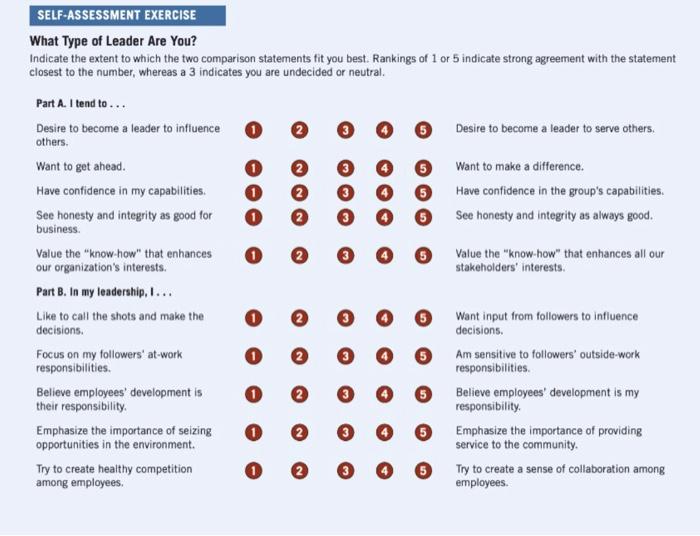
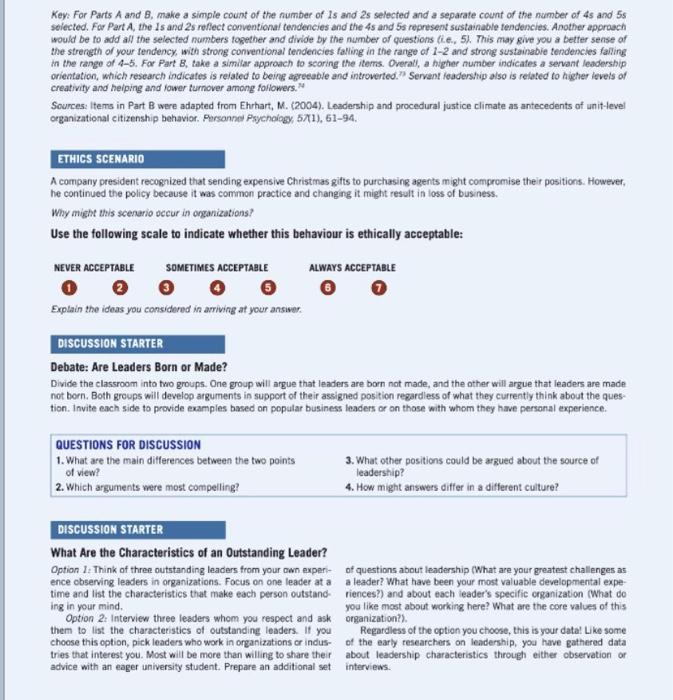
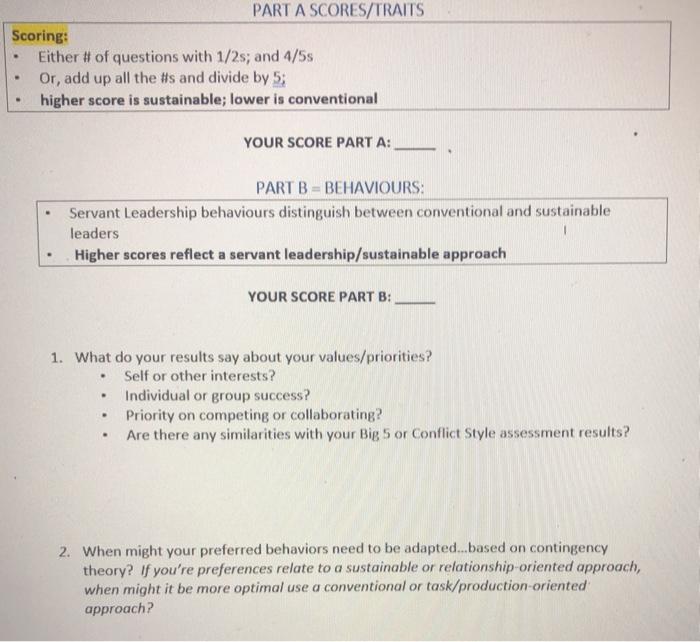
SELF-ASSESSMENT EXERCISE What Type of Leader Are You? Indicate the extent to which the two comparison statements fit you best. Rankings of 1 or 5 indicate strong agreement with the statement closest to the number, whereas a 3 indicates you are undecided or neutral. Part A. I tend to... Desire to become a leader to influence O Desire to become a leader to serve others. others. Want to get ahead. Want to make a difference. Have confidence in my capabilities. 0 2 Have confidence in the group's capabilities. See honesty and integrity as good for See honesty and integrity as always good. business Value the "know how that enhances 0 Value the "know-how" that enhances all our our organization's interests. stakeholders' interests. Part B. In my leadership, I... Like to call the shots and make the Want input from followers to influence decisions decisions Focus on my followers' at-work Am sensitive to followers outside-work responsibilities. responsibilities. Believe employees' development is Believe employees' development is my their responsibility responsibility Emphasize the importance of seizing O Emphasize the importance of providing opportunities in the environment. service to the community. Try to create healthy competition Try to create a sense of collaboration among among employees. employees. Key: For Parts A and 8. make a simple count of the number of Is and 2s selected and a separate count of the number of 4s and 5s selected. For Part A, the Is and 2s reflect conventional tendencies and the 4s and 5s represent sustainable tendencies. Another approach would be to add all the selected numbers together and divide by the number of questions (ie., 5). This may give you a better sense of the strength of your tendency, with strong conventional tendencies falling in the range of 1-2 and strong sustainabie tendencies falling in the range of 4-5. For Part 8, take a similar approach to scoring the terras. Overall, a higher number indicates a servant leadership orientation, which research indicates is related to being agreeable and introverted. Servant leadership also is related to higher levels of creativity and helping and fower turnover among followers. Sources: Items in Part B were adapted from Ehrhart, M. (2004). Leadership and procedural justice climate as antecedents of unit-evel organizational citizenship behavior. Personnel Psychology, 5/1), 61-94. ETHICS SCENARIO A company president recognized that sending expensive Christmas gifts to purchasing agents might compromise their positions. However, he continued the policy because it was common practice and changing it might result in loss of business. Why might this scenario occur in organizations? Use the following scale to indicate whether this behaviour is ethically acceptable: NEVER ACCEPTABLE SOMETIMES ACCEPTABLE ALWAYS ACCEPTABLE Explain the ideas you considered in arriving at your answer. DISCUSSION STARTER Debate: Are Leaders Born or Made? Divide the classroom into two groups. One group will argue that leaders are born not made, and the other will argue that leaders are made not born. Both groups will develop arguments in support of their assigned position regardless of what they currently think about the ques tion. Invite each side to provide examples based on popular business leaders or on those with whom they have personal experience. QUESTIONS FOR DISCUSSION 1. What are the main differences between the two points of view? 2. Which arguments were most compelling? 3. What other positions could be argued about the source of leadership? 4. How might answers differ in a different culture? DISCUSSION STARTER What Are the Characteristics of an Outstanding Leader? Option 1: Think of three outstanding leaders from your own experi- of questions about leadership (What are your greatest challenges as ence observing leaders in organizations. Focus on one leader ata a leader? What have been your most valuable developmental expe time and list the characteristics that make each person outstand-riences?) and about each leader's specific organization (What do ing in your mind you like most about working here? What are the core values of this Option 2: Interview three leaders whom you respect and ask organization?). them to list the characteristics of outstanding leaders. If you Regardless of the option you choose, this is your data! Like some choose this option, pick leaders who work in organizations or indus- of the early researchers on leadership, you have gathered data tries that interest you. Most will be more than willing to share their about leadership characteristics through either observation or advice with an eager university student. Prepare an additional set interviews PART A SCORES/TRAITS Scoring: Either # of questions with 1/2s; and 4/5s Or, add up all the #s and divide by 5; higher score is sustainable; lower is conventional - YOUR SCORE PART A: PART B = BEHAVIOURS: Servant Leadership behaviours distinguish between conventional and sustainable leaders Higher scores reflect a servant leadership/sustainable approach YOUR SCORE PART B: . 1. What do your results say about your values/priorities? Self or other interests? Individual or group success? Priority on competing or collaborating? Are there any similarities with your Big 5 or Conflict Style assessment results? 2. When might your preferred behaviors need to be adapted...based on contingency theory? If you're preferences relate to a sustainable or relationship-oriented approach, when might it be more optimal use a conventional or task/production-oriented approach? SELF-ASSESSMENT EXERCISE What Type of Leader Are You? Indicate the extent to which the two comparison statements fit you best. Rankings of 1 or 5 indicate strong agreement with the statement closest to the number, whereas a 3 indicates you are undecided or neutral. Part A. I tend to... Desire to become a leader to influence O Desire to become a leader to serve others. others. Want to get ahead. Want to make a difference. Have confidence in my capabilities. 0 2 Have confidence in the group's capabilities. See honesty and integrity as good for See honesty and integrity as always good. business Value the "know how that enhances 0 Value the "know-how" that enhances all our our organization's interests. stakeholders' interests. Part B. In my leadership, I... Like to call the shots and make the Want input from followers to influence decisions decisions Focus on my followers' at-work Am sensitive to followers outside-work responsibilities. responsibilities. Believe employees' development is Believe employees' development is my their responsibility responsibility Emphasize the importance of seizing O Emphasize the importance of providing opportunities in the environment. service to the community. Try to create healthy competition Try to create a sense of collaboration among among employees. employees. Key: For Parts A and 8. make a simple count of the number of Is and 2s selected and a separate count of the number of 4s and 5s selected. For Part A, the Is and 2s reflect conventional tendencies and the 4s and 5s represent sustainable tendencies. Another approach would be to add all the selected numbers together and divide by the number of questions (ie., 5). This may give you a better sense of the strength of your tendency, with strong conventional tendencies falling in the range of 1-2 and strong sustainabie tendencies falling in the range of 4-5. For Part 8, take a similar approach to scoring the terras. Overall, a higher number indicates a servant leadership orientation, which research indicates is related to being agreeable and introverted. Servant leadership also is related to higher levels of creativity and helping and fower turnover among followers. Sources: Items in Part B were adapted from Ehrhart, M. (2004). Leadership and procedural justice climate as antecedents of unit-evel organizational citizenship behavior. Personnel Psychology, 5/1), 61-94. ETHICS SCENARIO A company president recognized that sending expensive Christmas gifts to purchasing agents might compromise their positions. However, he continued the policy because it was common practice and changing it might result in loss of business. Why might this scenario occur in organizations? Use the following scale to indicate whether this behaviour is ethically acceptable: NEVER ACCEPTABLE SOMETIMES ACCEPTABLE ALWAYS ACCEPTABLE Explain the ideas you considered in arriving at your answer. DISCUSSION STARTER Debate: Are Leaders Born or Made? Divide the classroom into two groups. One group will argue that leaders are born not made, and the other will argue that leaders are made not born. Both groups will develop arguments in support of their assigned position regardless of what they currently think about the ques tion. Invite each side to provide examples based on popular business leaders or on those with whom they have personal experience. QUESTIONS FOR DISCUSSION 1. What are the main differences between the two points of view? 2. Which arguments were most compelling? 3. What other positions could be argued about the source of leadership? 4. How might answers differ in a different culture? DISCUSSION STARTER What Are the Characteristics of an Outstanding Leader? Option 1: Think of three outstanding leaders from your own experi- of questions about leadership (What are your greatest challenges as ence observing leaders in organizations. Focus on one leader ata a leader? What have been your most valuable developmental expe time and list the characteristics that make each person outstand-riences?) and about each leader's specific organization (What do ing in your mind you like most about working here? What are the core values of this Option 2: Interview three leaders whom you respect and ask organization?). them to list the characteristics of outstanding leaders. If you Regardless of the option you choose, this is your data! Like some choose this option, pick leaders who work in organizations or indus- of the early researchers on leadership, you have gathered data tries that interest you. Most will be more than willing to share their about leadership characteristics through either observation or advice with an eager university student. Prepare an additional set interviews PART A SCORES/TRAITS Scoring: Either # of questions with 1/2s; and 4/5s Or, add up all the #s and divide by 5; higher score is sustainable; lower is conventional - YOUR SCORE PART A: PART B = BEHAVIOURS: Servant Leadership behaviours distinguish between conventional and sustainable leaders Higher scores reflect a servant leadership/sustainable approach YOUR SCORE PART B: . 1. What do your results say about your values/priorities? Self or other interests? Individual or group success? Priority on competing or collaborating? Are there any similarities with your Big 5 or Conflict Style assessment results? 2. When might your preferred behaviors need to be adapted...based on contingency theory? If you're preferences relate to a sustainable or relationship-oriented approach, when might it be more optimal use a conventional or task/production-oriented approach









 Study Help