







Question: Please answer B and C Learning Goal: To learn the restrictions on each quantum number. What are the possible values of m for an electron
Please answer B and C
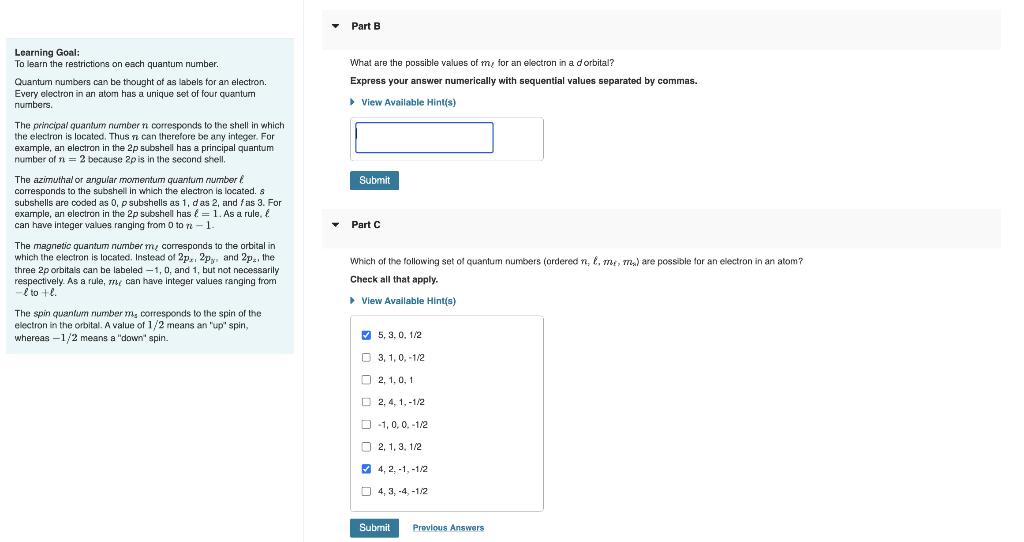
Learning Goal: To learn the restrictions on each quantum number. What are the possible values of m for an electron in a dorbital? Quantum numbers can be thought of as labels for an electron. Express your answer numerically with sequential values separated by commas. Every electron in an atom has a unique set of four quantum numbers. The principal quantum number n corresponds to the shell in which the eleciron is located. Thus n can therefore be any integer. For example, an electron in the 2p subshell has a principal quantum number of n=2 because 2p is in the second shell. The azimuthal or angular momentum quantum number \& corresponds to the subshell in which the electron is located. s subshells are coded as 0,p subshells as 1,d as 2 , and f as 3 . For example, an electron in the 2p subshell has =1. As a rule, . can have integer values ranging from 0 to n1. Part C The magnetic quantum number m corresponds to the ortital in which the electron is located. Instead of 2px,2py, and 2pz, the three 2 orbitals can be labeled 1,0, and 1 , but not necessarily Which of the following set of quantum numbers (ordered n,,mi,ms ) are possible for an electron in an atom? respectively. As a rule, mi can have integer values ranging from Check all that apply. to +. The spin quantum number ms corresponds to the spin of the electron in the orbital. A value of 1/2 means an 'up' spin, whereas 1/2 means a "down" spin. 5,3,0,1/23,1,0,1/22,1,0,12,4,1,1/21,0,0,1/22,1,3,1/24,2,1,1/24,3,4,1/2
Step by Step Solution
There are 3 Steps involved in it

Get step-by-step solutions from verified subject matter experts
 Study Help