







Question: Please answer b e f. Thank you very much! 1. Research collected data on hourly wages, gender (female=1 if female and otherwise), married (married=1 if
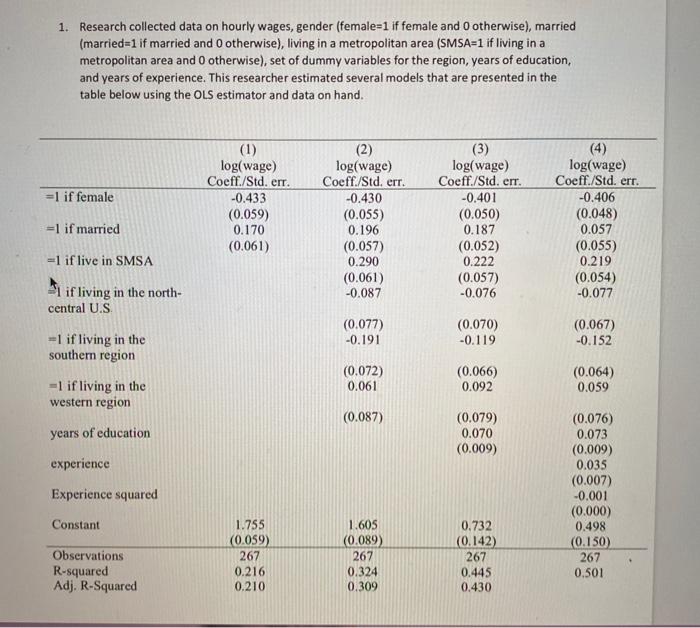



1. Research collected data on hourly wages, gender (female=1 if female and otherwise), married (married=1 if married and otherwise), living in a metropolitan area (SMSA=1 if living in a metropolitan area and otherwise), set of dummy variables for the region, years of education, and years of experience. This researcher estimated several models that are presented in the table below using the OLS estimator and data on hand. =1 if female (1) log( wage) Coeff./Std. err. -0.433 (0.059) 0.170 (0.061) (2) log(wage) Coeff./Std. err. -0.430 (0.055) 0.196 (0.057) 0.290 (0.061) -0.087 (3) log(wage) Coeff./Std. err. -0.401 (0.050) 0.187 (0.052) 0.222 (0.057) -0.076 =1 if married log(wage) Coeff./Std. err. -0.406 (0.048) 0.057 (0.055) 0.219 (0.054) -0.077 =1 if live in SMSA if living in the north- central U.S (0.077) -0.191 (0.070) -0.119 (0.067) -0.152 =1 if living in the southern region (0.072) 0.061 (0.066) 0.092 (0.064) 0.059 =1 if living in the western region (0.087) years of education (0.079) 0.070 (0.009) experience Experience squared (0.076) 0.073 (0.009) 0.035 (0.007) -0.001 (0.000) 0.498 (0.150) 267 0.501 Constant Observations R-squared Adj. R-Squared 1.755 (0.059) 267 0.216 0.210 1.605 (0.089) 267 0.324 0.309 0.732 (0.142) 267 0.445 0.430 b) Write down the population model for the model estimated in column 4. (HINT: Make sure to clearly define the variable names) (3pts) e) Is the region of living an important factor in determining log wages? Explain why yes or why not. Use statistical test(s) to support your argument (10pts) 1) Are all variables in column 4 statistically and economically important in determining log wago? (10pts) 1. Research collected data on hourly wages, gender (female=1 if female and otherwise), married (married=1 if married and otherwise), living in a metropolitan area (SMSA=1 if living in a metropolitan area and otherwise), set of dummy variables for the region, years of education, and years of experience. This researcher estimated several models that are presented in the table below using the OLS estimator and data on hand. =1 if female (1) log( wage) Coeff./Std. err. -0.433 (0.059) 0.170 (0.061) (2) log(wage) Coeff./Std. err. -0.430 (0.055) 0.196 (0.057) 0.290 (0.061) -0.087 (3) log(wage) Coeff./Std. err. -0.401 (0.050) 0.187 (0.052) 0.222 (0.057) -0.076 =1 if married log(wage) Coeff./Std. err. -0.406 (0.048) 0.057 (0.055) 0.219 (0.054) -0.077 =1 if live in SMSA if living in the north- central U.S (0.077) -0.191 (0.070) -0.119 (0.067) -0.152 =1 if living in the southern region (0.072) 0.061 (0.066) 0.092 (0.064) 0.059 =1 if living in the western region (0.087) years of education (0.079) 0.070 (0.009) experience Experience squared (0.076) 0.073 (0.009) 0.035 (0.007) -0.001 (0.000) 0.498 (0.150) 267 0.501 Constant Observations R-squared Adj. R-Squared 1.755 (0.059) 267 0.216 0.210 1.605 (0.089) 267 0.324 0.309 0.732 (0.142) 267 0.445 0.430 b) Write down the population model for the model estimated in column 4. (HINT: Make sure to clearly define the variable names) (3pts) e) Is the region of living an important factor in determining log wages? Explain why yes or why not. Use statistical test(s) to support your argument (10pts) 1) Are all variables in column 4 statistically and economically important in determining log wago? (10pts)
Step by Step Solution
There are 3 Steps involved in it

Get step-by-step solutions from verified subject matter experts
 Study Help