







Question: Please answer (b), ensure answer is not same exact work out available on cheg.g Question 2 (20 points). Consider the following (very simplified) version of
Please answer (b), ensure answer is not same exact work out available on cheg.g
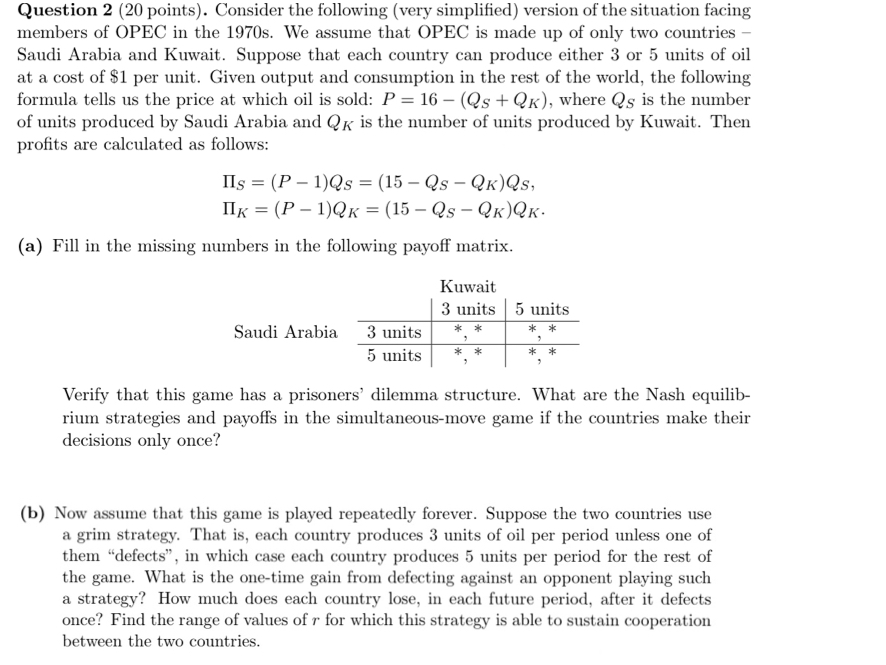
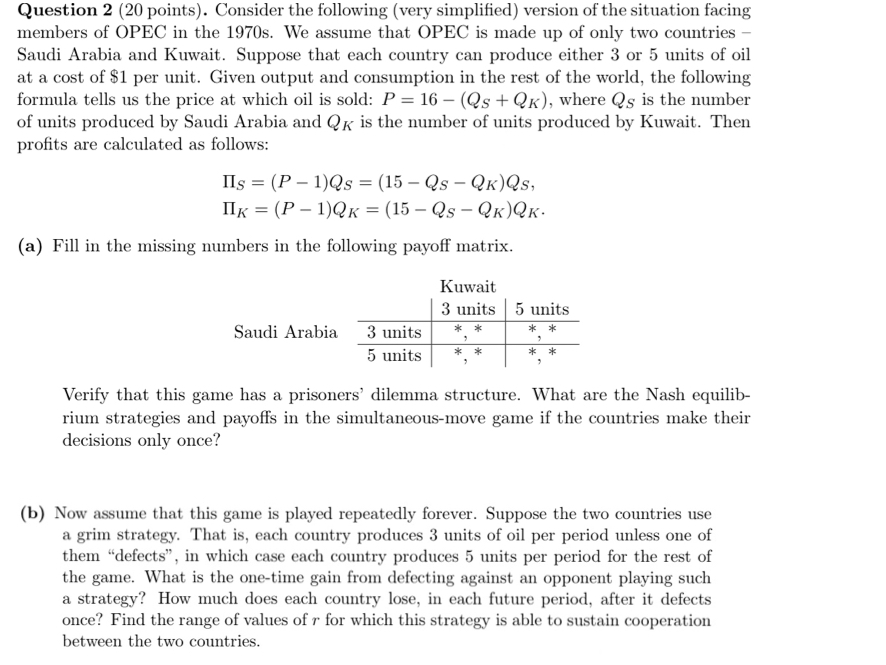
Question 2 (20 points). Consider the following (very simplified) version of the situation facing members of OPEC in the 1970s. We assume that OPEC is made up of only two countries - Saudi Arabia and Kuwait. Suppose that each country can produce either 3 or 5 units of oil at a cost of $1 per unit. Given output and consumption in the rest of the world, the following formula tells us the price at which oil is sold: P = 16 -(Qs + Qx), where Qs is the number of units produced by Saudi Arabia and Qx is the number of units produced by Kuwait. Then profits are calculated as follows: IIs = (P - 1)Qs = (15 - Qs - QK)Qs, IIK = (P -1)QK = (15 - Qs - QK)QK. (a) Fill in the missing numbers in the following payoff matrix. Kuwait 3 units 5 units Saudi Arabia 3 units 5 units Verify that this game has a prisoners' dilemma structure. What are the Nash equilib rium strategies and payoffs in the simultaneous-move game if the countries make their decisions only once? (b) Now assume that this game is played repeatedly forever. Suppose the two countries use a grim strategy. That is, each country produces 3 units of oil per period unless one of them "defects", in which case each country produces 5 units per period for the rest of the game. What is the one-time gain from defecting against an opponent playing such a strategy? How much does each country lose, in each future period, after it defects once? Find the range of values of r for which this strategy is able to sustain cooperation between the two countries
Step by Step Solution
There are 3 Steps involved in it

Get step-by-step solutions from verified subject matter experts
 Study Help