Question: Please answer. BE11-1 Identify items included in the conceptual framework. (LO 1) K Indicate which of the following statements are true or false. (Write T

Please answer.
Please answer. BE11-1 Identify items included inPlease answer. BE11-1 Identify items included inPlease answer. BE11-1 Identify items included in
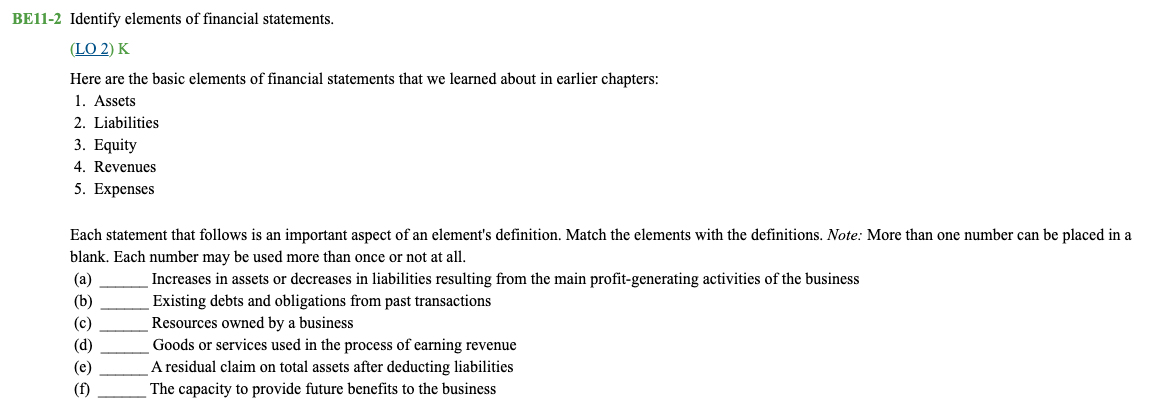
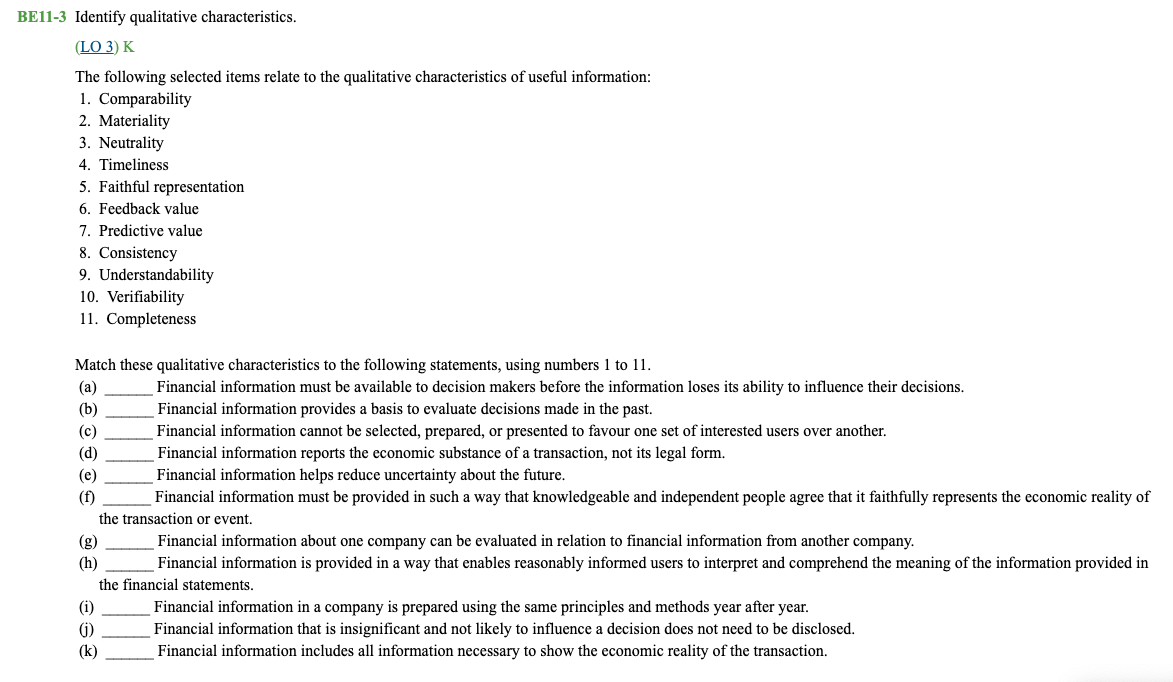
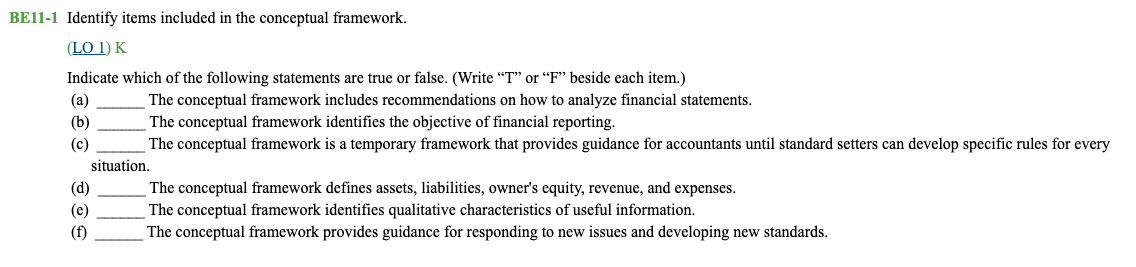
BE11-1 Identify items included in the conceptual framework. (LO 1) K Indicate which of the following statements are true or false. (Write "T" or "F" beside each item.) (a) The conceptual framework includes recommendations on how to analyze financial statements. (D) The conceptual framework identifies the objective of financial reporting. (c ) The conceptual framework is a temporary framework that provides guidance for accountants until standard setters can develop specific rules for every situation. (d) The conceptual framework defines assets, liabilities, owner's equity, revenue, and expenses. (e) The conceptual framework identifies qualitative characteristics of useful information. (f) The conceptual framework provides guidance for responding to new issues and developing new standards.BE11-2 Identify elements of financial statements. (LO 2) K Here are the basic elements of financial statements that we learned about in earlier chapters: 1. Assets 2. Liabilities 3. Equity 4. Revenues 5. Expenses Each statement that follows is an important aspect of an element's definition. Match the elements with the definitions. Note: More than one number can be placed in a blank. Each number may be used more than once or not at all. (a) Increases in assets or decreases in liabilities resulting from the main profit-generating activities of the business (b) Existing debts and obligations from past transactions Resources owned by a business Goods or services used in the process of earning revenue A residual claim on total assets after deducting liabilities The capacity to provide future benefits to the businessBE11-3 Identify qualitative characteristics. (LO 3) K The following selected items relate to the qualitative characteristics of useful information: 1. Comparability 2. Materiality 3. Neutrality 4. Timeliness 5. Faithful representation 6. Feedback value 7. Predictive value 8. Consistency 9. Understandability 10. Verifiability 11. Completeness Match these qualitative characteristics to the following statements, using numbers I to 11. (a) Financial information must be available to decision makers before the information loses its ability to influence their decisions. (b) Financial information provides a basis to evaluate decisions made in the past. (c) Financial information cannot be selected, prepared, or presented to favour one set of interested users over another. (d) Financial information reports the economic substance of a transaction, not its legal form. ( e ) Financial information helps reduce uncertainty about the future. (f) Financial information must be provided in such a way that knowledgeable and independent people agree that it faithfully represents the economic reality of the transaction or event. (g) Financial information about one company can be evaluated in relation to financial information from another company. (h) Financial information is provided in a way that enables reasonably informed users to interpret and comprehend the meaning of the information provided in the financial statements. (i) Financial information in a company is prepared using the same principles and methods year after year. Financial information that is insignificant and not likely to influence a decision does not need to be disclosed. (k) Financial information includes all information necessary to show the economic reality of the transaction

Step by Step Solution

There are 3 Steps involved in it

1 Expert Approved Answer
Step: 1 Unlock blur-text-image

Question Has Been Solved by an Expert!

Get step-by-step solutions from verified subject matter experts

Step: 2 Unlock
Step: 3 Unlock

Students Have Also Explored These Related Accounting Questions!