Question: Please answer below with brief expalnation to the article question. No plaigrism please!!!! Read the below case and answer the questions The United States Beer
Please answer below with brief expalnation to the article question. No plaigrism please!!!!
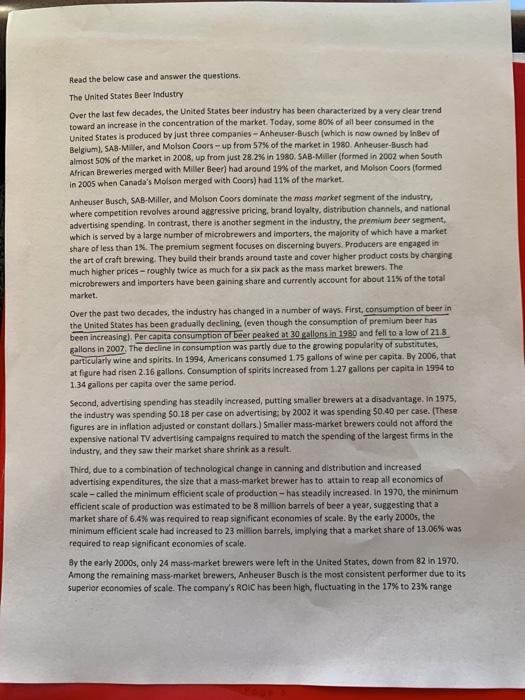
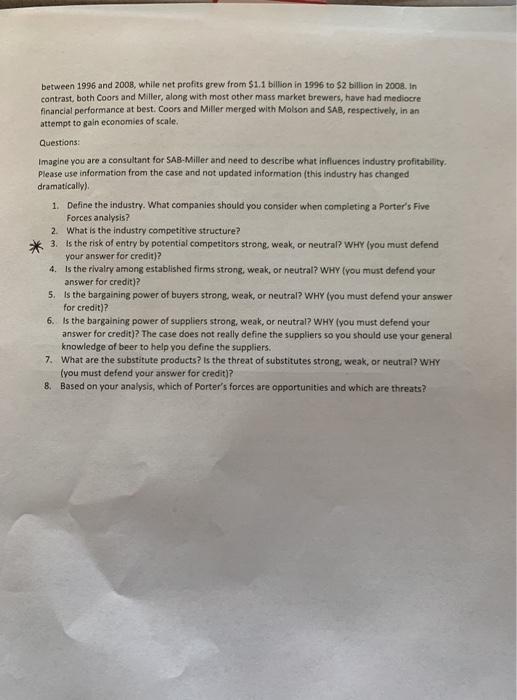
Read the below case and answer the questions The United States Beer Industry Over the last few decades, the United States beer industry has been characterized by a very clear trend toward an increase in the concentration of the market. Today, some 80% of all beer consumed in the United States is produced by Just three companies - Anheuser-Busch (which is now owned by InBev of Belgium), SABMiller, and Molson Coors - up from 57% of the market in 1980. Anheuser-Busch had almost 50% of the market in 2008, up from just 28.2% in 1980. SABMiller (formed in 2002 when South African Breweries merged with Miller Beer) had around 19% of the market, and Molson Coors (formed in 2005 when Canada's Molson merged with Coors) had 11% of the market. Anheuser Busch, SAB-Miller, and Molson Coors dominate the mass market segment of the industry. where competition revolves around aggressive pricing, brand loyalty, distribution channels, and national advertising spending In contrast, there is another segment in the industry, the premium beer segment, which is served by a large number of microbrewers and importers, the majority of which have a market share of less than 1%. The premium segment focuses on discerning buyers. Producers are engaged in the art of craft brewing. They build their brands around taste and cover higher product costs by charging much higher prices - roughly twice as much for a six pack as the mass market brewers. The microbrewers and importers have been gaining share and currently account for about 11% of the total market. Over the past two decades, the industry has changed in a number of ways. First, consumption of beer in the United States has been gradually declining. (even though the consumption of premium beer has been increasing). Per capita consumption of beer peaked at 30 gallons in 1980 and fell to a low of 21.8 gallons in 2007. The decline in consumption was partly due to the growing popularity of substitutes, particularly wine and spirits. In 1994, Americans consumed 1.75 gallons of wine per capita. By 2006, that at figure had risen 2.16 gallons. Consumption of spirits increased from 1.27 gallons per capita in 1994 to 1.34 gallons per capita over the same period. Second, advertising spending has steadily increased, putting smaller brewers at a disadvantage. In 1975, the industry was spending $0.18 per case on advertising: by 2002 it was spending $0.40 per case. These figures are in inflation adjusted or constant dollars.) Smaller mass-market brewers could not afford the expensive national TV advertising campaigns required to match the spending of the largest firms in the industry, and they saw their market share shrink as a result. Third, due to a combination of technological change in canning and distribution and increased advertising expenditures, the size that a mass-market brewer has to attain to reap all economics of scale-called the minimum efficient scale of production -has steadily increased. In 1970, the minimum efficient scale of production was estimated to be 8 million barrels of beer a year, suggesting that a market share of 6.4% was required to reap significant economies of scale. By the early 2000s, the minimum efficient scale had increased to 23 million barrels, implying that a market share of 13.06% was required to reap significant economies of scale. By the early 2000s, only 24 mass-market brewers were left in the United States, down from 82 in 1970. Among the remaining mass-market brewers, Anheuser Busch is the most consistent performer due to its superior economies of scale. The company's ROIC has been high, fluctuating in the 17% to 23% range between 1996 and 2008, while net profits grew from $1.1 billion in 1996 to $2 billion in 2008. In contrast, both Coors and Miller, along with most other mass market brewers, have had mediocre financial performance at best. Coors and Miller merged with Molson and SAB, respectively, in an attempt to gain economies of scale. Questions: Imagine you are a consultant for SAB-Miller and need to describe what influences industry profitability Please use information from the case and not updated information (this industry has changed dramatically) 1. Define the industry. What companies should you consider when completing a Porter's Five Forces analysis? 2. What is the industry competitive structure? * 3. Is the risk of entry by potential competitors strong, weak, or neutral? WHY (you must defend your answer for credit)? 4. Is the rivalry among established firms strong, weak, or neutral? WHY (you must defend your answer for credit)? 5. Is the bargaining power of buyers strong. weak, or neutral? WHY (you must defend your answer for credit)? 6. Is the bargaining power of suppliers strong, weak, or neutral? WHY (you must defend your answer for credit)? The case does not really define the suppliers so you should use your general knowledge of beer to help you define the suppliers. 7. What are the substitute products? is the threat of substitutes strong, weak, or neutral? WHY (you must defend your answer for credit)? 8. Based on your analysis, which of Porter's forces are opportunities and which are threats









 Study Help