







Question: Please answer both questions, Thank you 20. Problem 5.39 (Required Annuity Payments) eBook Your father is 50 years old and will retire in 10 years.

 Please answer both questions, Thank you
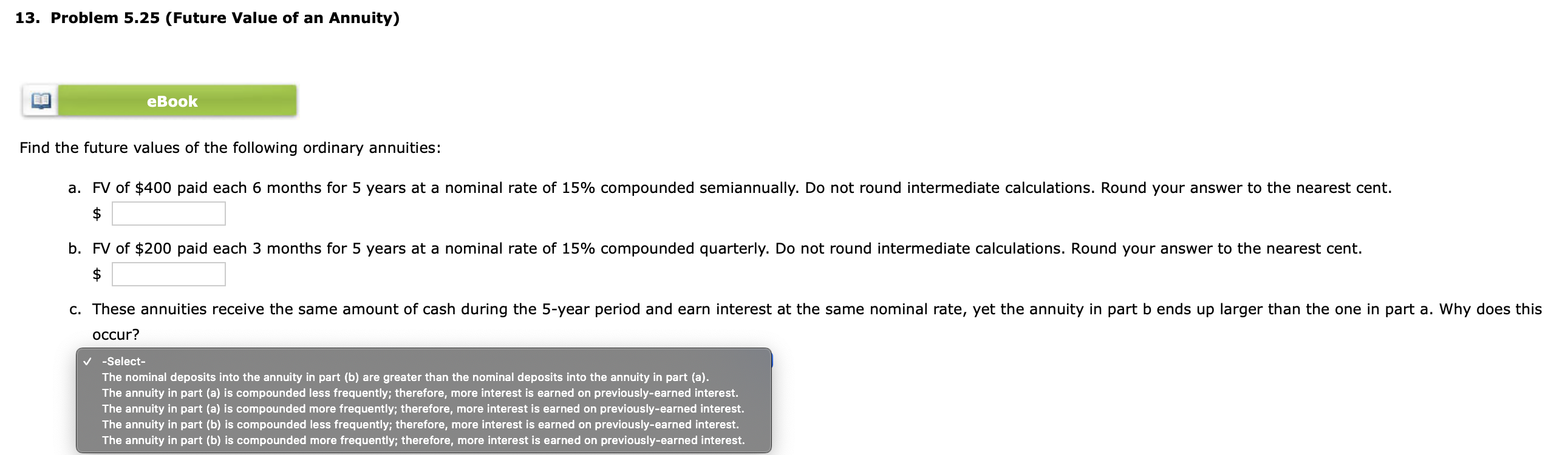
20. Problem 5.39 (Required Annuity Payments) eBook Your father is 50 years old and will retire in 10 years. He expects to live for 25 years after he retires, until he is 85. He wants a fixed retirement income that has the same purchasing power at the time he retires as $40,000 has today. (The real value of his retirement income will decline annually after he retires.) His retirement income will begin the day he retires, 10 years from today, at which time he will receive 24 additional annual payments. Annual inflation is expected to be 4%. He currently has $130,000 saved, and he expects to earn 9% annually on his savings. How much must he save during each of the next 10 years (end-of-year deposits) to meet his retirement goal? Do not round intermediate calculations. Round your answer to the nearest cent. 13. Problem 5.25 (Future Value of an Annuity) eBook Find the future values of the following ordinary annuities: a. FV of $400 paid each 6 months for 5 years at a nominal rate of 15% compounded semiannually. Do not round intermediate calculations. Round your answer to the nearest cent. b. FV of $200 paid each 3 months for 5 years at a nominal rate of 15% compounded quarterly. Do not round intermediate calculations. Round your answer to the nearest cent. c. These annuities receive the same amount of cash during the 5-year period and earn interest at the same nominal rate, yet the annuity in part b ends up larger than the one in part a. Why does this occur? -Select- The nominal deposits into the annuity in part (b) are greater than the nominal deposits into the annuity in part (a). The annuity in part (a) is compounded less frequently; therefore, more interest is earned on previously-earned interest. The annuity in part (a) is compounded more frequently, therefore, more interest is earned on previously-earned interest. The annuity in part (b) is compounded less frequently; therefore, more interest is earned on previously-earned interest. The annuity in part (b) is compounded more frequently; therefore, more interest is earned on previously-earned interest
Step by Step Solution
There are 3 Steps involved in it

Get step-by-step solutions from verified subject matter experts
 Study Help