



Question: Please answer (c) and (d)! 2. Moral Hazard and Crime (from Eric Rasmusen's textbook) (40 points) Individuals who are risk-neutral must decide whether to commit
Please answer (c) and (d)!
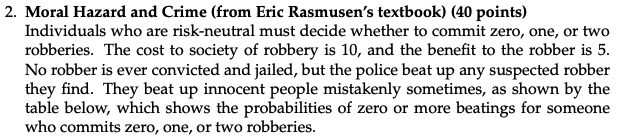
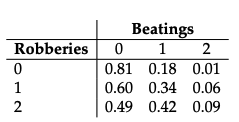
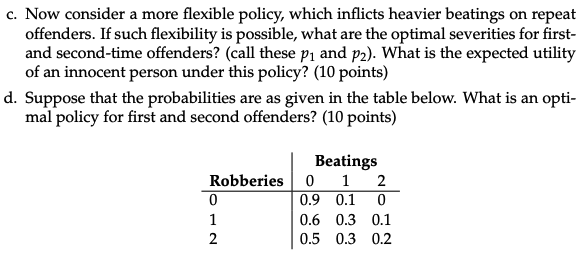
2. Moral Hazard and Crime (from Eric Rasmusen's textbook) (40 points) Individuals who are risk-neutral must decide whether to commit zero, one, or two robberies. The cost to society of robbery is 10 , and the benefit to the robber is 5 . No robber is ever convicted and jailed, but the police beat up any suspected robber they find. They beat up innocent people mistakenly sometimes, as shown by the table below, which shows the probabilities of zero or more beatings for someone who commits zero, one, or two robberies. \begin{tabular}{l|ccc} & \multicolumn{3}{|c}{ Beatings } \\ \hline Robberies & 0 & 1 & 2 \\ \hline 0 & 0.81 & 0.18 & 0.01 \\ 1 & 0.60 & 0.34 & 0.06 \\ 2 & 0.49 & 0.42 & 0.09 \end{tabular} c. Now consider a more flexible policy, which inflicts heavier beatings on repeat offenders. If such flexibility is possible, what are the optimal severities for firstand second-time offenders? (call these p1 and p2 ). What is the expected utility of an innocent person under this policy? ( 10 points) d. Suppose that the probabilities are as given in the table below. What is an optimal policy for first and second offenders? (10 points) 2. Moral Hazard and Crime (from Eric Rasmusen's textbook) (40 points) Individuals who are risk-neutral must decide whether to commit zero, one, or two robberies. The cost to society of robbery is 10 , and the benefit to the robber is 5 . No robber is ever convicted and jailed, but the police beat up any suspected robber they find. They beat up innocent people mistakenly sometimes, as shown by the table below, which shows the probabilities of zero or more beatings for someone who commits zero, one, or two robberies. \begin{tabular}{l|ccc} & \multicolumn{3}{|c}{ Beatings } \\ \hline Robberies & 0 & 1 & 2 \\ \hline 0 & 0.81 & 0.18 & 0.01 \\ 1 & 0.60 & 0.34 & 0.06 \\ 2 & 0.49 & 0.42 & 0.09 \end{tabular} c. Now consider a more flexible policy, which inflicts heavier beatings on repeat offenders. If such flexibility is possible, what are the optimal severities for firstand second-time offenders? (call these p1 and p2 ). What is the expected utility of an innocent person under this policy? ( 10 points) d. Suppose that the probabilities are as given in the table below. What is an optimal policy for first and second offenders? (10 points)
Step by Step Solution
There are 3 Steps involved in it

Get step-by-step solutions from verified subject matter experts