



Question: Please answer Case 14, Case Questions 1,2,3,4,5,6. The entire case 14 is presented here. bout his ability to present a clear picture of the CCHS
Please answer Case 14, Case Questions 1,2,3,4,5,6. The entire case 14 is presented here.
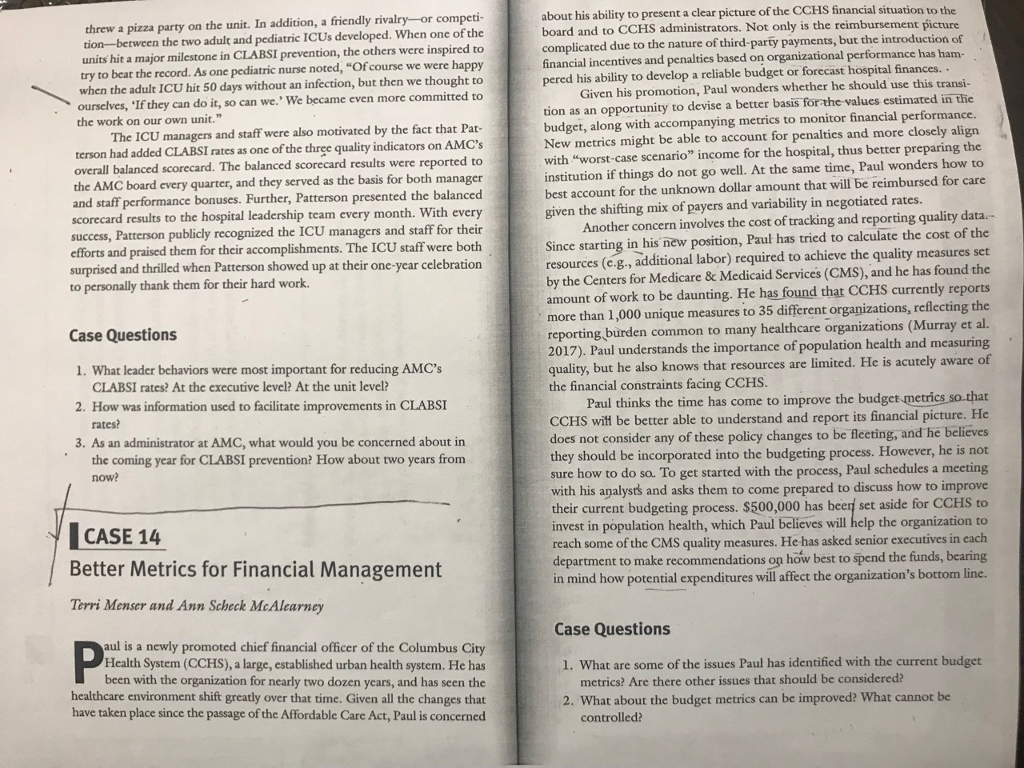
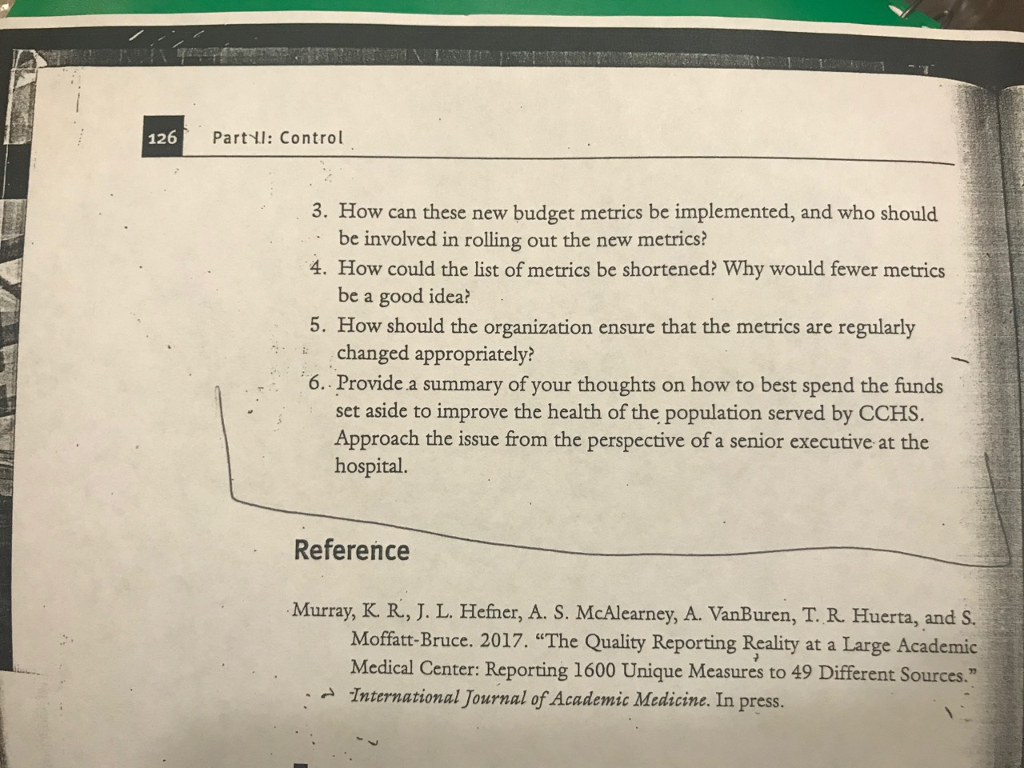
bout his ability to present a clear picture of the CCHS financial board and to CCHS administrators. Not only is the reimbursement picture complicated due to the nature of third-party payments, but the introduction of financial incentives and penalties based on organizational performance has ham- pered his ability to develop a reliable budget or forecast hospital finances. situation to the threw a pizza party on the unit. In addition, a friendly rivalry-or competi- tion-between the two adult and pediatric ICUs developed. When one of the units hit a major milestone in CLABSI prevention, the others were inspired to try to beat the record. As one pediatric nurse noted, "Of course we were ha when the adult ICU hit 50 days without an infection, but then we thought to ourselves, 'If they can do it, so can we.' We became even more committed to Given his promotion, Paul wonders whether he should use this transi tion as an opportunity to devise a better basis for-the values estimated in the budget, along with accompanying metrics to monitor financial performance. New metrics might be able to account for penalties and more closely align with "worst-case scenario" income for the hospital, thus better preparing the institution if things do not go well. At the same time, Paul wonders how to best account for the unknown dollar amount that will be reimbursed for care given the shifting mix of payers and variability in negotiated rates. the work on our own unit." The ICU managers and staff were also motivated by the fact that Pat terson had added CLABSI rates as one of the three quality indicators on AMC's overall balanced scorecard. The balanced scorecard results were reported to C board every quarter, and they served as the basis for both manager and staff performance bonuses. Further, Patterson presented the balanced scorecard results to the hospital leadership team every month. With every success, Patterson publicly recognized the ICU managers and staff for their efforts and praised them for their accomplishments. The ICU staff were both surprised and thrilled when Patterson showed up at their one-year celebration the AM Another concern involves the cost of tracking and reporting quality data.- Since starting in his new position, Paul has tried to calculate the cost of the resources (c.g., additional labor) required to achieve the quality measures set by the Centers for Medicare& Medicaid Services (CMS), and he has found the amount of work to be daunting. He has found that CCHS currently reports more than 1,000 unique measures to 35 different organizations, reflecting the reporting burden common to many healthcare organizations (Murray et al. 2017). Paul understands the importance of population health and measuring quality, but he also knows that resources are limited. He is acutely aware of the financial constraints facing CCHS. to personally thank them for their hard work. Case Questions 1. What leader behaviors were most important for reducing AMC's 2. How was information used to facilitate improvements in CLABSI 3. As an administrator at AMC, what would you be concerned about in CLABSI rates? At the executive level? At the unit level? Paul thinks the time has come to improve the budget metrics so.that CCHS witt be better able to understand and report its financial picture. He does not consider any of these policy changes to be fleeting, and he belicves they should be incorporated into the budgeting process. However, he is not sure how to do so. To get started with the process, Paul schedules a meeting with his analysts and asks them to come prepared to discuss how to improw their current budgeting process. $500,000 has been set aside for CCHS invest in population health, which Paul believes will help the organization reach some of the CMS quality measures. He-has asked senior executives in each department to make recommendations op how best to spend the funds, bearing in mind how potential expenditures will affect the organization's bottom line. rates? for CLABSI prevention? How about two years from the coming year now? CASE 14 Better Metrics for Financial Management Terri Menser and Ann Scheck McAlearney Case Questions aul is a newly promoted chief financial officer of the Columbus City Health System (CCHS), a large, established urban health system. He has been with the organization for nearly two dozen years, and has seen the healthcare environment shift greatly over that time. Given all the changes that have taken place since the passage of the Affordable Care Act, Paul is concerned 1. What are some of the issues Paul has identified with the current budget metrics? Are there other issues that should be considered? 2. What about the budget metrics can be improved? What cannot controlled
Step by Step Solution
There are 3 Steps involved in it

Get step-by-step solutions from verified subject matter experts