



Question: Please answer case questions 2.1, 2.2, and 2.7 tate laws tobacco do so? At the same time, Congress also approved the Chil dren's Internet Protection
Please answer case questions 2.1, 2.2, and 2.7
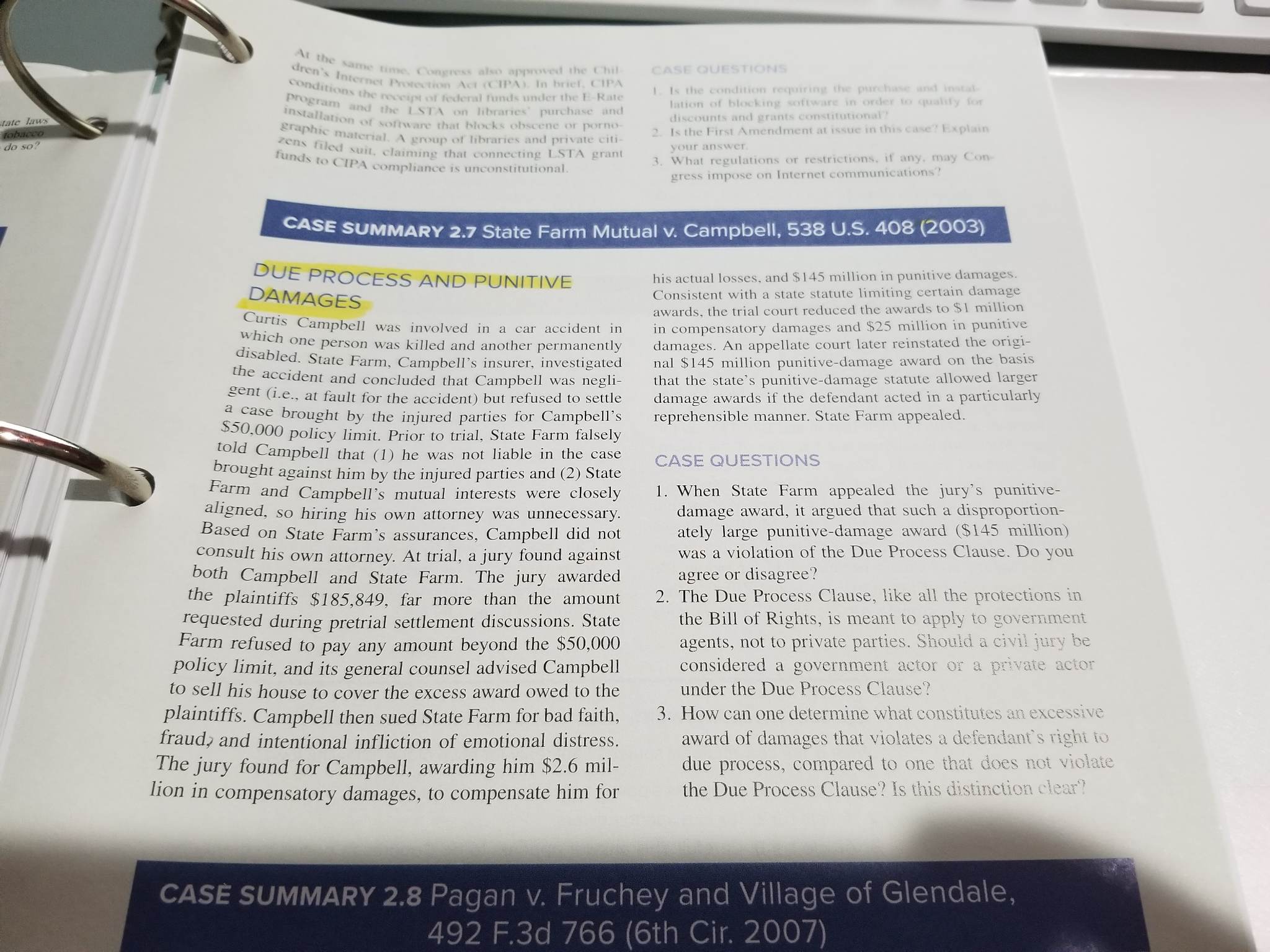
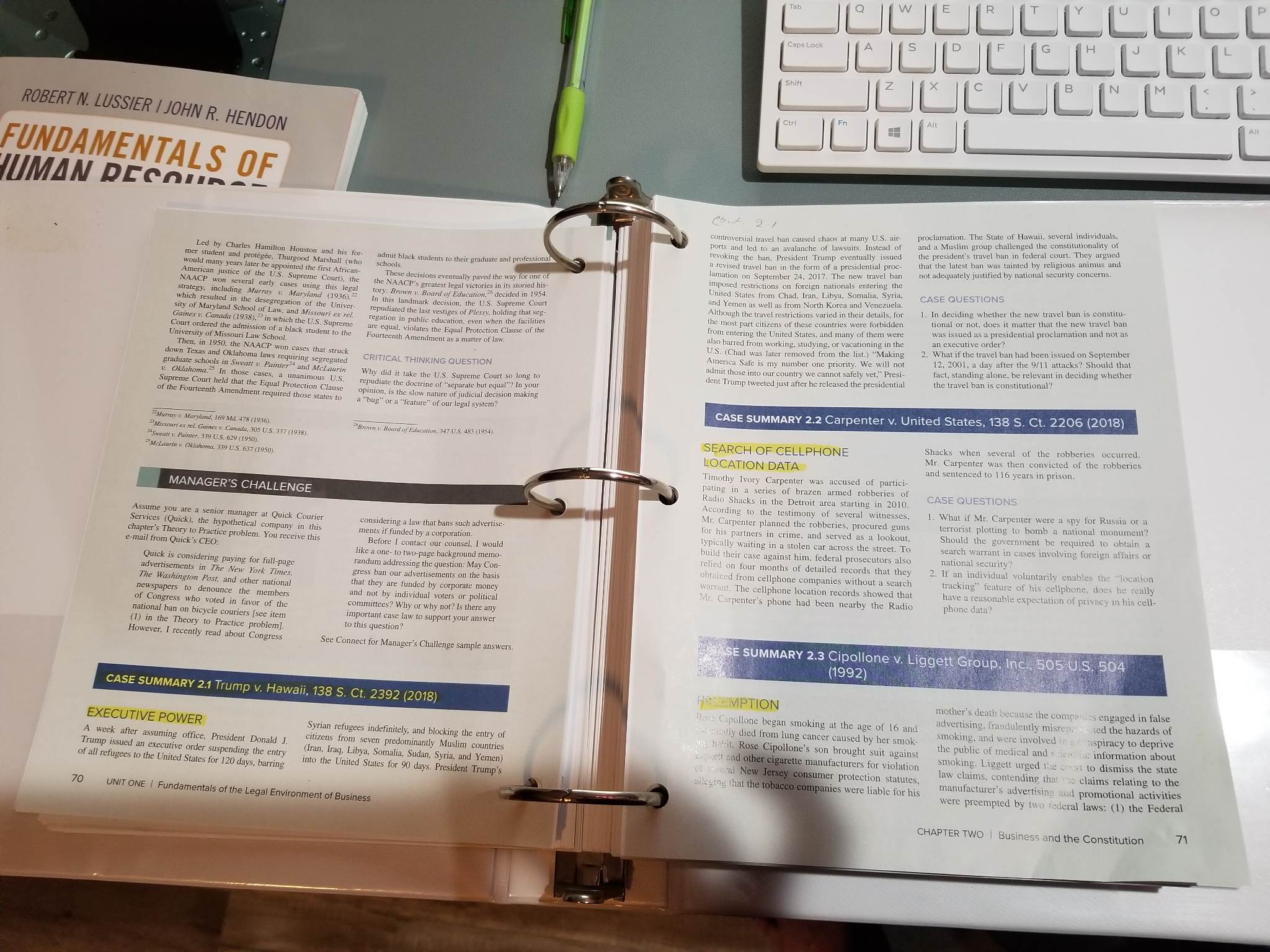
tate laws tobacco do so? At the same time, Congress also approved the Chil dren's Internet Protection Act (CIPA). In brief, CIPA conditions the receipt of federal funds under the E-Rate program and the LSTA on libraries' purchase and installation of software that blocks obscene or porno- graphic material. A group of libraries and private citi- zens filed suit, claiming that connecting LSTA grant funds to CIPA compliance is unconstitutional. CASE QUESTIONS 1. Is the condition requiring the purchase and instal lation of blocking software in order to qualify for discounts and grants constitutional? 2. Is the First Amendment at issue in this case? Explain your answer. 3. What regulations or restrictions, if any, may Con gress impose on Internet communications? CASE SUMMARY 2.7 State Farm Mutual v. Campbell, 538 U.S. 408 (2003) DUE PROCESS AND PUNITIVE DAMAGES Curtis Campbell was involved in a car accident in which one person was killed and another permanently disabled. State Farm, Campbell's insurer, investigated the accident and concluded that Campbell was negli- gent (i.e., at fault for the accident) but refused to settle a case brought by the injured parties for Campbell's $50,000 policy limit. Prior to trial, State Farm falsely told Campbell that (1) he was not liable in the case brought against him by the injured parties and (2) State Farm and Campbell's mutual interests were closely aligned, so hiring his own attorney was unnecessary. Based on State Farm's assurances, Campbell did not consult his own attorney. At trial, a jury found against both Campbell and State Farm. The jury awarded the plaintiffs $185,849, far more than the amount requested during pretrial settlement discussions. State Farm refused to pay any amount beyond the $50,000 policy limit, and its general counsel advised Campbell to sell his house to cover the excess award owed to the plaintiffs. Campbell then sued State Farm for bad faith, fraud, and intentional infliction of emotional distress. The jury found for Campbell, awarding him $2.6 mil- lion in compensatory damages, to compensate him for his actual losses, and $145 million in punitive damages. Consistent with a state statute limiting certain damage awards, the trial court reduced the awards to $1 million in compensatory damages and $25 million in punitive damages. An appellate court later reinstated the origi- nal $145 million punitive-damage award on the basis that the state's punitive-damage statute allowed larger damage awards if the defendant acted in a particularly reprehensible manner. State Farm appealed. CASE QUESTIONS 1. When State Farm appealed the jury's punitive- damage award, it argued that such a disproportion- ately large punitive-damage award ($145 million) was a violation of the Due Process Clause. Do you agree or disagree? 2. The Due Process Clause, like all the protections in the Bill of Rights, is meant to apply to government agents, not to private parties. Should a civil jury be considered a government actor or a private actor under the Due Process Clause? 3. How can one determine what constitutes an excessive award of damages that violates a defendant's right to due process, compared to one that does not violate the Due Process Clause? Is this distinction clear? CASE SUMMARY 2.8 Pagan v. Fruchey and Village of Glendale, 492 F.3d 766 (6th Cir. 2007)
Step by Step Solution
There are 3 Steps involved in it

Get step-by-step solutions from verified subject matter experts