Question: please answer case questions Aldi started as a small, family-owned grocery store located in Essen, Germany, in 1915. Two sons, Karl and Theo, took over
please answer case questions
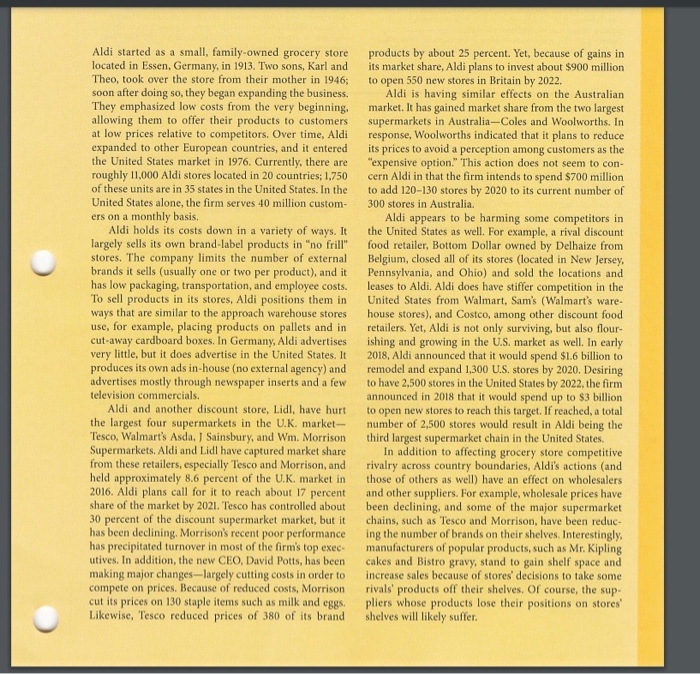
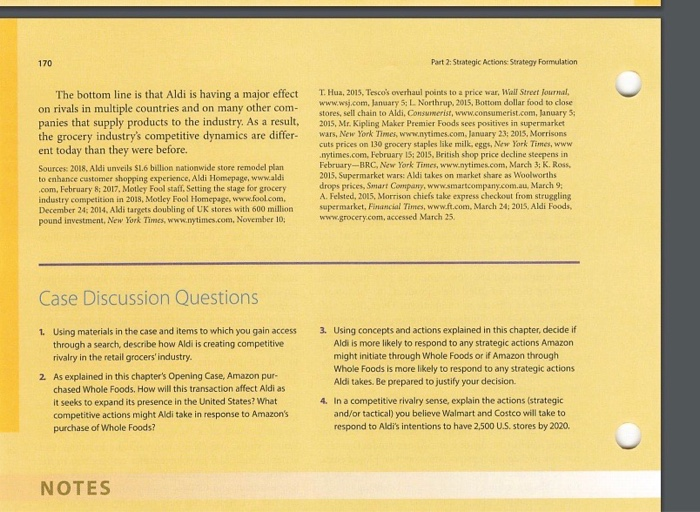
Aldi started as a small, family-owned grocery store located in Essen, Germany, in 1915. Two sons, Karl and Theo, took over the store from their mother in 1946; soon after doing so, they began expanding the business. They emphasized low costs from the very beginning, allowing them to offer their products to customers at low prices relative to competitors. Over time, Aldi expanded to other European countries, and it entered the United States market in 1976. Currently, there are roughly 11,000 Aldi stores located in 20 countries: 1.750 of these units are in 35 states in the United States. In the United States alone, the firm serves 40 million custom- ers on a monthly basis. Aldi holds its costs down in a variety of ways. It largely sells its own brand-label products in "no frill" stores. The company limits the number of external brands it sells (usually one or two per product), and it has low packaging, transportation, and employee costs. To sell products in its stores, Aldi positions them in ways that are similar to the approach warehouse stores use, for example, placing products on pallets and in cut-away cardboard boxes. In Germany, Aldi advertises very little, but it does advertise in the United States. It produces its own ads in-house (no external agency) and advertises mostly through newspaper inserts and a few television commercials. Aldi and another discount store. Lidl, have hurt the largest four supermarkets in the U.K. market- Tesco, Walmart's Asda, Sainsbury, and Wm Morrison Supermarkets. Aldi and Lidl have captured market share from these retailers, especially Tesco and Morrison, and held approximately 8.6 percent of the UK market in 2016. Aldi plans call for it to reach about 17 percent share of the market by 2021. Tesco has controlled about 30 percent of the discount supermarket market, but it has been declining. Morrison's recent poor performance has precipitated turnover in most of the firm's top exec- utives. In addition, the new CEO, David Potts, has been making major changes-largely cutting costs in order to compete on prices. Because of reduced costs, Morrison cut its prices on 130 staple items such as milk and eggs Likewise. Tesco reduced prices of 380 of its brand products by about 25 percent. Yet, because of gains in its market share, Aldi plans to invest about $900 million to open 550 new stores in Britain by 2022. Aldi is having similar effects on the Australian market. It has gained market share from the two largest supermarkets in Australia-Coles and Woolworths. In response, Woolworths indicated that it plans to reduce its prices to avoid a perception among customers as the "expensive option." This action does not seem to con cern Aldi in that the firm intends to spend $700 million to add 120-130 stores by 2020 to its current number of 300 stores in Australia. Aldi appears to be harming some competitors in the United States as well. For example, a rival discount food retailer, Bottom Dollar owned by Delhaize from Belgium, closed all of its stores (located in New Jersey, Pennsylvania, and Ohio) and sold the locations and leases to Aldi. Aldi does have stiffer competition in the United States from Walmart, Sam's (Walmart's ware- house stores), and Costco, among other discount food retailers. Yet, Aldi is not only surviving, but also flour- ishing and growing in the U.S. market as well. In early 2018, Aldi announced that it would spend S1.6 billion to remodel and expand 1,300 U.S. stores by 2020. Desiring to have 2.500 stores in the United States by 2022, the firm announced in 2018 that it would spend up to $3 billion to open new stores to reach this target. If reached a total number of 2,500 stores would result in Aldi being the third largest supermarket chain in the United States. In addition to affecting grocery store competitive rivalry across country boundaries, Aldi's actions (and those of others as well) have an effect on wholesalers and other suppliers. For example, wholesale prices have been declining, and some of the major supermarket chains, such as Tesco and Morrison, have been reduc- ing the number of brands on their shelves. Interestingly, manufacturers of popular products, such as Mr. Kipling cakes and Bistro gravy, stand to gain shelf space and increase sales because of stores decisions to take some rivals products off their shelves. Of course, the sup pliers whose products lose their positions on stores shelves will likely suffer 170 Part 2: Strategic Actions: Strategy Formulation The bottom line is that Aldi is having a major effect on rivals in multiple countries and on many other com- panies that supply products to the industry. As a result, the grocery industry's competitive dynamics are differ- ent today than they were before. Sources: 2018, Aldi unveils S1.6 billion nationwide store remodel plan to enhance customer shopping experience, Aldi Homepage, www.aldi .com, February 8; 2017, Motley Fool staff. Setting the stage for grocery industry competition in 2018, Motley Fool Homepage, www.fool.com December 24, 2014. Aldi targets doubling of UK stores with 600 million pound investment, New York Times, www.nytimes.com. November 10, T. Hua, 2015. Tesco's overhaul points to a price war, Wall Street Journal, www.wsj.com, January 5; L. Northrup, 2015, Bottom dollar food to close stores, sell chain to Aldi, Consumerist, www.consumerist.com, January 5; 2015, Mr. Kipling Maker Premier Foods sees positives in supermarket wars, New York Times, www.nytimes.com, January 23, 2015, Morrisons cuts prices on 130 grocery staples like milk, eggs, New York Times, www .nytimes.com, February 15, 2015, British shop price decline steepens in February --BRC, New York Times, www.nytimes.com, March 3; K. Ross, 2015, Supermarket wars: Aldi takes on market share as Woolworths drops prices, Smart Company, www.smartcompany.com.au, March 9; A. Felsted, 2015. Morrison chiefs take express checkout from struggling supermarket, Financial Times, www.ft.com, March 24, 2015, Aldi Foods, www.grocery.com, accessed March 25. Case Discussion Questions 1. Using materials in the case and items to which you gain access through a search, describe how Aldi is creating competitive rivalry in the retail grocers' industry. 2 As explained in this chapter's Opening Case, Amazon pur- chased Whole Foods. How will this transaction affect Aldi as it seeks to expand its presence in the United States? What competitive actions might Aldi take in response to Amazon's purchase of Whole Foods? 3. Using concepts and actions explained in this chapter decide if Aldi is more likely to respond to any strategic actions Amazon might initiate through Whole Foods or if Amazon through Whole Foods is more likely to respond to any strategic actions Aldi takes. Be prepared to justify your decision 4. In a competitive rivalry sense, explain the actions (strategic and/or tactical) you believe Walmart and Costco will take to respond to Aldi's intentions to have 2,500 U.S.stores by 2020. The Ripple Effect of Supermarket Wars: Aldi Is Changing the Markets in Many Countries Aldi started as a small, familyowned grocery store located in Essen, Germany, in 1913. Two sons, Karl and Theo, took over the store from their mother in 1946; soon after doing so, they began expanding the business. They emphasized low costs from the very beginning, allowing them to offer their products to customers at low prices relative to competitors. Over time, Aldi expanded to other European countries, and it entered the United States market in 1976. Currently, there are roughly 11,000 Aldi stores located in 20 countries: 1.750 of these units are in 35 states in the United States. In the United States alone, the firm serves 10 million custom ers on a monthly basis, Aldi holds its costs down in a variety of ways. It largely sells its own brand-label products in "no frill" stores. The company limits the number of external brands it sells (usually one or two per product, and it has low packaging, transportation, and employee costs. To sell products in its stores, Aldi positions them in ways that are similar to the approach warehouse stores use, for example, placing products on pallets and in cut-away cardboard boxes. In Germany, Aldi advertises very little, but it does advertise in the United States. It produces its own ads in-house (no external agency) and advertises mostly through newspaper inserts and a few television commercials, Aldi and another discount store, Lidl, have hurt the largest four supermarkets in the UK, market Tesco, Walmarts Asda, Sainsbury, and Wm. Morrison Supermarkets. Aldi and Lidl have captured market share from these retailers, especially Tesco and Morrison, and held approximately 8.6 percent of the U.K market in 2016. Aldi plans call for it to reach about 17 percent share of the market by 2021. Tesco has controlled about 30 percent of the discount supermarket market, but it has been declining. Morrison's recent poor performance has precipitated turnover in most of the firm's top exec utives. In addition, the new CEO, David Potts, has been making major changes-largely cutting costs in order to compete on prices. Because of reduced costs. Morrison cut its prices on 130 staple items such as milk and se Likewise, Tesco reduced prices of 380 of its brand products by about 25 percent. Yet, because of gains in its market share, Aldi plans to invest about $900 million to open 550 new stores in Britain by 2022, Aldi is having similar effects on the Australian market. It has gained market share from the two largest supermarkets in Australia-Coles and Woolworths. In response, Woolworths indicated that it plans to reduce its prices to avoid a perception among customers as the "expensive option." This action does not seem to con- cern Aldi in that the firm intends to spend $700 million to add 120-130 stores by 2020 to its current number of 300 stores in Australia Aldi appears to be harming some competitors in the United States as well. For example, a rival discount food retailer, Bottom Dollar owned by Delhaize from Belgium, closed all of its stores (located in New Jersey, Pennsylvania, and Ohio) and sold the locations and leases to Aldi. Aldi does have stiffer competition in the United States from Walmart, Sam's (Walmart's ware- house stores), and Costco, among other discount food retailers. Yet. Aldi is not only surviving, but also four- ishing and growing in the U.S. market as well. In early 2018. Aldi announced that it would spend S1.6 billion to remodel and expand 1.300 US stores by 2020. Desiring to have 2.500 stores in the United States by 2022, the firm announced in 2018 that it would spend up to $3 billion to open new stores to reach this target. If reached, a total number of 2,500 stores would result in Aldi being the third largest supermarket chain in the United States, In addition to affecting grocery store competitive rivalry across country boundaries, Aldis actions (and those of others as well) have an effect on wholesalers and other suppliers. For example, wholesale prices have been declining, and some of the major supermarket chains, such as Tesco and Morrison, have been reduc ing the number of brands on their shelves. Interestingly, manufacturers of popular products, such as Mr. Kipling cakes and Bistro gravy, stand to gain shelf space and increase sales because of stores decisions to take some rivals products off their shelves. Of course, the sup. pliers whose products lose their positions on stores! shelves will likely suffer compete cut its prices on 130 staple items such as milk and eggs. Likewise, Tesco reduced prices of 380 of its brand pliers whose products lose their positions on stores' shelves will likely suffer. Part 2 Staategic Actions Strategy formulation 170 The bottom line is that Aldi is having a major effect on rivals in multiple countries and on many other com- panies that supply products to the industry. As a result, the grocery industry's competitive dynamics are differ ent today than they were before. Sources: 2018. Aldi weils $16 billion nationwide store remodel plan to chance customer shopping experience All Homepage cald com, February 8, 2017. Motley Fool stall, Setting the stage for grocery industry competition in 2018, Motley Fool Homepage www.fool.com, December 24, 2014. Aldi targeta doubling of UK or with 600 million pound investment, New York That, www.nytimes.com, November 10, T. Hua, 2015. Tesco's overhaul points to a price war, Wall Stref ournal www.wsj.com, January 5: L Northrup, 2015, Bottom dollar food to close stores, sell chain to Aldi. Consumeris, www.consumerist.com, January 5 2015. Mt. Kipling Maker Premier Foods sees positives in supermarket wars, New York Times, www.nytimes.com, January 23, 2015. Morrisons cuts prices on 180 grocery staples like milk. New York Times, www nytimes.com, February 15, 2015. British shop price decline steepens in February-BRC, New York Times, www.nytimes.com, March 3 K. Ross 2015. Supermarket wars: All takes on market share as Woolworths drops prices, Smart Company, www.smartcompany.com.au March Alded, 2015. Morrison chiefs take express checkout from struggling supermarket, Fial Times, www.ft.com, March 24, 2015, Aldi Foods www.grocery.com, accessed March 25 Case Discussion Questions 1. Using materials in the case and items to which you gain access through a search describe how Aldi is creating competitive rivalry in the retail grocers industry 2. As explained in this chapter's Opening Cine Amazon pur chased Whole Foods. How will this transaction alfect Aldias It seeks to expand its presence in the United States? What competitive actions might Aldi tale in response to Amazon's purchase of Whole Foods? 3. Using concepts and actions explained in this chapter, decide if Aldi is more likely to respond to any strategic actions Amazon might initiate through Whole Foods or if Amazon through Whole Foods is more likely to respond to any strategk actions All takes the prepared to justify your decision 4. in a competitive rivalry sense, explain the actions strategie and/or tacticall you believe Walmart and Costco will take to respond to Aldi's intentions to have 2,500 US stores by 2020 Aldi started as a small, family-owned grocery store located in Essen, Germany, in 1913. Two sons, Karl and Theo, took over the store from their mother in 1946; soon after doing so, they began expanding the business. They emphasized low costs from the very beginning, allowing them to offer their products to customers at low prices relative to competitors. Over time, Aldi expanded to other European countries, and it entered the United States market in 1976. Currently, there are roughly 11,000 Aldi stores located in 20 countries; 1,750 of these units are in 35 states in the United States. In the United States alone, the firm serves 40 million custom- ers on a monthly basis. Aldi holds its costs down in a variety of ways. It largely sells its own brand-label products in "no frill" stores. The company limits the number of external brands it sells (usually one or two per product), and it has low packaging, transportation, and employee costs. To sell products in its stores, Aldi positions them in ways that are similar to the approach warehouse stores use, for example, placing products on pallets and in cut-away cardboard boxes. In Germany, Aldi advertises very little, but it does advertise in the United States. It produces its own ads in-house (no external agency) and advertises mostly through newspaper inserts and a few television commercials. Aldi and another discount store, Lidl, have hurt the largest four supermarkets in the U.K. market- Tesco, Walmarts Asda, J Sainsbury, and Wm. Morrison Supermarkets. Aldi and Lidl have captured market share from these retailers, especially Tesco and Morrison, and held approximately 8.6 percent of the U.K. market in 2016. Aldi plans call for it to reach about 17 percent share of the market by 2021. Tesco has controlled about 30 percent of the discount supermarket market, but it has been declining. Morrison's recent poor performance has precipitated turnover in most of the firm's top exec- utives. In addition, the new CEO, David Potts, has been making major changes - largely cutting costs in order to compete on prices. Because of reduced costs, Morrison cut its prices on 130 staple items such as milk and eggs. Likewise, Tesco reduced prices of 380 of its brand products by about 25 percent. Yet, because of gains in its market share, Aldi plans to invest about $900 million to open 550 new stores in Britain by 2022. Aldi is having similar effects on the Australian market. It has gained market share from the two largest supermarkets in Australia-Coles and Woolworths. In response, Woolworths indicated that it plans to reduce its prices to avoid a perception among customers as the "expensive option." This action does not seem to con- cern Aldi in that the firm intends to spend $700 million to add 120-130 stores by 2020 to its current number of 300 stores in Australia Aldi appears to be harming some competitors in the United States as well. For example, a rival discount food retailer, Bottom Dollar owned by Delhaize from Belgium, closed all of its stores (located in New Jersey, Pennsylvania, and Ohio) and sold the locations and leases to Aldi. Aldi does have stiffer competition in the United States from Walmart, Sam's (Walmart's ware- house stores), and Costco, among other discount food retailers. Yet, Aldi is not only surviving, but also flour- ishing and growing in the U.S. market as well. In early 2018, Aldi announced that it would spend $1.6 billion to remodel and expand 1,300 U.S. stores by 2020. Desiring to have 2,500 stores in the United States by 2022, the firm announced in 2018 that it would spend up to $3 billion to open new stores to reach this target. If reached, a total number of 2,500 stores would result in Aldi being the third largest supermarket chain in the United States. In addition to affecting grocery store competitive rivalry across country boundaries, Aldi's actions (and those of others as well) have an effect on wholesalers and other suppliers. For example, wholesale prices have been declining, and some of the major supermarket chains, such as Tesco and Morrison, have been reduc- ing the number of brands on their shelves. Interestingly, manufacturers of popular products, such as Mr. Kipling cakes and Bistro gravy, stand to gain shelf space and increase sales because of stores' decisions to take some rivals' products off their shelves. Of course, the sup. pliers whose products lose their positions on stores' shelves will likely suffer. 170 Part 2: Strategic Actions: Strategy formulation The bottom line is that Aldi is having a major effect on rivals in multiple countries and on many other com- panies that supply products to the industry. As a result, the grocery industry's competitive dynamics are differ- ent today than they were before. Sources: 2018. Aldi unveils $1.6 billion nationwide store remodel plan to enhance customer shopping experience, Aldi Homepage, www.aldi .com, February 8, 2017, Motley Fool staff. Setting the stage for grocery industry competition in 2018, Motley Fool Homepage www.fool.com, December 24, 2014. Aldi targets doubling of UK stores with 600 million pound investment, New York Times, www.nytimes.com, November 10, T. Hua, 2015. Tesco's overhaul points to a price war, Wall Street Journal, www.wsj.com, January 5: L Northrup. 2015, Bottom dollar food to close stores, sell chain to Aldi, Consumerist, www.consumerist.com, January 5: 2015. Mr. Kipling Maker Premier Foods sees positives in supermarket wars, New York Times, www.nytimes.com, January 23, 2015, Morrisons cuts prices on 130 grocery staples like milk, eggs, New York Times, www .nytimes.com, February 15:2015, British shop price decline steepens in February-BRC, New York Times, www.nytimes.com, March 3; K. Ross, 2015. Supermarket Wars: Aldi takes on market share as Woolworths drops prices, Smart Company, www.smartcompany.com.au. March 9, A. Felsted, 2015, Morrison chiefs take express checkout from struggling supermarket, Facial Times, www.ft.com, March 24, 2015. Aldi Foods, www.grocery.com, accessed March 25 Case Discussion Questions 1. Using materials in the case and items to which you gain access through a search, describe how Aldi is creating competitive rivalry in the retail grocers'industry. 2 As explained in this chapter's Opening Case, Amazon pur- chased Whole Foods. How will this transaction affect Aldi as it seeks to expand its presence in the United States? What competitive actions might Aldi take in response to Amazon's purchase of Whole Foods? 3. Using concepts and actions explained in this chapter, decide if Aldi is more likely to respond to any strategic actions Amazon might initiate through Whole Foods or if Amazon through Whole Foods is more likely to respond to any strategic actions Aldi takes. Be prepared to justify your decision 4. In a competitive rivalry sense, explain the actions (strategic and/or tactical) you believe Walmart and Costco will take to respond to Aldi's intentions to have 2,500 U.S. stores by 2020. NOTES









 Study Help