







Question: please answer charge and the current (1) is zero, then fq =0 at time t =0, then = 1 /2. Example: A 300-V dc power
please answer
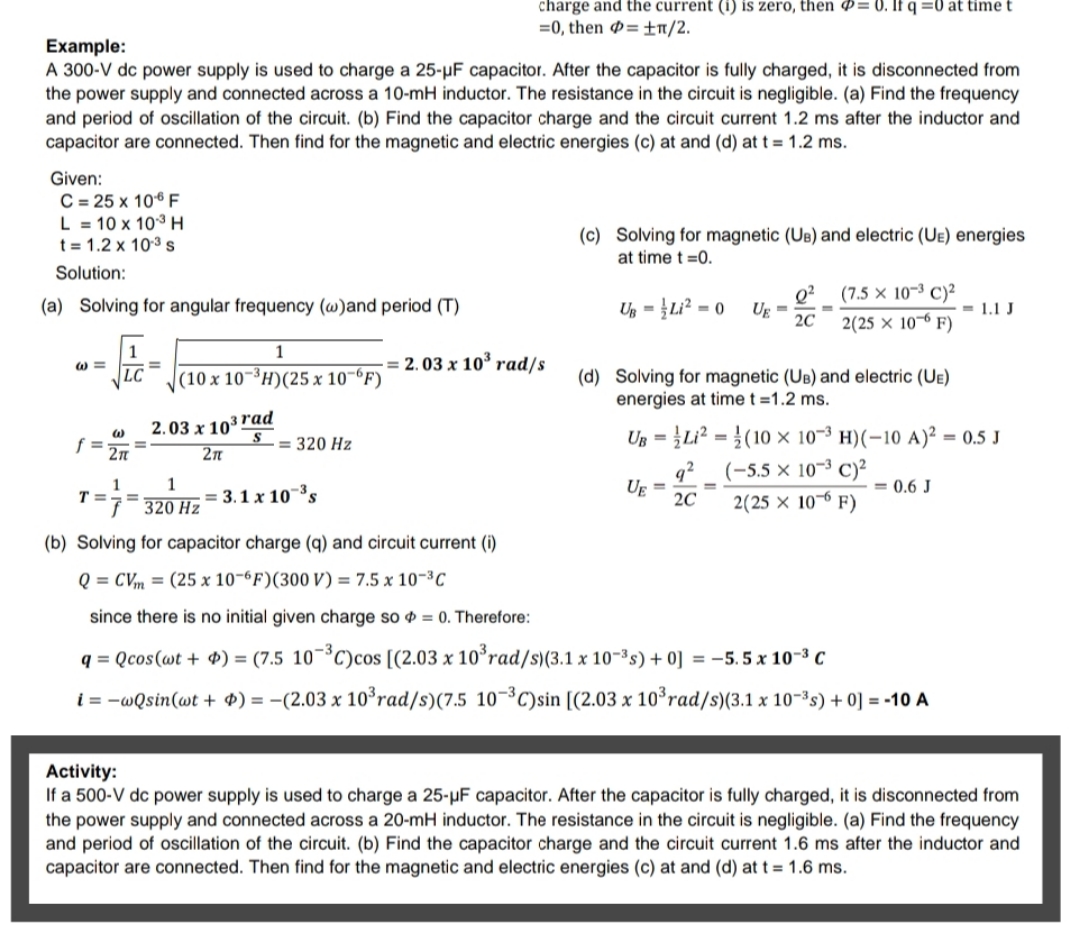
charge and the current (1) is zero, then fq =0 at time t =0, then = 1 /2. Example: A 300-V dc power supply is used to charge a 25-uF capacitor. After the capacitor is fully charged, it is disconnected from the power supply and connected across a 10-mH inductor. The resistance in the circuit is negligible. (a) Find the frequency and period of oscillation of the circuit. (b) Find the capacitor charge and the circuit current 1.2 ms after the inductor and capacitor are connected. Then find for the magnetic and electric energies (c) at and (d) at t = 1.2 ms. Given: C = 25 x 106 F L = 10 x 103 H t = 1.2 x 10⁻³ s (c) Solving for magnetic (Us) and electric (UE) energies at time t =0. Solution: (a) Solving for angular frequency (w)and period (T) UB = Li2 - 0 Up _ _ (7.5 x 10⁻³ C)2 2C 2(25 X 10 6 F) - = 1.1 J W = 1 1 LC (10 x 10 H) (25 x 10-6F) = 2. 03 x 10* rad/s (d) Solving for magnetic (UB) and electric (UE) energies at time t =1.2 ms. 2.03 x 10³ rad f= 2 7 $ = 320 Hz UB = 2412 = (10 X 10-3 H)(-10 A)2 = 0.5 J UF - 9 (-5.5 x 10 3 C)2 T= 320 Hz = 3.1 x 10 3s = 0.6 J 2C 2(25 X 10 % F) (b) Solving for capacitor charge (q) and circuit current (i) Q = CVm = (25 x 10-F) (300 V) = 7.5 x 10⁻³C since there is no initial given charge so $ = 0. Therefore: q = Qcos(wt + +) = (7.5 10 C)cos [(2.03 x 10 rad/s)(3.1 x 10-3s) + 0] = -5.5 x 10⁻³ c i = -wQsin(wt + +) = -(2.03 x 10*rad/s)(7.5 10-3C)sin [(2.03 x 10³rad/s)(3.1 x 10-3s) + 0] = -10 A Activity: If a 500-V dc power supply is used to charge a 25-JF capacitor. After the capacitor is fully charged, it is disconnected from the power supply and connected across a 20-mH inductor. The resistance in the circuit is negligible. (a) Find the frequency and period of oscillation of the circuit. (b) Find the capacitor charge and the circuit current 1.6 ms after the inductor and capacitor are connected. Then find for the magnetic and electric energies (c) at and (d) at t = 1.6 ms
Step by Step Solution
There are 3 Steps involved in it

Get step-by-step solutions from verified subject matter experts
 Study Help