





Question: please answer clearly and concisely a 0/1 Submissions Used ASK YOUR TEACHER PRACTICE ANOTHER In Chapter 1, we modeled the world population from 1900 to

please answer clearly and concisely
please answer clearly and concisely a 0/1
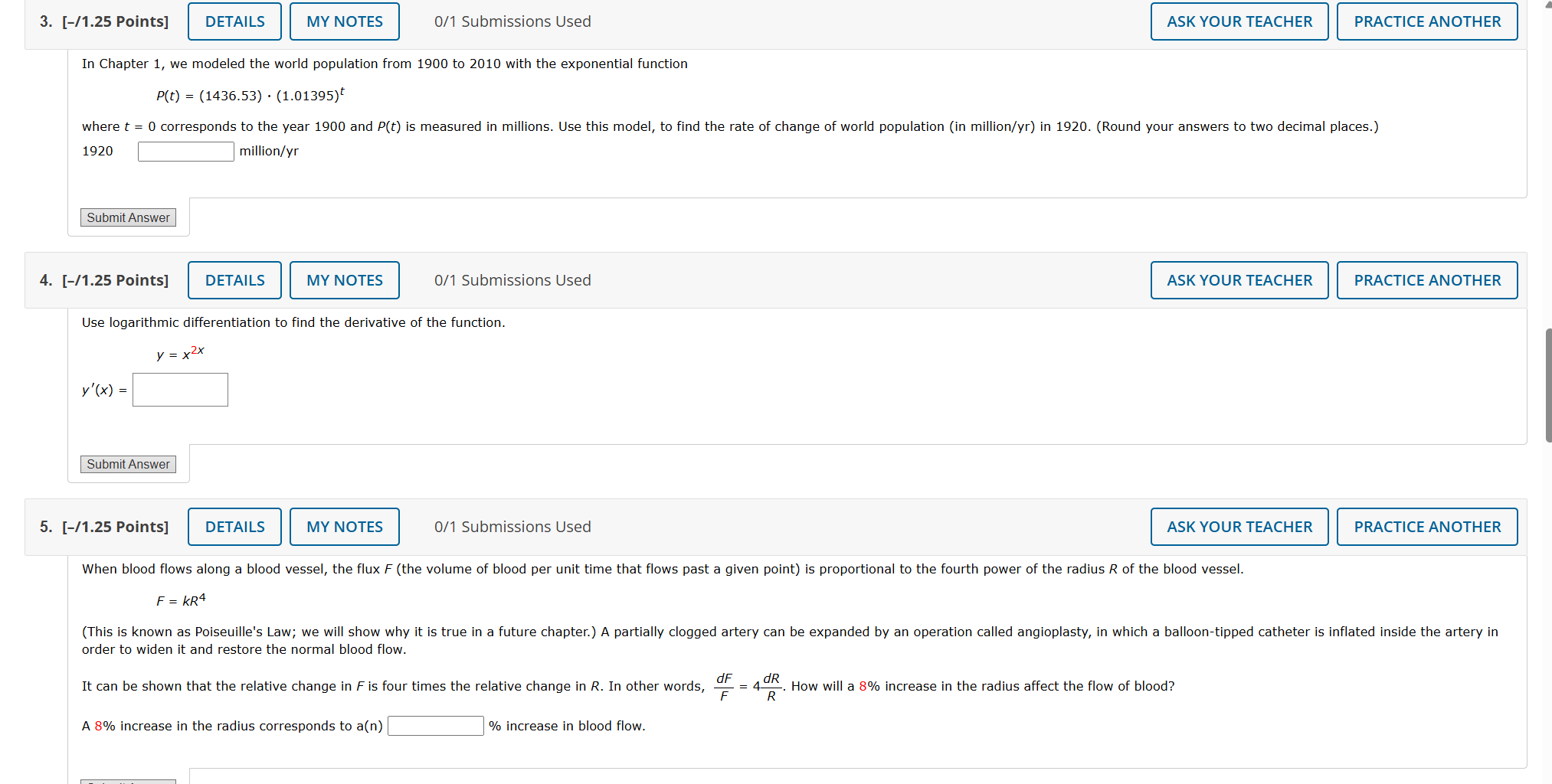
a 0/1 Submissions Used ASK YOUR TEACHER PRACTICE ANOTHER In Chapter 1, we modeled the world population from 1900 to 2010 with the exponential function 3. [-/1.25 Points] P(t) = (1436.53) - (1.01395) where t = 0 corresponds to the year 1900 and P(t) is measured in millions. Use this model, to find the rate of change of world population (in million/yr) in 1920. (Round your answers to two decimal places.) 1920 [ | million/yr Submit Answer 0/1 Submissions Used ASK YOUR TEACHER PRACTICE ANOTHER Use logarithmic differentiation to find the derivative of the function. 4. [-/1.25 Points] y = x> y'(x) = Submit Answer ASKYOUR TEACHER PRACTICE ANOTHER 5. [-/1.25 Points] DETAILS MY NOTES 0/1 Submissions Used When blood flows along a blood vessel, the flux F (the volume of blood per unit time that flows past a given point) is proportional to the fourth power of the radius R of the blood vessel. F=kR* (This is known as Poiseuille's Law; we will show why it is true in a future chapter.) A partially clogged artery can be expanded by an operation called angioplasty, in which a balloon-tipped catheter is inflated inside the artery in order to widen it and restore the normal blood flow. It can be shown that the relative change in F is four times the relative change in R. In other words, dFF = 4%. How will a 8% increase in the radius affect the flow of blood? A 8% increase in the radius corresponds to a(n) : % increase in blood flow

Step by Step Solution

There are 3 Steps involved in it

1 Expert Approved Answer
Step: 1 Unlock blur-text-image

Question Has Been Solved by an Expert!

Get step-by-step solutions from verified subject matter experts

Step: 2 Unlock
Step: 3 Unlock

Students Have Also Explored These Related Business Writing Questions!