







Question: please answer clearly with steps and the correct answer. Particles may aggregate in water as a result of their hydrophobicity or Van de Waals attractions.
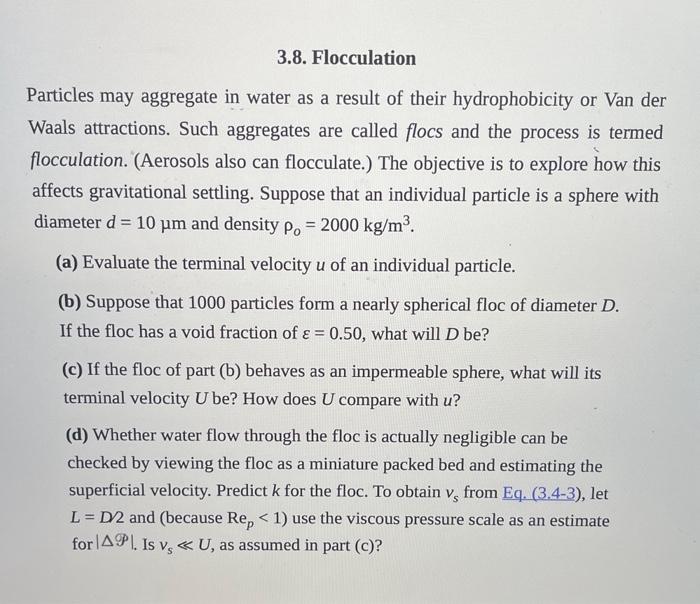
Particles may aggregate in water as a result of their hydrophobicity or Van de Waals attractions. Such aggregates are called flocs and the process is terme flocculation. (Aerosols also can flocculate.) The objective is to explore how this affects gravitational settling. Suppose that an individual particle is a sphere with diameter d=10m and density o=2000kg/m3. (a) Evaluate the terminal velocity u of an individual particle. (b) Suppose that 1000 particles form a nearly spherical floc of diameter D. If the floc has a void fraction of =0.50, what will D be? (c) If the floc of part (b) behaves as an impermeable sphere, what will its terminal velocity U be? How does U compare with u ? (d) Whether water flow through the floc is actually negligible can be checked by viewing the floc as a miniature packed bed and estimating the superficial velocity. Predict k for the floc. To obtain vs from Eq. (3.4-3), let L=D2 and (because Rep
Step by Step Solution
There are 3 Steps involved in it

Get step-by-step solutions from verified subject matter experts
 Study Help