







Question: PLEASE ANSWER: Compare and discuss insights between the two numbers. PROBLEM 2 Manila Hospital uses job-order costing system to assign costs to its patients. Its
PLEASE ANSWER:
Compare and discuss insights between the two numbers.
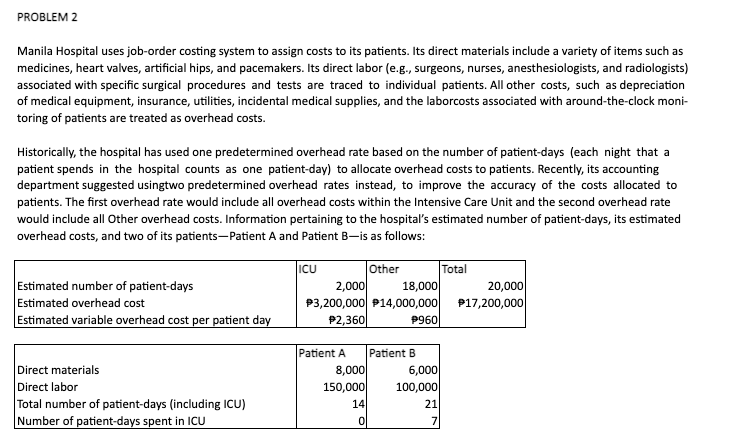
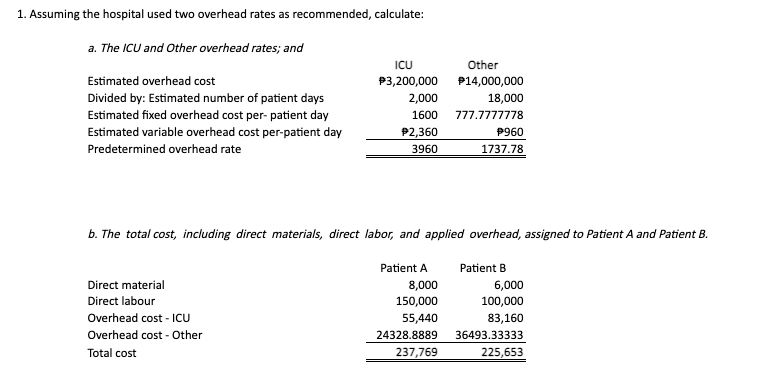
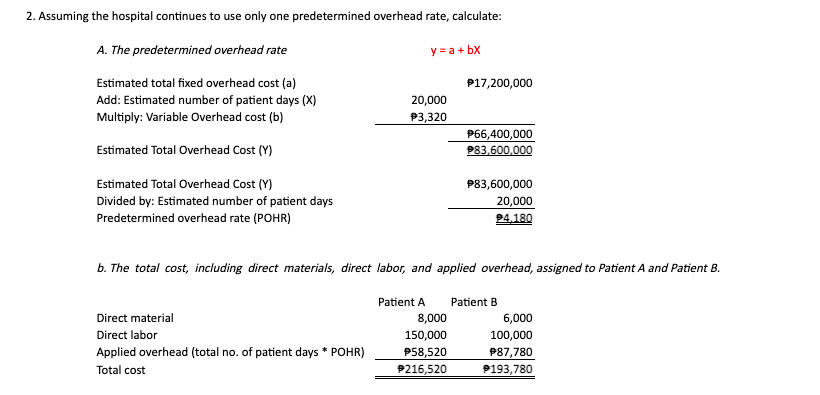
PROBLEM 2 Manila Hospital uses job-order costing system to assign costs to its patients. Its direct materials include a variety of items such as medicines, heart valves, artificial hips, and pacemakers. Its direct labor (e.g., surgeons, nurses, anesthesiologists, and radiologists) associated with specific surgical procedures and tests are traced to individual patients. All other costs, such as depreciation of medical equipment, insurance, utilities, incidental medical supplies, and the laborcosts associated with around-the-clock moni- toring of patients are treated as overhead costs. Historically, the hospital has used one predetermined overhead rate based on the number of patient-days (each night that a patient spends in the hospital counts as one patient-day) to allocate overhead costs to patients. Recently, its accounting department suggested usingtwo predetermined overhead rates instead, to improve the accuracy of the costs allocated to patients. The first overhead rate would include all overhead costs within the Intensive Care Unit and the second overhead rate would include all other overhead costs. Information pertaining to the hospital's estimated number of patient-days, its estimated overhead costs, and two of its patients-Patient A and Patient B-is as follows: Estimated number of patient-days Estimated overhead cost Estimated variable overhead cost per patient day ICU Other Total 2,000 18,000 20,000 23,200,000 P14,000,000 P17,200,000 P2,360 P960 Direct materials Direct labor Total number of patient-days (including ICU) Number of patient-days spent in ICU Patient A Patient B 8,000 6,000 150,000 100,000 14 21 0 7 1. Assuming the hospital used two overhead rates as recommended, calculate: a. The ICU and Other overhead rates; and Estimated overhead cost Divided by: Estimated number of patient days Estimated fixed overhead cost per patient day Estimated variable overhead cost per-patient day Predetermined overhead rate ICU P3,200,000 2,000 1600 P2,360 3960 Other P14,000,000 18,000 777.7777778 P960 1737.78 b. The total cost, including direct materials, direct labor, and applied overhead, assigned to patient A and Patient B. Direct material Direct labour Overhead cost - ICU Overhead cost - Other Total cost Patient A 8,000 150,000 55,440 24328.8889 237,769 Patient B 6,000 100,000 83,160 36493.33333 225,653 2. Assuming the hospital continues to use only one predetermined overhead rate, calculate: A. The predetermined overhead rate y = a + bx P17,200,000 Estimated total fixed overhead cost (a) Add: Estimated number of patient days (X) Multiply: Variable Overhead cost (b) 20,000 P3,320 Estimated Total Overhead Cost (Y) P66,400,000 283,600,000 Estimated Total Overhead Cost (Y) Divided by: Estimated number of patient days Predetermined overhead rate (POHR) P83,600,000 20,000 24.180 b. The total cost, including direct materials, direct labor, and applied overhead, assigned to patient A and Patient B. Direct material Direct labor Applied overhead (total no. of patient days * POHR) Total cost Patient A Patient B 8,000 6,000 150,000 100,000 P58,520 P87,780 P216,520 9193,780
Step by Step Solution
There are 3 Steps involved in it

Get step-by-step solutions from verified subject matter experts
 Study Help