







Question: Please answer completely and correctly 2. The following is an example of a schedule of concurrent transactions: Ti ReadX) Write(X) Commit T2 T3 Read(Y) Write(Y)
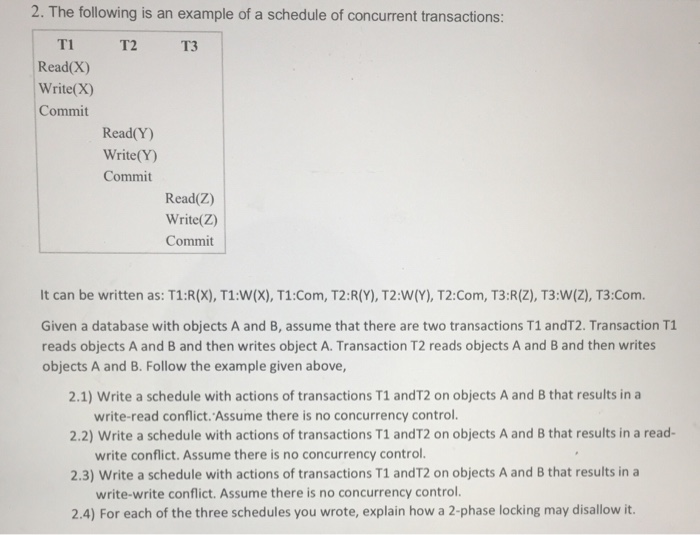
2. The following is an example of a schedule of concurrent transactions: Ti ReadX) Write(X) Commit T2 T3 Read(Y) Write(Y) Commit Read(Z) Write(Z) Commit It can be written as: T1:R(X), T1:W(X), T1:Com, T2:R(Y), T2W(Y), T2:Com, T3:R(Z), T3:W(Z), T3:Com. reads objects A and B and then writes object A. Transaction T2 reads objects A and B and then writes 2.1) Write a schedule with actions of transactions T1 andT2 on objects A and B that results in a Given a database with objects A and B, assume that there are two transactions T1 andT2. Transaction T1 objects A and B. Follow the example given above, write-read conflict. Assume there is no concurrency control. write conflict. Assume there is no concurrency control. write-write conflict. Assume there is no concurrency control. 2.2) Write a schedule with actions of transactions T1 andT2 on objects A and B that results in a read- 2.3) Write a schedule with actions of transactions T1 andT2 on objects A and B that results in a 2.4) For each of the three schedules you wrote, explain how a 2-phase locking may disallow it
Step by Step Solution
There are 3 Steps involved in it

Get step-by-step solutions from verified subject matter experts
 Study Help