Question: please answer completely and thoroughly How do firms develop a distinctive and positive reputation? How can the general public affect a company's reputation? Identify an
please answer completely and thoroughly
How do firms develop a distinctive and positive reputation? How can the general public affect a company's reputation? Identify an organization that has recovered from having a bad reputation and explain how the firm restored public confidence.
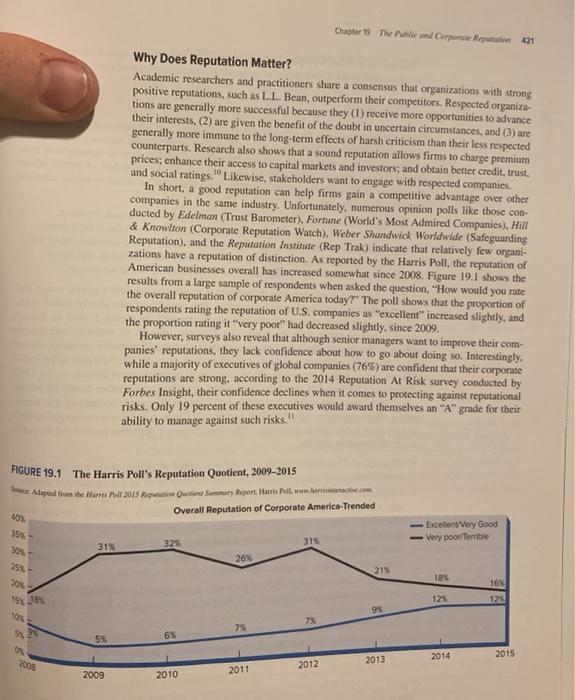
What Is Reputation? It may seem obvious that business organizations want to cultivate a good reputation. The term corporate reputation refers to desirable or undesirable qualities associated with an organization or its actors that may influence the organization's relationships with its stakeholders. It relies on the collective perceptions of past actions, results, and future prospects. The importance of a good reputation is certainly obvious to Warren Buffet, owner of conglomerate Berkshire Hathaway. He reminds his managers each year in a now famous memo that their top priority must be to guard Berkshire's 16 reputation: "As I've said in these memos for more than 25 years." Buffet wrote, "we can afford to lose money--even a lot of money. But we can't afford to lose reputation--even a shred of reputation. It takes 20 years to build a reputation and five minutes to ruin it. Scholars have noted that reputation is related to corporate identity and corporate image and that these sometimes reinforce each other. Corporate identity refers to the way in which an organization presents itself to an audience, while corporate image refers to the way organizational members believe others see the organization. For example, the way an organization presents itself to it stakeholders (identity) may influence the stakeholders' perceptions of the organization (image). Each of these concepts is important to keep in mind when crafting a reputation-building strategy. Few companies start with a reputation of distinction, simply because such a reputation must be built over time. Firms may have name recognition-an identity-but that is not the same as having a good reputation. So, firms need a strategy for building a good reputation Building a reputation can be thought of as a step-by-step process beginning with the very product(s) or service(s) the firm offers. Therefore, managers must first strive to become a company that is perceived by its stakeholders to offer significantly better products and services than its competitors. This perception is largely based on image. For example, the success of Apple smartphones and tablets is based in large part on their reputation for superior performance. Next, managers must aim to create and convey an identity: a consistent and compelling story about who the company is and what it stands for. This story needs to grab the atten- tion of the news media, online media, and opinion leaders. The L.L. Bean company consistently tells the story that its products, designed for the outdoor enthusiast, are durable. Its policy of allowing consumers to return items, indefinitely, helps it uphold that reputational claim. One consumer has been returning her L.L. Bean backpacks for two decades whenever a zipper breaks. According to Steve Fuller, L.L. Bean's chief marketing officer, "If she believes her zippers should last a longer time, we'll respect that and we'll refund her money or give her a new product until she's happy," he said. Fuller believes that the real value of the policy is in how many times the woman tells people about her back- pack returns. REI, also a maker of outdoor clothing and gear, had the same policy but noticed that the amount of questionable returns was increasing after people talked about it on social media. In contrast to L.L. Bean, REI thought it was getting a reputation as a sucker. Nicknames like "Rental Equipment Inc.." "Rent Every Item," or "Return Every Item" began popping up on Facebook and Twitter. REI decided to change its policy to a one-year limit. These two different examples illustrate that a company's story must be a message that it can uphold and one that echoes the strong ethical values and beliefs of the company. Chapter 19 The Public Corporate Reputation 421 Why Does Reputation Matter? Academic researchers and practitioners share a consensus that organizations with strong positive reputations, such as L.L. Bean, outperform their competitors. Respected organiza- tions are generally more successful because they (1) receive more opportunities to advance their interests, (2) are given the benefit of the doubt in uncertain circumstances, and (3) are generally more immune to the long-term effects of harsh criticism than their less respected counterparts. Research also shows that a sound reputation allows firms to charge premium prices, enhance their access to capital markets and investors, and obtain better credit, trust, and social ratings. Likewise, stakeholders want to engage with respected companies. In short, a good reputation can help firms gain a competitive advantage over other companies in the same industry. Unfortunately, numerous opinion polls like those con- ducted by Edelman (Trust Barometer). Fortune (World's Most Admired Companies), Hill & Knowlton (Corporate Reputation Watch), Weber Shandwick Worldwide (Safeguarding Reputation), and the Reputation Institute (Rep Trak) indicate that relatively few organi- zations have a reputation of distinction. As reported by the Harris Poll, the reputation of American businesses overall has increased somewhat since 2008. Figure 19.1 shows the results from a large sample of respondents when asked the question, "How would you rate the overall reputation of corporate America today?" The poll shows that the proportion of respondents rating the reputation of U.S. companies as "excellent" increased slightly, and the proportion rating it very poor" had decreased slightly, since 2009. However, surveys also reveal that although senior managers want to improve their com- panies' reputations, they lack confidence about how to go about doing so. Interestingly, while a majority of executives of global companies (76%) are confident that their corporate reputations are strong, according to the 2014 Reputation At Risk survey conducted by Forbes Insight, their confidence declines when it comes to protecting against reputational risks. Only 19 percent of these executives would award themselves an "A" grade for their ability to manage against such risks." FIGURE 19.1 The Harris Poll's Reputation Quotient. 2009-2015 Source Adapted from the Harris Par 2015 kelen Summary Report, Hari Pell, www Murrinnere.com Overall Reputation of Corporate America-Trended 10% 35% ExcelentVery Good Very poor/Terrible 325 31% 31% 26% 25% 20% 21% 18% 16% 12% 15% Jes 123 93 10% 7% 5% 6% 2014 2015 2008 2012 2013 2009 2010 2011 The task of building a corporation's reputation, and protecting it against various risks, is often entrusted to the firm's public relations department, as discussed next










 Study Help