







Question: Please answer correctly. Thank you Suppose there exist two imaginary countries, Everglades and Glacier. Their labor forces are each capable of supplying four million hours
Please answer correctly. Thank you
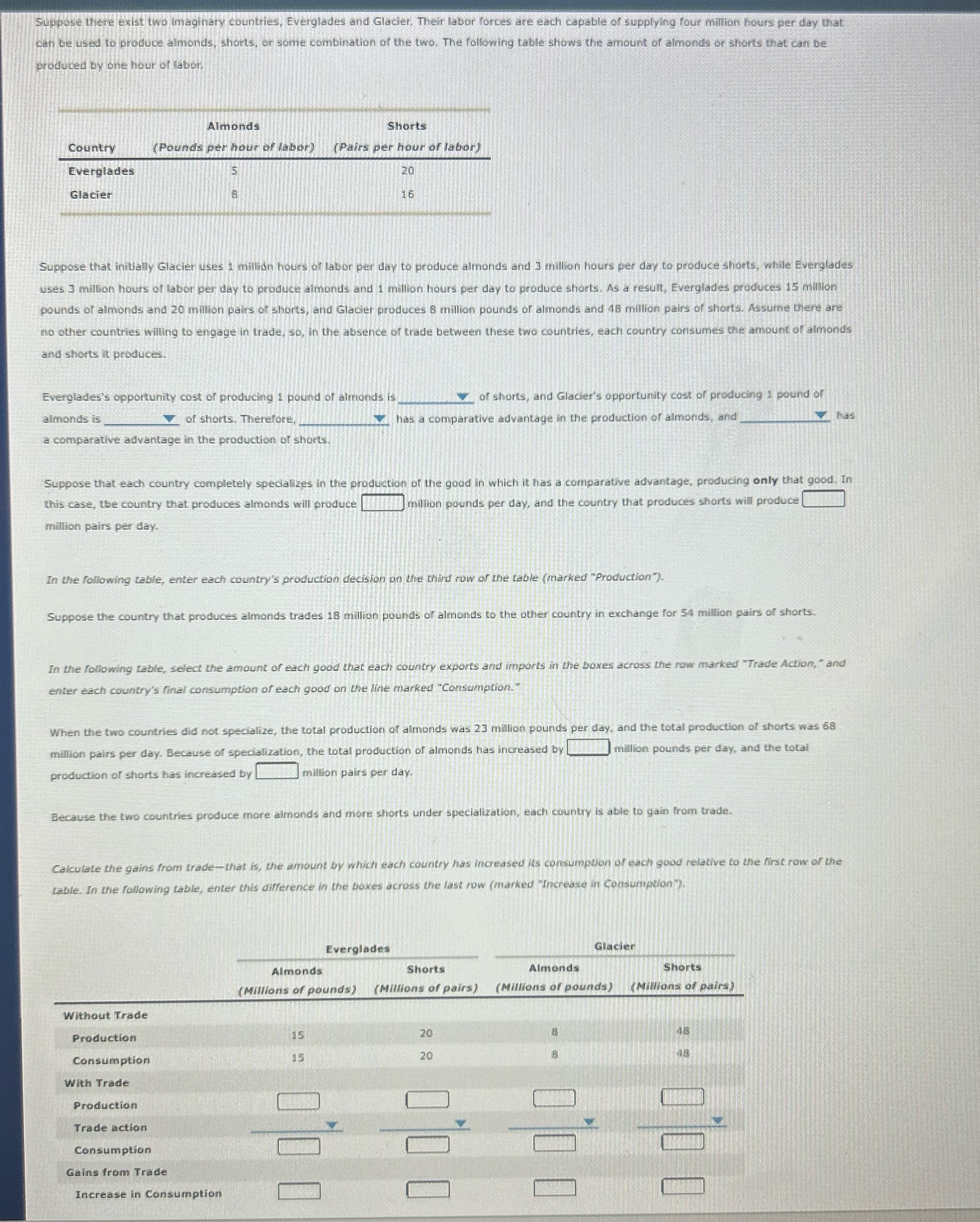
Suppose there exist two imaginary countries, Everglades and Glacier. Their labor forces are each capable of supplying four million hours per day that can be used to produce almonds, shorts, or some combination of the two. The following table shows the amount of almonds or shorts that can be produced by one hour of labor. Almonds Shorts Country Pounds per hour of labor) (Pairs per hour of labor) Everglades 20 Glacier 16 Suppose that initially Glacier uses 1 million hours of labor per day to produce almonds and 3 million hours per day to produce shorts, while Everglades uses 3 million hours of labor per day to produce almonds and 1 million hours per day to produce shorts. As a result, Everglades produces 15 million pounds of almonds and 20 million pairs of shorts, and Glacier produces 8 million pounds of almonds and 48 million pairs of shorts. Assume there are no other countries willing to engage in trade, so, in the absence of trade between these two countries, each country consumes the amount of almonds and shorts it produces. Everglades's opportunity cost of producing i pound of almonds is of shorts, and Glacier's opportunity cost of producing 1 pound of almonds is of shorts. Therefore. Ihas a comparative advantage in the production of almonds, and has a comparative advantage in the production of shorts. Suppose that each country completely specializes in the production of the good in which it has a comparative advantage, producing only that good. In this case, the country that produces almonds will produce IIIIIIill million pounds per day, and the country that produces shorts will produce million pairs per day- In the following table, enter each country's production decision on the third row of the table (marked "Production"). Suppose the country that produces almonds trades 18 million pounds of almonds to the other country in exchange for 54 million pairs of shorts. In the following table, select the mount of each good that each country exports and imports in the boxes across the row marked "Trade Action, " and enter each country's final consumption of each good on the line marked "Consumption." When the two countries did not specialize, the total production of almonds was 23 million pounds per day, and the total production of shorts was 68 million pairs per day. Because of specialization, the total production of almonds has increased by million pounds per day, and the total production of shorts has increased by million pairs per day. Because the two countries produce more almonds and more shorts under specialization, each country is able to gain from trade. Calculate the gains from trade-that is, the amount by which each country has increased its consumption of each good relative to the first row of the Lable. In the following table, enter this difference in the boxes across the last row (marked "Increase in Consumption Everglades Glacier Almonds Shorts Almonds Shorts (Millions of pounds) (Millions of pairs) (Millions of pounds) (Millions of pairs) Without Trade Production 15 20 Consumption 15 20 With Trade Production Trade action Consumption Gains from Trade Increase in Consumption
Step by Step Solution
There are 3 Steps involved in it

Get step-by-step solutions from verified subject matter experts
 Study Help