







Question: Please answer discussion question #12-40 12 CASE 12.2 THE IMPORTANCE OF INTELLECTUAL PROPERTY 437 Protecting Intellectual Property: Elvis's Memory and Intellectual Property Live On Web:
Please answer discussion question #12-40
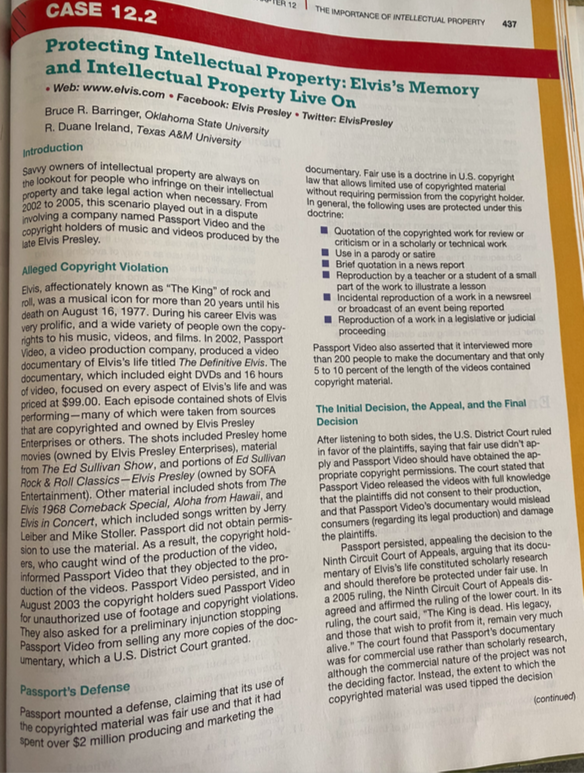
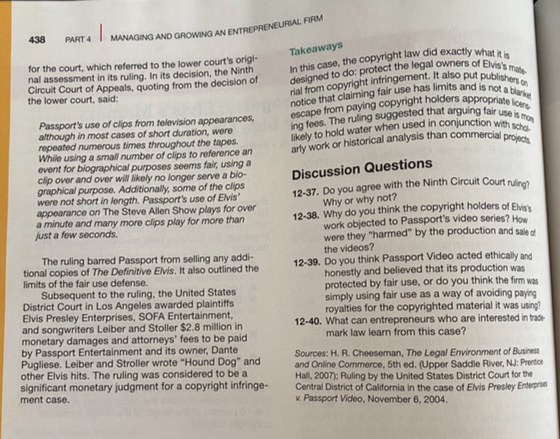
12 CASE 12.2 THE IMPORTANCE OF INTELLECTUAL PROPERTY 437 Protecting Intellectual Property: Elvis's Memory and Intellectual Property Live On Web: www.elvis.com Facebook: Elvis Presley Twitter. Elvis Presley Bruce R. Barringer, Oklahoma State University R. Duane Ireland, Texas A&M University Introduction Savvy owners of intellectual property are always on the lookout for people who infringe on their intellectual property and take legal action when necessary. From 2002 to 2005, this scenario played out in a dispute involving a company named Passport Video and the copyright holders of music and videos produced by the late Elvis Presley Alleged Copyright Violation Elvis, affectionately known as "The King of rock and roll, was a musical icon for more than 20 years until his death on August 16, 1977. During his career Elvis was very prolific, and a wide variety of people own the copy- rights to his music, videos, and films. In 2002, Passport Video, a video production company, produced a video documentary of Elvis's life titled The Definitive Elvis. The documentary, which included eight DVDs and 16 hours of video, focused on every aspect of Elvis's life and was priced at $99.00. Each episode contained shots of Elvis performing-many of which were taken from sources that are copyrighted and owned by Elvis Presley Enterprises or others. The shots included Presley home movies (owned by Elvis Presley Enterprises), material from The Ed Sullivan Show, and portions of Ed Sullivan Rock & Roll Classics - Elvis Presley (owned by SOFA Entertainment). Other material included shots from The Evis 1968 Comeback Special, Aloha from Hawaii, and Elvis in Concert, which included songs written by Jerry Leiber and Mike Stoller. Passport did not obtain permis- documentary. Fair use is a doctrine in U.S. copyright law that allows limited use of copyrighted material without requiring permission from the copyright holder In general, the following uses are protected under this doctrine: Quotation of the copyrighted work for review or criticism or in a scholarly or technical work Use in a parody or satire Brief quotation in a news report Reproduction by a teacher or a student of a small part of the work to illustrate a lesson Incidental reproduction of a work in a newsreel or broadcast of an event being reported Reproduction of a work in a legislative or judicial proceeding Passport Video also asserted that it interviewed more than 200 people to make the documentary and that only 5 to 10 percent of the length of the videos contained copyright material The Initial Decision, the Appeal, and the Final Decision After listening to both sides, the U.S. District Court ruled in favor of the plaintiffs, saying that fair use didn't ap- ply and Passport Video should have obtained the ap- propriate copyright permissions. The court stated that Passport Video released the videos with full knowledge that the plaintiffs did not consent to their production, and that Passport Video's documentary would mislead sion to use the material. As a result, the copyright hold- ers, who caught wind of the production of the video, informed Passport Video that they objected to the pro- duction of the videos. Passport Video persisted, and in August 2003 the copyright holders sued Passport Video for unauthorized use of footage and copyright violations. consumers (regarding its legal production) and damage the plaintiffs. Passport persisted, appealing the decision to the Ninth Circuit Court of Appeals, arguing that its docu- mentary of Elvis's life constituted scholarly research and should therefore be protected under fair use. In a 2005 ruling, the Ninth Circuit Court of Appeals dis- agreed and affirmed the ruling of the lower court. In its ruling, the court said, "The King is dead. His legacy and those that wish to profit from it, remain very much alive." The court found that Passport's documentary was for commercial use rather than scholarly research, although the commercial nature of the project was not the deciding factor. Instead, the extent to which the copyrighted material was used tipped the decision (continued) They also asked for a preliminary injunction stopping Passport Video from selling any more copies of the doc- umentary, which a U.S. District Court granted. Passport's Defense Passport mounted a defense, claiming that its use of the copyrighted material was fair use and that it had Spent over $2 million producing and marketing the 1 438 PART 4 MANAGING AND GROWING AN ENTREPRENEURIAL FIRM Takeaways for the court, which referred to the lower court's origi- nal assessment in its ruling. In its decision, the Ninth Circuit Court of Appeals, quoting from the decision of the lower court, said: Passport's use of clips from television appearances, although in most cases of short duration, were repeated numerous times throughout the tapes. While using a small number of clips to reference an event for biographical purposes seems fair, using a clip over and over will likely no longer serve a bio- graphical purpose. Additionally, some of the clips were not short in length. Passport's use of Elvis' appearance on The Steve Allen Show plays for over a minute and many more clips play for more than just a few seconds. designed to do: protect the legal owners of Elvis's me In this case, the copyright law did exactly what is notice that claiming fair use has limits and is not a barve rial from copyright infringement. It also put publishers escape from paying copyright holders appropriate los Ing fees. The ruling suggested that arguing fair use is likely to hold water when used in conjunction with scho arly work or historical analysis than commercial projects Discussion Questions The ruling barred Passport from selling any addi- tional copies of The Definitive Elvis. It also outlined the limits of the fair use defense. Subsequent to the ruling, the United States District Court in Los Angeles awarded plaintiffs Elvis Presley Enterprises, SOFA Entertainment, and songwriters Leiber and Stoller $2.8 million in monetary damages and attorneys' fees to be paid by Passport Entertainment and its owner, Dante Pugliese. Leiber and Stroller wrote "Hound Dog" and other Elvis hits. The ruling was considered to be a significant monetary judgment for a copyright infringe- ment case. 12-37. Do you agree with the Ninth Circuit Court ruling? Why or why not? 12-38. Why do you think the copyright holders of Elvis work objected to Passport's video series? How were they "harmed by the production and sale of the videos? 12-39. Do you think Passport Video acted ethically and honestly and believed that its production was protected by fair use, or do you think the firm was simply using fair use as a way of avoiding paying royalties for the copyrighted material it was using 12-40. What can entrepreneurs who are interested in trade mark law learn from this case? Sources: H. R. Cheeseman, The Legal Environment of Business and Online Commerce, 5th ed. (Upper Saddle River, NJ: Preto Hall, 2007); Ruling by the United States District Court for the Central District of California in the case of Elvis Presley Enterpro x. Passport Video, November 6, 2004Step by Step Solution
There are 3 Steps involved in it
1 Expert Approved Answer
Step: 1 Unlock

Question Has Been Solved by an Expert!
Get step-by-step solutions from verified subject matter experts
Step: 2 Unlock
Step: 3 Unlock
 Study Help