Question: please answer each question 1) What is a single source of truth? Explain in your own words. You can search the web to enhance your
please answer each question
1) What is a single source of truth? Explain in your own words. You can search the web to enhance your understanding of this topic. In this case, you should cite any key online reference used.
2) Identify and discuss TWO key benefits of a single source of truth to organizations. In your answer, use an example (real or hypothetical) to explain these benefits.
3) There might be risks for organizations seeking to achieve a single source of truth, particularly when changing data governance practices. Identify and discuss TWO risks related to the need for firms to centralize the management and use of data repositories. In your answer, use an example (real or hypothetical) to explain these risks.
Provide at least a paragraph length response to these questions.
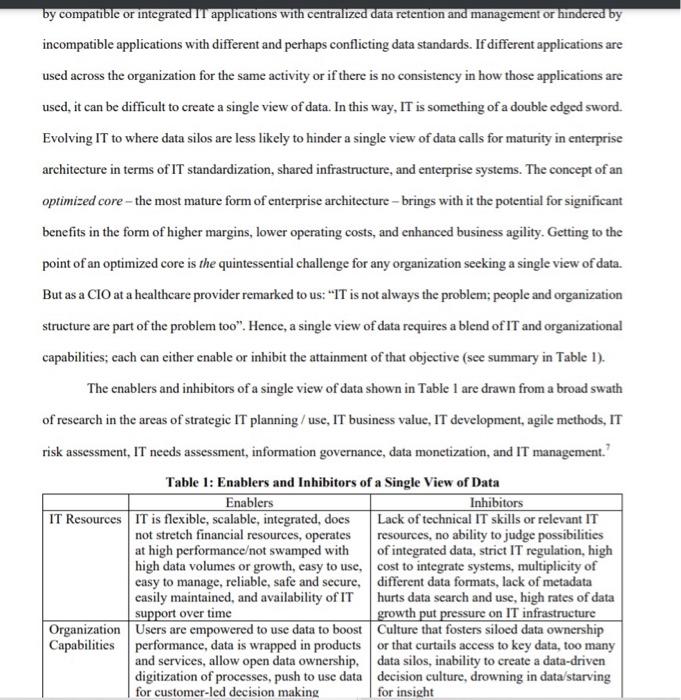
Executive Summary The ability to obtain value from data is contingent on the availability of, and access to quality, reliable data and yet, all too often, data remains locked inside insurmountable data silos. While most organizations aspire to a single source of truth - free of data silos with a culture that welcomes data sharing - many are unaware of how to get there. In this paper, we present results from a survey of 400 organizations across the E.U. and U.S. To assist our analysis, we cluster organizations into three groups according to their level of value from data (low, medium, and high). We then find that organizations with high data value report higher levels of enablers of a single source of truth such as a flexible, scalable, and adaptable IT infrastructure and a culture of open data ownership. These organizations also have higher levels of inhibitors of a single source of truth such as conflicting data formats and a lack of technical skills and yet they succeed in spite of these obstacles. As expected, organizations with lower value from data report fewer enablers but, interestingly, they also report fewer - not more - inhibitors. Organizations with lower value from data may have lofty aspirations for their failure to emphasize key enablers of a single source of truth or their ignorance of key inhibitors is a concern worth noting. We turn these results into a series of prescriptions for organizations seeking to pursue a single source of truth that might allow them to unlock increased value from data. INTRODUCTION Interest in data analytics and its implications for data management has, in the last decade, begun to feature prominently in surveys of information technology (IT) executives.' One such initiative involves the pursuit of a single source of truth or a single view of data, meaning a consistent and integrated view of real time or historical data on customers, products, processes or resources. The opposite of a single view of data is a siloed view of data, one that lacks uniform data definitions or with duplicative and inconsistent versions of the same data. The case of Nestl paying 29 different prices to the same supplier for the same ingredient, due to the use of inconsistent supplier coding in different business units, reveals the potential and challenge for combining data into a single view. Nestl resolved this challenge with a global SAP rollout. However, IT is not the only way to enable or, indeed, to inhibit a single view of data. Organizational factors that speak to a culture of data sharing and data-driven decision making or whose absence fosters mistrust and isolation are likely to further enable or inhibit efforts to create a single view of data beyond technology factors alone. For those who want to excel at using data analytics, a single view of data is a capability that enables relevant, timely, and actionable insights. Without this, managers could base decisions on incomplete or bad data, not unlike Nestl when managers made decisions using data held inside their local silos. Organizations recognize the benefit of a single view of data but often lack awareness of how to reach that objective or the organizational and technological factors that might enable or inhibit progress towards that goal. BENEFITS OF A SINGLE VIEW OF DATA Research increasingly recognizes the strategic value of data and the risks associated with failing to manage data according to its financial, regulatory, reputational or social value. Whether treated as a digital asset that is retained for future use or as input into a short term decision, more data may not always lead to better outcomes - information overload is possible and more data can delay the decision-making process but few would argue that less data or no data is always better. The question as to how a single view of data creates value involves knowing what data to share (relevance), when data might be shared (timeliness), and with whom (accessibility). Knowing when it is appropriate to share data speaks to privacy issues which are of growing importance as managers confront data breaches, financial penalties, and the threat of regulation. If data is relevant, timely, and complete, it is more likely to improve decision outcomes a first order effect) with downstream potential for greater agility, lower costs, and higher margins (all second order effects). A single view of data may also provide IT benefits if organizations are able to curtail IT complexity by avoiding conflicting IT standards or by decreasing costs associated with duplicative data or the need for time consuming data munging. More efficient use of IT resources could allow organizations to invest more resources in strategic possibilities, potentially allowing organizations to scale up faster if slack IT resources can be deployed at short notice (extra data storage or processor capacity, for example)." But for IT to achieve this degree of effectiveness, there may be a need for complementary IT and organizational capabilities. DATA SHARING: A RESOURCE AND CAPABILITIES VIEW Data sharing is at the heart of a single view of data. Data is generated in a decentralized manner by distributed or standalone applications, unless the organization uses a centralized system in which case, data may be more standardized and consistent. It is not uncommon for organizations to accumulate hundreds of bespoke and home-grown applications. Duplicate applications, often due to M&A activity, are not unusual, and are a primary cause of data silos. The ability to combine data into a single view may, as such, be enabled by compatible or integrated Il applications with centralized data retention and management or hindered by incompatible applications with different and perhaps conflicting data standards. If different applications are used across the organization for the same activity or if there is no consistency in how those applications are used, it can be difficult to create a single view of data. In this way, IT is something of a double edged sword. Evolving IT to where data silos are less likely to hinder a single view of data calls for maturity in enterprise architecture in terms of IT standardization, shared infrastructure, and enterprise systems. The concept of an optimized core - the most mature form of enterprise architecture brings with it the potential for significant benefits in the form of higher margins, lower operating costs, and enhanced business agility. Getting to the point of an optimized core is the quintessential challenge for any organization seeking a single view of data. But as a CIO at a healthcare provider remarked to us: "It is not always the problem; people and organization structure are part of the problem too". Hence, a single view of data requires a blend of IT and organizational capabilities; cach can either enable or inhibit the attainment of that objective (see summary in Table 1). The enablers and inhibitors of a single view of data shown in Table I are drawn from a broad swath of research in the areas of strategic IT planning /use, IT business value, IT development, agile methods, IT risk assessment, IT needs assessment, information governance, data monetization, and IT management. Table 1: Enablers and Inhibitors of a Single View of Data Enablers Inhibitors IT Resources IT is flexible, scalable, integrated, does Lack of technical IT skills or relevant IT not stretch financial resources, operates resources, no ability to judge possibilities at high performanceot swamped with of integrated data, strict IT regulation, high high data volumes or growth, easy to use, cost to integrate systems, multiplicity of casy to manage, reliable, safe and secure, different data formats, lack of metadata easily maintained, and availability of IT hurts data search and use, high rates of data support over time growth put pressure on IT infrastructure Organization Users are empowered to use data to boost Culture that fosters siloed data ownership Capabilities performance, data is wrapped in products or that curtails access to key data, too many and services, allow open data ownership. data silos, inability to create a data-driven digitization of processes, push to use data decision culture, drowning in data/starving for customer-led decision making for insight









 Study Help