Question: PLEASE ANSWER EACH QUESTION IN ONE TO TWO PARAGRAPHS (AT LEAST FIVE SENTENCES). Help 1: part 1: Access the Executive Summary of COSO Internal Control-
PLEASE ANSWER EACH QUESTION IN ONE TO TWO PARAGRAPHS (AT LEAST FIVE SENTENCES).
Help 1:
part 1: Access the Executive Summary of COSO Internal Control- Integrated Framework from www.COSO.Org and answer the following:
1) What do you understand by the term 'Internal Control'? Explain in your own words. 2) Discuss the five components of internal control under the COSO framework.
3)Under which component does commitment to integrity and ethical values fall and how is such commitment established or demonstrated?
Part 2:
1) Discuss the 'Twelve Questions Model for Ethical Decision Making' listed therein.
Explain each question in own words.
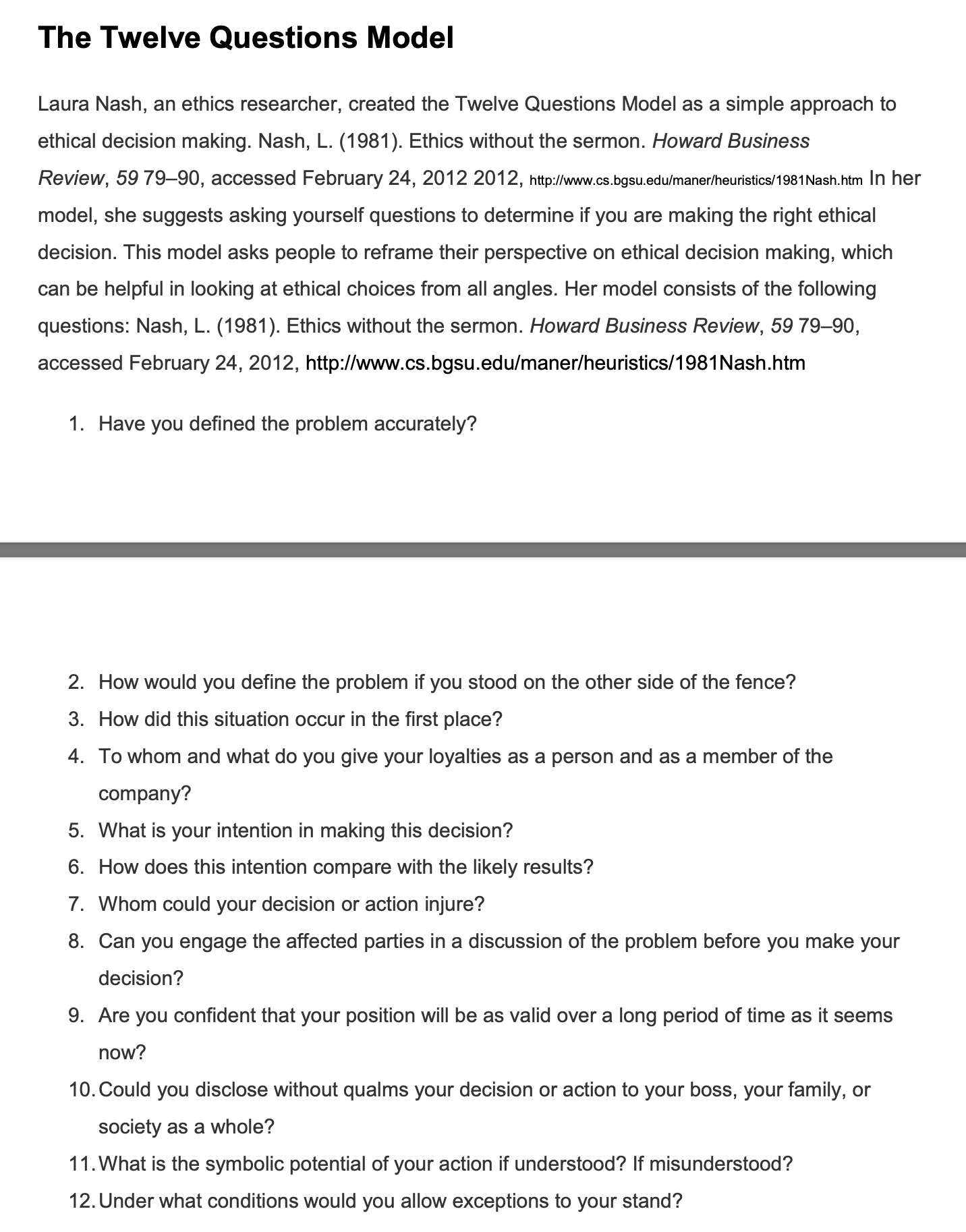
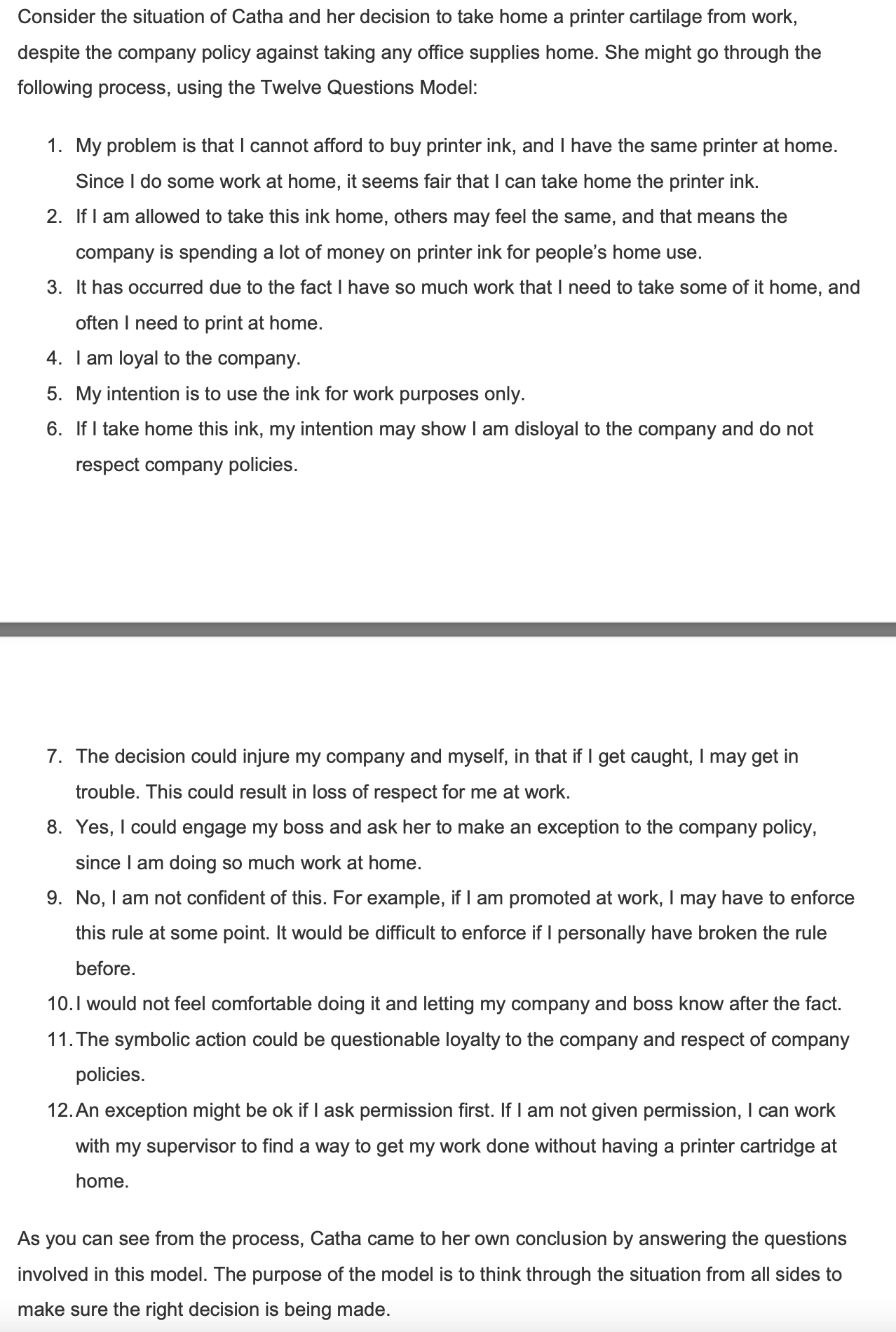
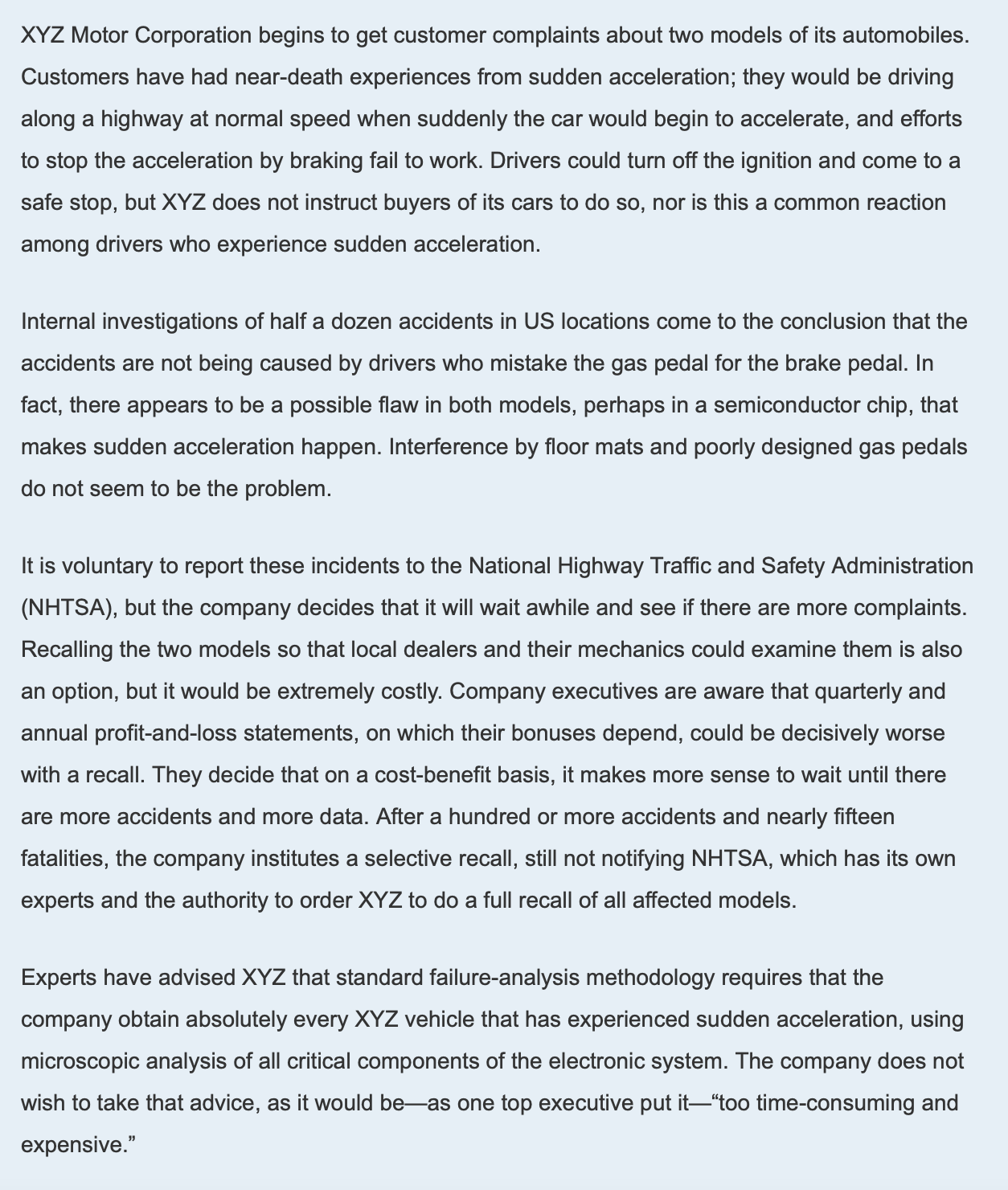
The Twelve Questions Model Laura Nash, an ethics researcher, created the Twelve Questions Model as a simple approach to ethical decision making. Nash, L. (1981). Ethics without the sermon. Howard Business Review, 59 7990, accessed February 24, 2012 2012, http:iiwww.cs.bgsu.eduimaneriheuristicsi1981Nash.htm In her model, she suggests asking yourself questions to determine if you are making the right ethical decision. This model asks people to reframe their perspective on ethical decision making, which can be helpful in looking at ethical choices from all angles. Her model consists of the following questions: Nash, L. (1981). Ethics without the sermon. Howard Business Review, 59 7990, accessed February 24, 2012, http:ilwww.cs.bgsu.eduimanerlheuristicsi'i981Nash.htm 1. Have you dened the problem accurately? 2. How would you define the problem if you stood on the other side of the fence? 3. How did this situation occur in the rst place? :P" To whom and what do you give your loyalties as a person and as a member of the company? What is your intention in making this decision? How does this intention compare with the likely results? Whom could your decision or action injure? 939.\" Can you engage the affected parties in a discussion of the problem before you make your decision? 9. Are you condent that your position will be as valid over a long period of time as it seems now? 10.Cou|d you disclose without qualms your decision or action to your boss, your family, or society as a whole? 11.What is the symbolic potential of your action if understood? If misunderstood? 12. Under what conditions would you allow exceptions to your stand? Consider the situation of Catha and her decision to take home a printer cartilage from work, despite the company policy against taking any office supplies home. She might go through the following process, using the Twelve Questions Model: 1. My problem is that I cannot afford to buy printer ink, and l have the same printer at home. Since I do some work at home, it seems fair that I can take home the printer ink. 2. If I am allowed to take this ink home, others may feel the same, and that means the company is spending a lot of money on printer ink for people's home use. 3. It has occurred due to the fact I have so much work that I need to take some of it home, and often I need to print at home. 4. I am loyal to the company. 5. My intention is to use the ink for work purposes only. 6. If I take home this ink, my intention may show I am disloyal to the company and do not respect company policies. 7. The decision could injure my company and myself, in that if I get caught, I may get in trouble. This could result in loss of respect for me at work. 8. Yes, I could engage my boss and ask her to make an exception to the company policy, since I am doing so much work at home. 9. No, I am not confident of this. For example, if I am promoted at work, I may have to enforce this rule at some point. It would be difficult to enforce if I personally have broken the rule before. 10.| would not feel comfortable doing it and letting my company and boss know after the fact. 11.The symbolic action could be questionable loyalty to the company and respect of company policies. 12.An exception might be ok if I ask permission rst. If I am not given permission, I can work with my supervisor to find a way to get my work done without having a printer cartridge at home. As you can see from the process, Catha came to her own conclusion by answering the questions involved in this model. The purpose of the model is to think through the situation from all sides to make sure the right decision is being made. XYZ Motor Corporation begins to get customer complaints about two models of its automobiles. Customers have had near-death experiences from sudden acceleration; they would be driving along a highway at normal speed when suddenly the car would begin to accelerate, and efforts to stop the acceleration by braking fail to work. Drivers could turn off the ignition and come to a safe stop, but XYZ does not instruct buyers of its cars to do so, nor is this a common reaction among drivers who experience sudden acceleration. Internal investigations of half a dozen accidents in US locations come to the conclusion that the accidents are not being caused by drivers who mistake the gas pedal for the brake pedal. In fact, there appears to be a possible aw in both models, perhaps in a semiconductor chip, that makes sudden acceleration happen. Interference by oor mats and poorly designed gas pedals do not seem to be the problem. It is voluntary to report these incidents to the National Highway Trafc and Safety Administration (NHTSA), but the company decides that it will wait awhile and see if there are more complaints. Recalling the two models so that local dealers and their mechanics could examine them is also an option, but it would be extremely costly. Company executives are aware that quarterly and annual prot-and-loss statements, on which their bonuses depend, could be decisively worse with a recall. They decide that on a cost-benet basis, it makes more sense to wait until there are more accidents and more data. After a hundred or more accidents and nearly fteen fatalities, the company institutes a selective recall, still not notifying NHTSA, which has its own experts and the authority to order XYZ to do a full recall of all affected models. Experts have advised XYZ that standard failure-analysis methodology requires that the company obtain absolutely every XYZ vehicle that has experienced sudden acceleration, using microscopic analysis of all critical components of the electronic system. The company does not wish to take that advice, as it would beas one top executive put it\"too time-consuming and expensive."
Step by Step Solution
There are 3 Steps involved in it
1 Expert Approved Answer
Step: 1 Unlock
Question Has Been Solved by an Expert!
Get step-by-step solutions from verified subject matter experts
Step: 2 Unlock
Step: 3 Unlock
Students Have Also Explored These Related Accounting Questions!









 Study Help