







Question: Please answer each question. Question 4A. Once again, a particle travels at velocity |t'l| at time t. Divide the time interval [0,2] into 2k intervals
Please answer each question.
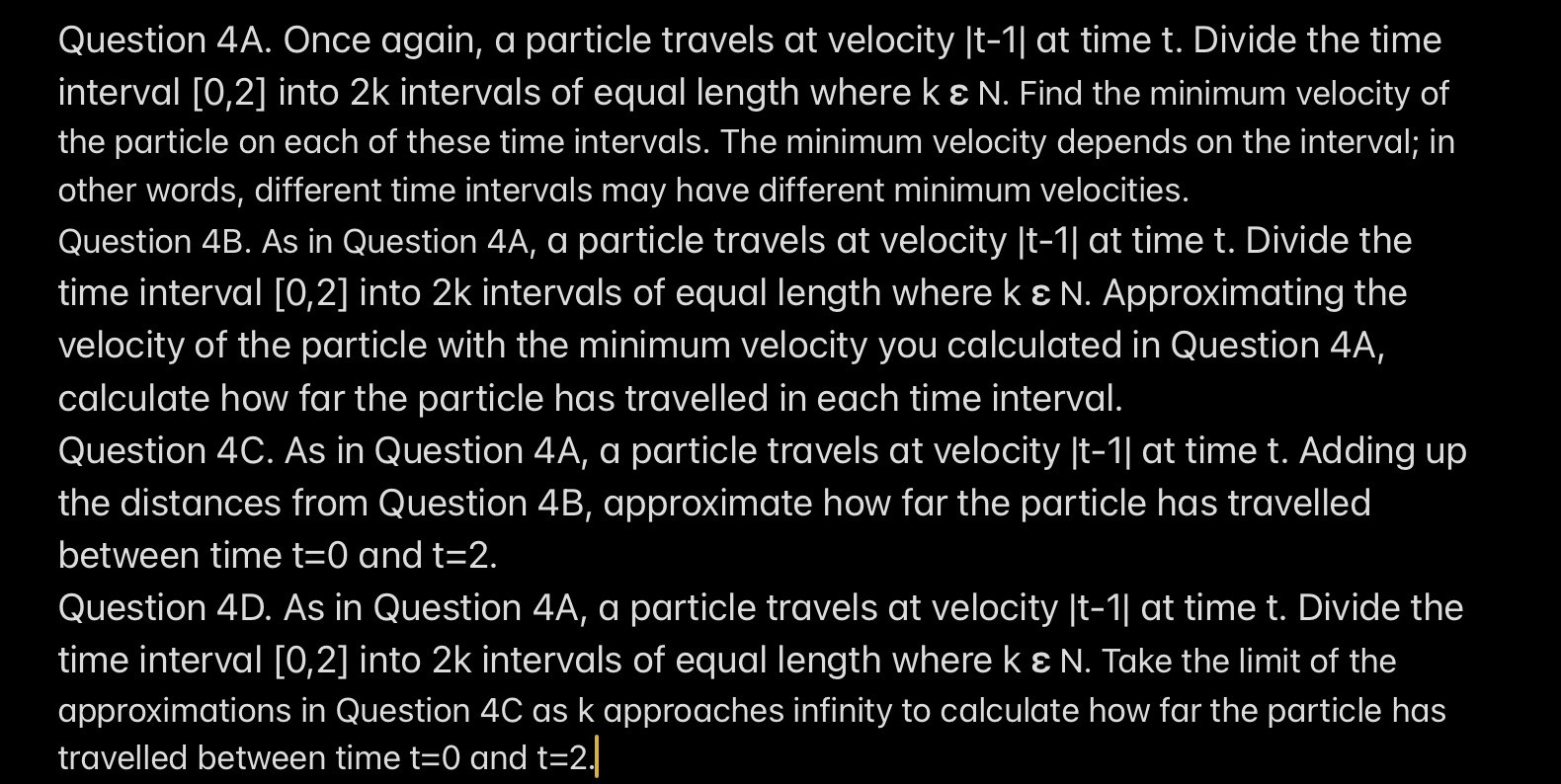
Question 4A. Once again, a particle travels at velocity |t'l| at time t. Divide the time interval [0,2] into 2k intervals of equal length where k e N. Find the minimum velocity of the particle on each of these time intervals. The minimum velocity depends on the interval; in other words, different time intervals may have different minimum velocities. Question 48. As in Question 4A, a particle travels at velocity |t'l| at time t. Divide the time interval [0,2] into 2k intervals of equal length where k e N. Approximating the velocity of the particle with the minimum velocity you calculated in Question 4A, calculate how far the particle has travelled in each time interval. Question 4C. As in Question 4A, a particle travels at velocity |t'l| at time t. Adding up the distances from Question 48, approximate how far the particle has travelled between time t=0 and t:2. Question 4D. As in Question 4A, a particle travels at velocity |t'l| at time t. Divide the time interval [0,2] into 2k intervals of equal length where k a N. Take the limit of the approximations in Question 40 as k approaches infinity to calculate how far the particle has travelled between time t:0 and t:2
Step by Step Solution
There are 3 Steps involved in it

Get step-by-step solutions from verified subject matter experts
 Study Help