Question: Please answer each question with two paragraphs. Type each answer SEZs on the coast, the need for new transportation facilities first step in expanding public
Please answer each question with two paragraphs. Type each answer
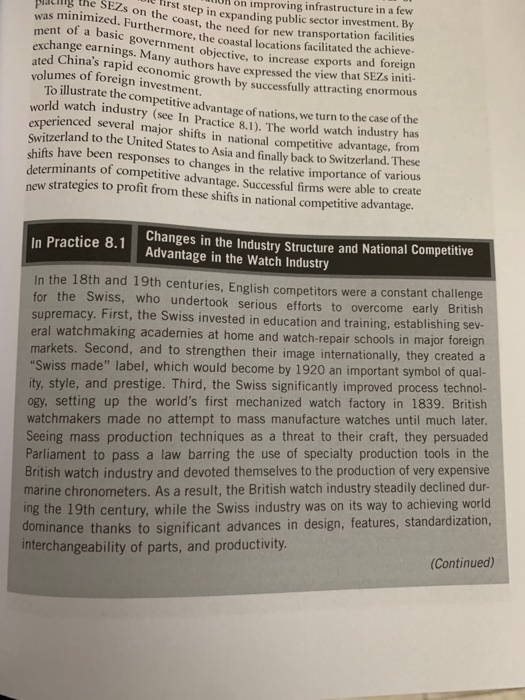
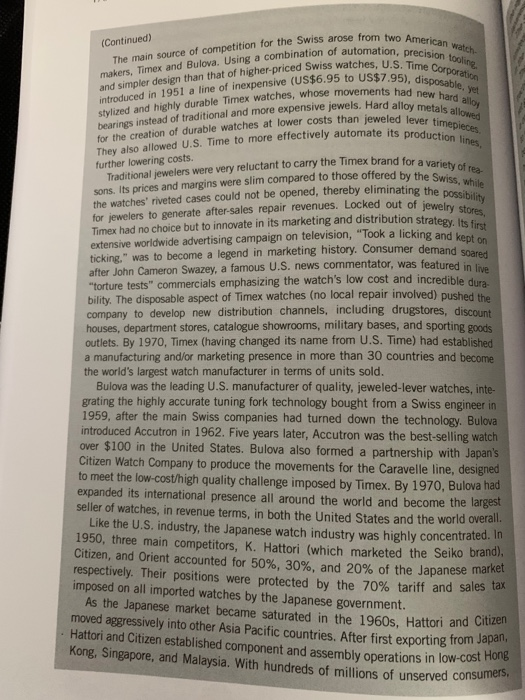
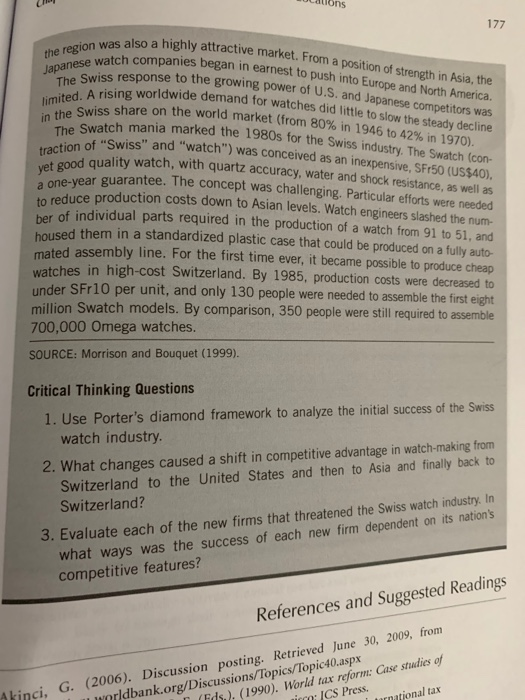
SEZs on the coast, the need for new transportation facilities first step in expanding public sector investment. By minimized. Furthermore, the coastal locations facilitated the achieve ment of a basic government objective, exchange earnings. Many authors have expressed the view that SEZs initi- ated China's rapid economic growth by successfully attracting enormous volumes of foreign investment. To illustrate the competitive advantage of nations, we turn to the case of the placing was on improving infrastructure in a few to increase exports and foreign world watch industry (see In Practice 8.1). The world watch industry has experienced several major shifts in national competitive advantage, from Switzerland to the United States to Asia and finally back to Switzerland. These shifts have been responses to changes in the relative importance of various determinants of competitive advantage. Successful firms were able to create new strategies to profit from these shifts in national competitive advantage. In Practice 8.1 Changes in the Industry Structure and National Competitive Advantage in the Watch Industry In the 18th and 19th centuries, English competitors were a constant challenge for the Swiss, who undertook serious efforts to overcome early British supremacy. First, the Swiss invested in education and training, establishing sev- eral watchmaking academies at home and watch-repair schools in major foreign markets. Second, and to strengthen their image internationally, they created a "Swiss made" label, which would become by 1920 an important symbol of qual- ity, style, and prestige. Third, the Swiss significantly improved process technol- ogy, setting up the world's first mechanized watch factory in 1839. British watchmakers made no attempt to mass manufacture watches until much later. Seeing mass production techniques as a threat to their craft, they persuaded Parliament to pass a law barring the use of specialty production tools in the British watch industry and devoted themselves to the production of very expensive marine chronometers. As a result, the British watch industry steadily declined dur- ing the 19th century, while the Swiss industry was on its way to achieving world dominance thanks to significant advances in design, features, standardization, interchangeability of parts, and productivity. (Continued) The main source of competition for the Swiss arose from two American watch- makers, Timex and Bulova. Using a combination of automation, precision tooling and simpler design than that of higher-priced Swiss watches, U.S. Time Corporation stylized and highly durable Timex watches, whose movements had new hard alloy introduced in 1951 a line of inexpensive (US$6.95 to US$7.95), disposable, yet bearings instead of traditional and more expensive jewels. Hard alloy metals allowed for the creation of durable watches at lower costs than jeweled lever timepieces They also allowed U.S. Time to more effectively automate its production lines, Traditional jewelers were very reluctant to carry the Timex brand for a variety of res sons. Its prices and margins were slim compared to those offered by the Swiss, while for jewelers to generate after-sales repair revenues. Locked out of jewelry stores, the watches' riveted cases could not be opened, thereby eliminating the possibility (Continued) further lowering costs. Kong, Singapore, and Malaysia. With hundreds of millions of unserved consumers, Timex had no choice but to innovate in its marketing and distribution strategy. Its firy extensive worldwide advertising campaign on television, "Took a licking and kept on ticking." was to become a legend in marketing history. Consumer demand soared after John Cameron Swazey, a famous U.S. news commentator, was featured in live "torture tests" commercials emphasizing the watch's low cost and incredible dura. bility. The disposable aspect of Timex watches (no local repair involved) pushed the company to develop new distribution channels, including drugstores, discount houses, department stores, catalogue showrooms, military bases, and sporting goods outlets. By 1970, Timex (having changed its name from U.S. Time) had established a manufacturing and/or marketing presence in more than 30 countries and become the world's largest watch manufacturer in terms of units sold. Bulova was the leading U.S. manufacturer of quality, jeweled-lever watches, inte- grating the highly accurate tuning fork technology bought from a Swiss engineer in 1959, after the main Swiss companies had turned down the technology. Bulova introduced Accutron in 1962. Five years later, Accutron was the best-selling watch over $100 in the United States. Bulova also formed a partnership with Japan's Citizen Watch Company to produce the movements for the Caravelle line, designed to meet the low-cost/high quality challenge imposed by Timex. By 1970, Bulova had expanded its international presence all around the world and become the largest seller of watches, in revenue terms, in both the United States and the world overall. Like the U.S. industry, the Japanese watch industry was highly concentrated. In 1950, three main competitors, K. Hattori (which marketed the Seiko brand), Citizen, and Orient accounted for 50%, 30%, and 20% of the Japanese market respectively. Their positions were protected by the 70% tariff and sales tax As the Japanese market became saturated in the 1960s, Hattori and Citizen moved aggressively into other Asia Pacific countries. After first exporting from Japan, imposed on all imported watches by the Japanese government. Hattori and Citizen established component and assembly operations in low-cost Hong the region was also a highly attractive market. From a position of strength in Asia, the Japanese watch companies began in earnest to push into Europe and North America. limited. A rising worldwide demand for watches did little to slow the steady decline The Swiss response to the growing power of U.S. and Japanese competitors was in the Swiss share on the world market (from 80% in 1946 to 42% in 1970). The Swatch mania marked the 1980s for the Swiss industry. The Swatch (con- traction of "Swiss" and "watch") was conceived as an inexpensive, SFr50 (US$40). yet good quality watch, with quartz accuracy, water and shock resistance, as well as a one-year guarantee. The concept was challenging. Particular efforts were needed 177 to reduce production costs down to Asian levels. Watch engineers slashed the num- ber of individual parts required in the production of a watch from 91 to 51, and housed them in a standardized plastic case that could be produced on a fully auto- mated assembly line. For the first time ever, it became possible to produce cheap watches in high-cost Switzerland. By 1985, production costs were decreased to under SFr10 per unit, and only 130 people were needed to assemble the first eight million Swatch models. By comparison, 350 people were still required to assemble 700,000 Omega watches. SOURCE: Morrison and Bouquet (1999). Critical Thinking Questions 1. Use Porter's diamond framework to analyze the initial success of the Swiss watch industry. 2. What changes caused a shift in competitive advantage in watch-making from Switzerland to the United States and then to Asia and finally back to Switzerland? 3. Evaluate each of the new firms that threatened the Swiss watch industry. In what ways was the success of each new firm dependent on its nation's competitive features? References and Suggested Readings Akinci, G. (2006). Discussion posting. Retrieved June 30, 2009, from worldbank.org/Discussions/Topics/Topic40.aspx Fids (1990). World tax reform: Case studies of ir: ICS Press. arnational tax









 Study Help