







Question: Please answer every question in depth. I will appretiate it is you can as specific as possible. Thank you for answering my question. APPLICATIONS Improving
Please answer every question in depth. I will appretiate it is you can as specific as possible. Thank you for answering my question. 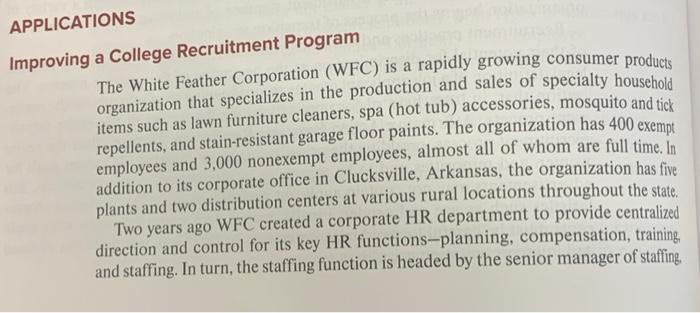
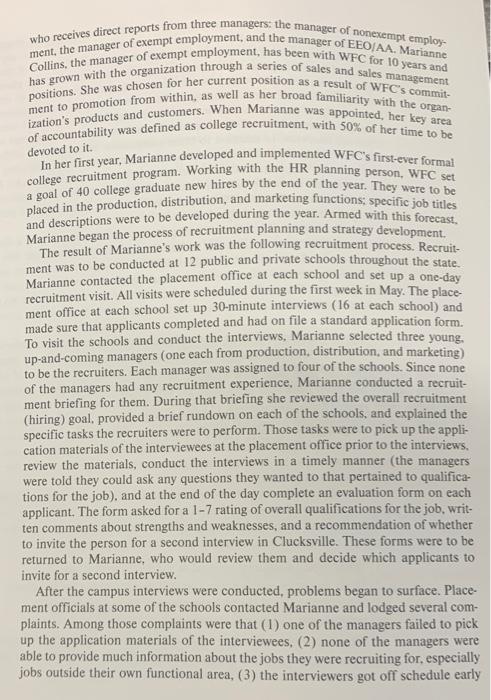
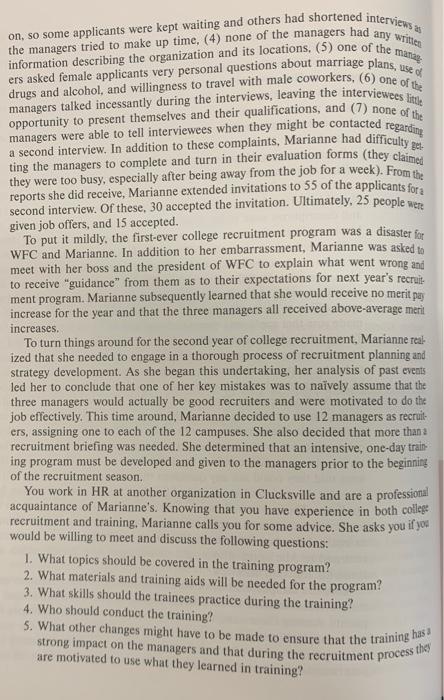
APPLICATIONS Improving a College Recruitment Program The White Feather Corporation (WFC) is a rapidly growing consumer products organization that specializes in the production and sales of specialty household items such as lawn furniture cleaners, spa (hot tub) accessories, mosquito and tick repellents, and stain-resistant garage floor paints. The organization has 400 exempt employees and 3,000 nonexempt employees, almost all of whom are full time. In addition to its corporate office in Clucksville, Arkansas, the organization has five plants and two distribution centers at various rural locations throughout the state. Two years ago WFC created a corporate HR department to provide centralized direction and control for its key HR functions--planning, compensation, training, and staffing. In turn, the staffing function is headed by the senior manager of staffing devoted to it. who receives direct reports from three managersthe manager of nonexempt employ ment, the manager of exempt employment, and the manager of EEOJAA. Marianne Collins, the manager of exempt employment, has been with WFC for 10 years and has grown with the organization through a series of sales and sales management ment to promotion from within, as well as her broad familiarity with the organ- positions. She was chosen for her current position as a result of WFC's commit ization's products and customers. When Marianne was appointed, her key area of accountability was defined as college recruitment, with 50% of her time to be college recruitment program. Working with the HR planning person, WFC set In her first year, Marianne developed and implemented WFC's first-ever formal a goal of 40 college graduate new hires by the end of the year. They were to be placed in the production, distribution, and marketing functions, specific job titles and descriptions were to be developed during the year. Armed with this forecast Marianne began the process of recruitment planning and strategy development The result of Marianne's work was the following recruitment process. Recruit- ment was to be conducted at 12 public and private schools throughout the state. Marianne contacted the placement office at each school and set up a one-day recruitment visit. All visits were scheduled during the first week in May. The place ment office at each school set up 30-minute interviews (16 at each school) and made sure that applicants completed and had on file a standard application form. To visit the schools and conduct the interviews, Marianne selected three young up-and-coming managers (one each from production, distribution, and marketing) to be the recruiters. Each manager was assigned to four of the schools. Since none of the managers had any recruitment experience, Marianne conducted a recruit- ment briefing for them. During that briefing she reviewed the overall recruitment (hiring) goal, provided a brief rundown on each of the schools, and explained the specific tasks the recruiters were to perform. Those tasks were to pick up the appli- cation materials of the interviewees at the placement office prior to the interviews review the materials, conduct the interviews in a timely manner (the managers were told they could ask any questions they wanted to that pertained to qualifica- tions for the job), and at the end of the day complete an evaluation form on each applicant. The form asked for a 1-7 rating of overall qualifications for the job, writ- ten comments about strengths and weaknesses, and a recommendation of whether to invite the person for a second interview in Clucksville. These forms were to be returned to Marianne, who would review them and decide which applicants to invite for a second interview, After the campus interviews were conducted, problems began to surface. Place- ment officials at some of the schools contacted Marianne and lodged several com- plaints. Among those complaints were that (1) one of the managers failed to pick up the application materials of the interviewees, (2) none of the managers were able to provide much information about the jobs they were recruiting for, especially jobs outside their own functional area, (3) the interviewers got off schedule early on, so some applicants were kept waiting and others had shortened interviews as information describing the organization and its locations, (5) one of the manag the managers tried to make up time, (4) none of the managers had any written ers asked female applicants very personal questions about marriage plans, use of drugs and alcohol, and willingness to travel with male coworkers. (6) one of the managers talked incessantly during the interviews, leaving the interviewees little managers were able to tell interviewees when they might be contacted regarding a second interview. In addition to these complaints, Marianne had difficulty met ting the managers to complete and turn in their evaluation forms (they claimed they were too busy, especially after being away from the job for a week). From the reports she did receive, Marianne extended invitations to 55 of the applicants for second interview. Of these, 30 accepted the invitation. Ultimately, 25 people were given job offers, and 15 accepted. To put it mildly, the first-ever college recruitment program was a disaster for WFC and Marianne. In addition to her embarrassment, Marianne was asked to meet with her boss and the president of WFC to explain what went wrong and to receive "guidance from them as to their expectations for next year's recruit ment program. Marianne subsequently learned that she would receive no merit pas increase for the year and that the three managers all received above average meril increases. To turn things around for the second year of college recruitment, Marianne real ized that she needed to engage in a thorough process of recruitment planning and strategy development. As she began this undertaking, her analysis of past events led her to conclude that one of her key mistakes was to naively assume that the three managers would actually be good recruiters and were motivated to do the job effectively. This time around, Marianne decided to use 12 managers as recruit ers, assigning one to each of the 12 campuses. She also decided that more than a recruitment briefing was needed. She determined that an intensive, one-day train ing program must be developed and given to the managers prior to the beginning of the recruitment season. You work in HR at another organization in Clucksville and are a professional acquaintance of Marianne's. Knowing that you have experience in both college recruitment and training, Marianne calls you for some advice. She asks you if you would be willing to meet and discuss the following questions: 1. What topics should be covered in the training program? 2. What materials and training aids will be needed for the program? 3. What skills should the trainees practice during the training? 4. Who should conduct the training? 5. What other changes might have to be made to ensure that the training has strong impact on the managers and that during the recruitment process the are motivated to use what they learned in training Step by Step Solution
There are 3 Steps involved in it
1 Expert Approved Answer
Step: 1 Unlock

Question Has Been Solved by an Expert!
Get step-by-step solutions from verified subject matter experts
Step: 2 Unlock
Step: 3 Unlock
 Study Help