







Question: Please answer exercise 4. Write legibly. Use Lemma 13.15 that is at the top of the page. 146 Chapter 2. Sets , Functions , and
Please answer exercise 4. Write legibly. Use Lemma 13.15 that is at the top of the page.
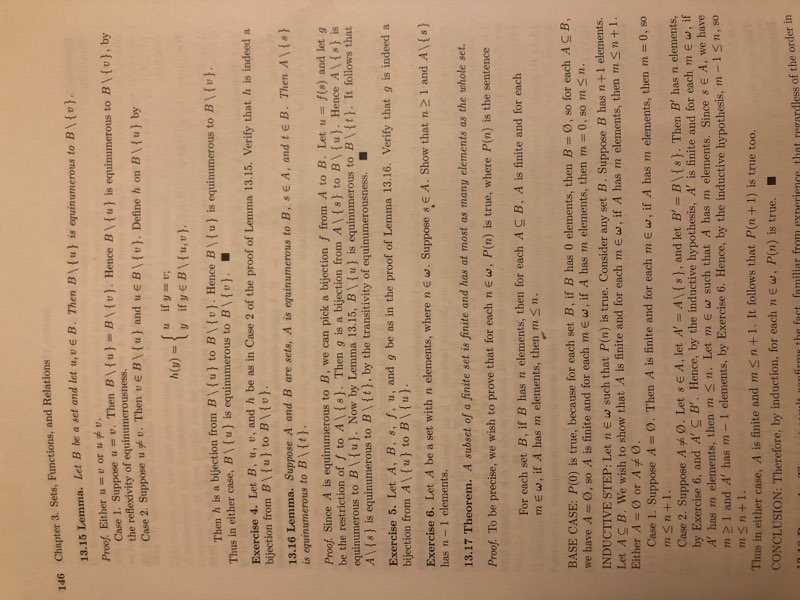
146 Chapter 2. Sets , Functions , and Relations* 12.15 Lemma . Let & & a set and let `. WEB. Then BI ( * ) is Equinumerous to BY ful . Proof. Either " E " Or " # V . CASE 1 . Suppose " = V . Then Bilal . BY 1 0 1. Hence { } { ` ] is equinumerous to &" ful , by the reflexivity of equinumerousness . Case ?. Suppose " # ` . Then WE BY / { } and HE BY 1 41 . Define ` on BY ( a ) by ly if NE BY 1 0 , 0 1 . Then A is a bijection from BY ( a ) to BY ful . Hence BY ( " ) is Equinumerous to BY / { } . Thing in either case , &" ( " ) Is Equinumerous to $1 1 0). !` Exercise 1. Let &. ", " , and to be as in Case I of the proof of Lemma 12.15 . Verify that it is indeed a binjection from BY Lut to BY 1 07 .` 13. 16 Lemma . Suppose A and B are sets , A is equinumerous to B. SEA, and LEE. Then A ^ ^ ^ ^ Is Equinumerous to BY fit .` Proof . Since A is equinumerous to B , we can pick a bijection } from A to B . Let " = $(s) and let `` be the restriction of } to 1 1 (`]. Then I is a bijection from A$ 1= 1 to BY ful. Hence Al ( s ) is equinumerous to &! ( 4). Now by Lemma 13. 15. BY 1 { } is Equinumerous to $ 1 1 1]. It follows that All of is equinumerous to &! It), by the transitivity of equinumerousness . Exercise S . Let A, B, &. I. " , and If he is in the proof of Lemma 13. 16 . Verify that & is indeed a` bijection From A $ 1 4 1 10 BY ``] .` Exercise G . Let A be a set with A elements , where NEW. Suppose & EA. Show that no > I and A$ 1 8 } ling 12 - 1 clements .` 13. 17 Theorem . A subset of a finite set is finite and line at most as many elements as the whole set. Proof. To be precise , we wish to prove that for each NEW . Flaj is true , where Flail is the sentence* For each set. B. if & has It elements , then for each A [ B. A is finite and for each TH Ew , if A has in elements , then mis !. . BASE CASE : Flo'; is true , because for each set B, if B has I elements , then B = O, so for each A { {` we have A = O, so* is finite and for each MEW , if A has in elements , then in = 1. 80 m { n . INDUCTIVE STEP : Let " Ew such that Fin) is true . Consider any set B. Suppose B has n + 1 elements . Let A [ B . We wish to show that A is finite and for each m Ew, if A has in elements , then m { n + 1 . Either A = O or A * 0. Case 1. Suppose A = Q . Then A is finite and for each in Ew, if A has in elements , then m = O. ` m s n + 1 . CASE 2. Suppose* $ 0. Let SEA, let AN' _ All`], and let {" = BY 1{ }. Then I" has no clements. by Exercise &, and *' CE". Hence , by the inductive hypothesis , A' is finite and for each m Ew , it A " has m elements , then i S 1 . Let ME w such that A has in elements . Since & E A, we have* M . I and A' has m - 1 elements , by Exercise &. Hence , by the inductive hypothesis , m - 1 5 M . ` m s n + 1 . This in either case , A is Finite and in { ~ + 1 . It follows that Pin + 1 ) is true too . CONCLUSION : Therefore . by induction , for each NEW . Play is true . { ` PES of the order in
Step by Step Solution
There are 3 Steps involved in it

Get step-by-step solutions from verified subject matter experts
 Study Help