







Question: Please , Answer for question (3) only (use adjacency list) using this code that was done for question 2: #include #include using namespace std; struct
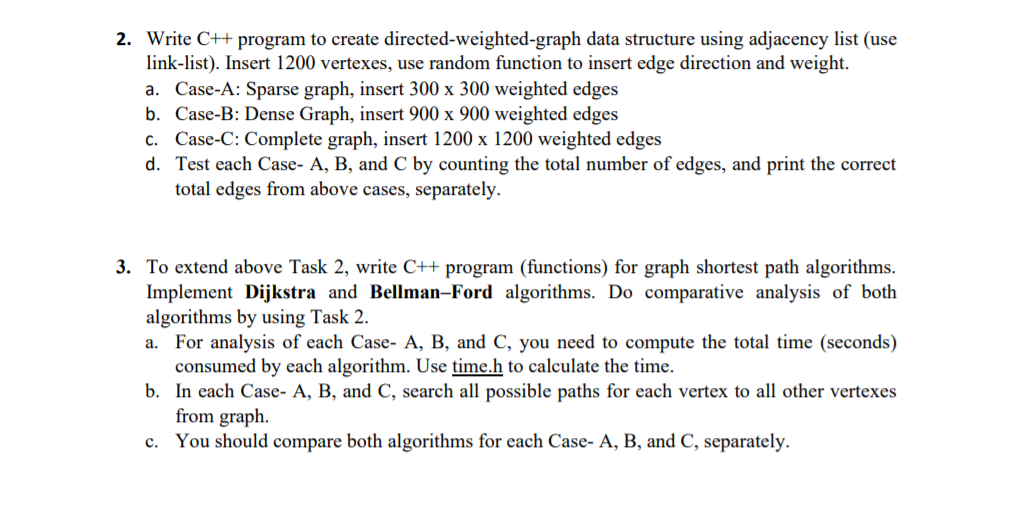
Please , Answer for question (3) only (use adjacency list) using this code that was done for question 2:
#include
newNode->next = head; return newNode; } int N; public: Node **head; Graph(edge edges[], int n, int N) { head = new Node*[N](); this->N = N; for (int i = 0; i
//Case A: int main(){ edge edges[300]; for(int i=0;i
int main(){ edge edges[900]; for(int i=0;i
//Case C:
int main(){ edge edges[1200]; for(int i=0;i 2. Write C++ program to create directed-weighted-graph data structure using adjacency list (use link-list). Insert 1200 vertexes, use random function to insert edge direction and weight. a. Case-A: Sparse graph, insert 300 x 300 weighted edges b. Case-B: Dense Graph, insert 900 x 900 weighted edges C. Case-C: Complete graph, insert 1200 x 1200 weighted edges d. Test each Case- A, B, and C by counting the total number of edges, and print the correct total edges from above cases, separately. 3. To extend above Task 2, write C++ program (functions) for graph shortest path algorithms. Implement Dijkstra and Bellman-Ford algorithms. Do comparative analysis of both algorithms by using Task 2. a. For analysis of each Case- A, B, and C, you need to compute the total time (seconds) consumed by each algorithm. Use time.h to calculate the time. b. In each Case- A, B, and C, search all possible paths for each vertex to all other vertexes from graph. You should compare both algorithms for each Case- A, B, and C, separately. c
Step by Step Solution
There are 3 Steps involved in it

Get step-by-step solutions from verified subject matter experts
 Study Help