







Question: please answer fully! Problem 4 (Covered In Recitation) Suppose Roger has tastes for tennis racquets ((13) and tennis balls ((13) described by the utility function
please answer fully!
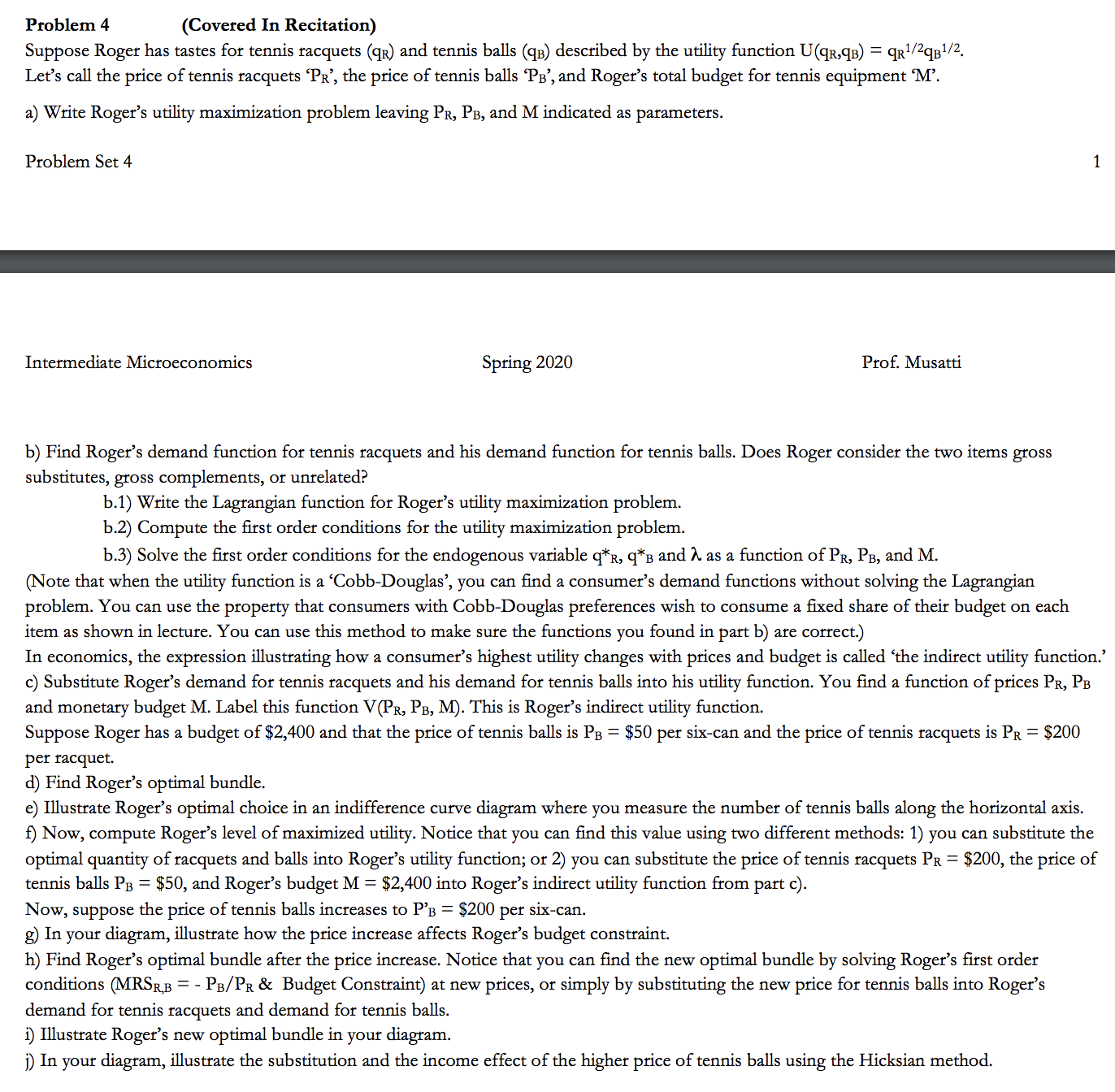
Problem 4 (Covered In Recitation) Suppose Roger has tastes for tennis racquets ((13) and tennis balls ((13) described by the utility function U(qR,qB) = qR1/2q31/2. Let's call the price of tennis racquets 'PR', the price of tennis balls 'PB', and Roger's total budget for tennis equipment M'. a) Write Roger's utility maximization problem leaving P3, P3, and M indicated as parameters. Problem Set 4 1 Intermediate Microeconomics Spring 2020 Prof. Musatti b) Find Roger's demand function for tennis racquets and his demand function for tennis balls. Does Roger consider the two items gross substitutes, gross complements, or unrelated? b.1) Write the Lagrangian anction for Roger's utility maximization problem. b.2) Compute the rst order conditions for the utility maximization problem. b.3) Solve the rst order conditions for the endogenous variable q*R, q*B and 7 as a function of PR, PB, and M. (Note that when the utility anction is a 'Cobb-Douglas', you can nd a consumer's demand functions without solving the Lagrangian problem. You can use the property that consumers with Cobb-Douglas preferences wish to consume a xed share of their budget on each item as shown in lecture. You can use this method to make sure the functions you found in part b) are correct.) In economics, the expression illustrating how a consumer's highest utility changes with prices and budget is called 'the indirect utility function.' c) Substitute Roger's demand for tennis racquets and his demand for tennis balls into his utility Jnction. You nd a anction of prices PR, PB and monetary budget M. Label this function V03, PB, M). This is Roger's indirect utility function. Suppose Roger has a budget of $2,400 and that the price of tennis balls is P]; = $50 per six-can and the price of tennis racquets is PR = $200 per racquet. d) Find Roger's optimal bundle. e) Illustrate Roger's optimal choice in an indifference curve diagram where you measure the number of tennis balls along the horizontal axis. f) Now, compute Roger's level of maximized utility. Notice that you can nd this value using two different methods: 1) you can substitute the optimal quantity of racquets and balls into Roger's utility function; or 2) you can substitute the price of tennis racquets PR = $200, the price of tennis balls P3 = $50, and Roger's budget M = $2,400 into Roger's indirect utility function from part c). Now, suppose the price of tennis balls increases to P1; = $200 per six-can. g) In your diagram, illustrate how the price increase affects Roger's budget constraint. h) Find Roger's optimal bundle after the price increase. Notice that you can nd the new optimal bundle by solving Roger's rst order conditions MRS\" = - PB/PR 8: Budget Constraint) at new prices, or simply by substituting the new price for tennis balls into Roger's demand for tennis racquets and demand for tennis balls. i) Illustrate Roger's new optimal bundle in your diagram. j) In your diagram, illustrate the substitution and the income effect of the higher price of tennis balls using the Hicksian method
Step by Step Solution
There are 3 Steps involved in it

Get step-by-step solutions from verified subject matter experts
 Study Help