







Question: please answer in electronic text if possible. thanks 5. Risk aversion and making investment choices: You are hired to make investment decisions for a large
 please answer in electronic text if possible. thanks
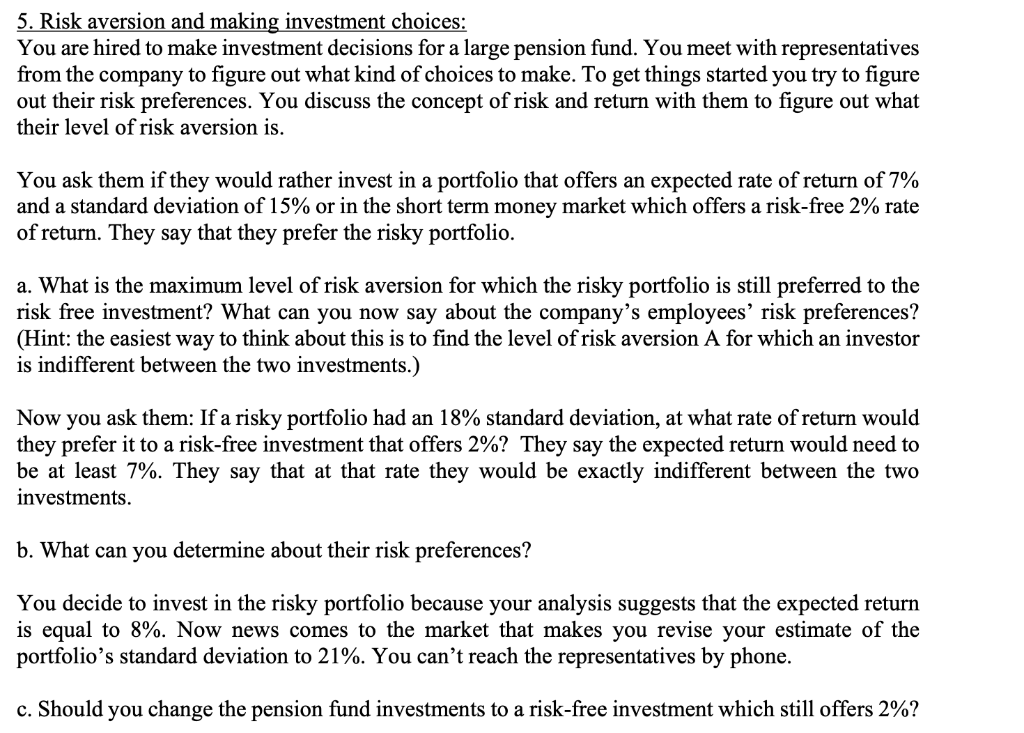
5. Risk aversion and making investment choices: You are hired to make investment decisions for a large pension fund. You meet with representatives from the company to figure out what kind of choices to make. To get things started you try to figure ut their risk preferences. You discuss the concept of risk and return with them to figure out what their level of risk aversion is. You ask them if they would rather invest in a portfolio that offers an expected rate ofreturn of 790 and a standard deviation of 1 5% or in the short term money market which offers a risk-free 2% rate of return. They say that they prefer the risky portfolio. a. What is the maximum level of risk aversion for which the risky portfolio is still preferred to risk free investment? What can you now say about the company's employees' risk preferences? (Hint: the easiest way to think about this is to find the level of risk aversion A for which an investor is indifferent between the two investments.) Now you ask them: If a risky portfolio had an 18% standard deviation, at what rate of return would they prefer it to a risk-free investment that offers 2%? They say the expected return would need to be at least 7%. They say that at that rate they would be exactly indifferent between the two investments b. What can you determine about their risk preferences? You decide to invest in the risky portfolio because your analysis suggests that the expected return is equal to 8%. Now news comes to the market that makes you revise your estimate of the portfolio's standard deviation to 21%. You can't reach the representatives by phone C. Should you change the pension fund investments to a risk-free investment which still offers 2%
Step by Step Solution
There are 3 Steps involved in it

Get step-by-step solutions from verified subject matter experts
 Study Help