







Question: Please answer in full details with full steps how you got to your conclusion and round all answers to 2 decimal points! Thank you! 5)
Please answer in full details with full steps how you got to your conclusion and round all answers to 2 decimal points! Thank you!
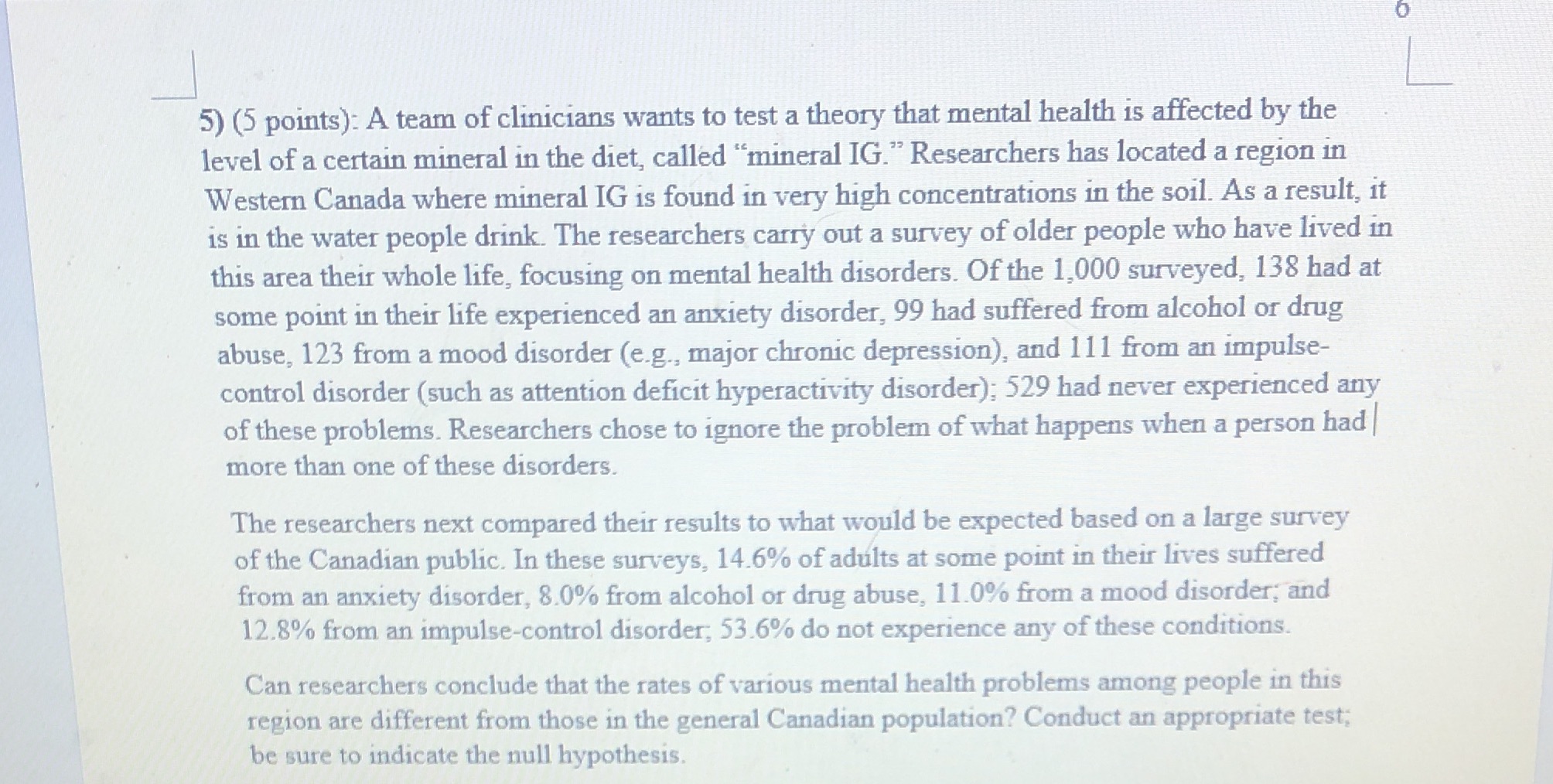
5) (5 points): A team of clinicians wants to test a theory that mental health is affected by the level of a certain mineral in the diet, called "mineral IG." Researchers has located a region in Western Canada where mineral IG is found in very high concentrations in the soil. As a result, it is in the water people drink. The researchers carry out a survey of older people who have lived in this area their whole life, focusing on mental health disorders. Of the 1,000 surveyed, 138 had at some point in their life experienced an anxiety disorder, 99 had suffered from alcohol or drug abuse, 123 from a mood disorder (e.g., major chronic depression), and 111 from an impulse- control disorder (such as attention deficit hyperactivity disorder); 529 had never experienced any of these problems. Researchers chose to ignore the problem of what happens when a person had more than one of these disorders. The researchers next compared their results to what would be expected based on a large survey of the Canadian public. In these surveys, 14.6% of adults at some point in their lives suffered from an anxiety disorder, 8.0% from alcohol or drug abuse, 11.0% from a mood disorder; and 12.8% from an impulse-control disorder, 53.6% do not experience any of these conditions. Can researchers conclude that the rates of various mental health problems among people in this region are different from those in the general Canadian population? Conduct an appropriate test, be sure to indicate the null hypothesis
Step by Step Solution
There are 3 Steps involved in it

Get step-by-step solutions from verified subject matter experts
 Study Help