







Question: PLEASE ANSWER IN LAYMAN'S TERMS PLEASE USE LANGUAGE THAT IS IN THE QUESTION PLEASE ANSWER ALL QUESTIONS AND NOT JUST SOME PLEASE PROVIDE THE EXACT
PLEASE ANSWER IN LAYMAN'S TERMS
PLEASE USE LANGUAGE THAT IS IN THE QUESTION
PLEASE ANSWER ALL QUESTIONS AND NOT JUST SOME
PLEASE PROVIDE THE EXACT NUMBERS FOR THE POINTS AND UP AND DOWN ARROWS
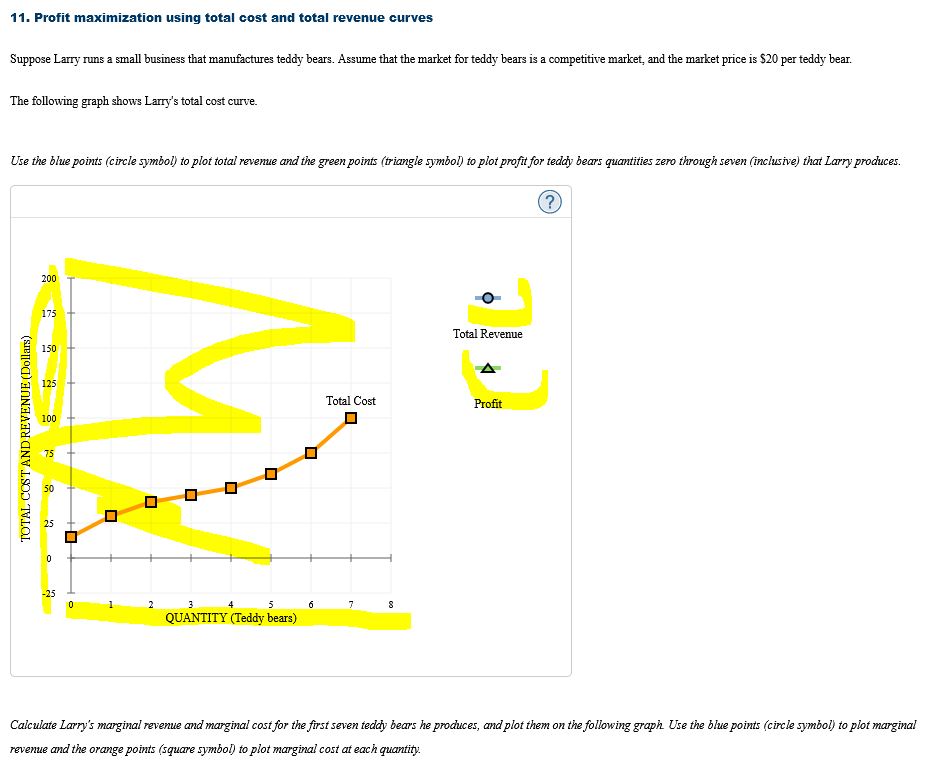
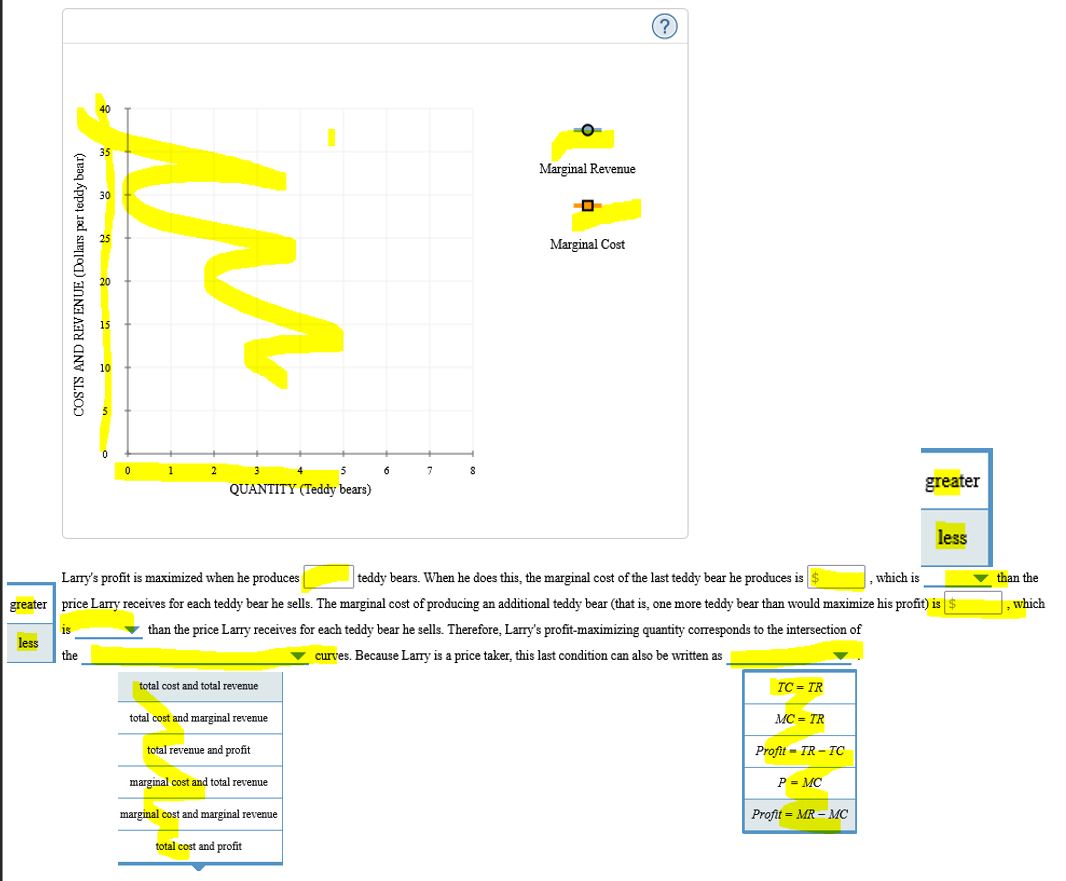
11. Profit maximization using total cost and total revenue curves Suppose Larry runs a small business that manufactures teddy bears. Assume that the market for teddy bears is a competitive market, and the market price is $20 per teddy bear. The following graph shows Larry's total cost curve. Use the blue points (circle symbol) to plot total revenue and the green points (triangle symbol) to plot profit for teddy bears quantities zero through seven (inclusive) that Larry produces. 200 O 175 Total Revenue 150 125 Total Cost Profit 100 TOTAL COST AND REVENUE (Dollars) 75 15 2 3 5 7 QUANTITY (Teddy bears) Calculate Larry's marginal revenue and marginal cost for the first seven teddy bears he produces, and plot them on the following graph Use the blue points (circle symbol) to plot marginal evenue and the orange points (square symbol) to plot marginal cost at each quantity.? 35 Marginal Revenue 30 Marginal Cost COSTS AND REVENUE (Dollars per teddy bear) 10 0 1 2 5 6 greater QUANTITY (Teddy bears) less Larry's profit is maximized when he produces teddy bears. When he does this, the marginal cost of the last teddy bear he produces is $ , which is than the price Larry receives for each teddy bear he sells. The marginal cost of producing an additional teddy bear (that is, one more teddy bear than would maximize his profit) is $ , which greater than the price Larry receives for each teddy bear he sells. Therefore, Larry's profit-maximizing quantity corresponds to the intersection of less the curves. Because Larry is a price taker, this last condition can also be written as total cost and total revenue IC = IR total cost and marginal revenue MC = TR total revenue and profit Profit - TR - IC marginal cost and total revenue P = MC marginal cost and marginal revenue Profit = MR-MC total cost and profit
Step by Step Solution
There are 3 Steps involved in it

Get step-by-step solutions from verified subject matter experts
 Study Help