







Question: Please Answer! In the questions in this section, we will use the Romer model {with a modest modication below), described by equations Y. = AfLy;
Please Answer!
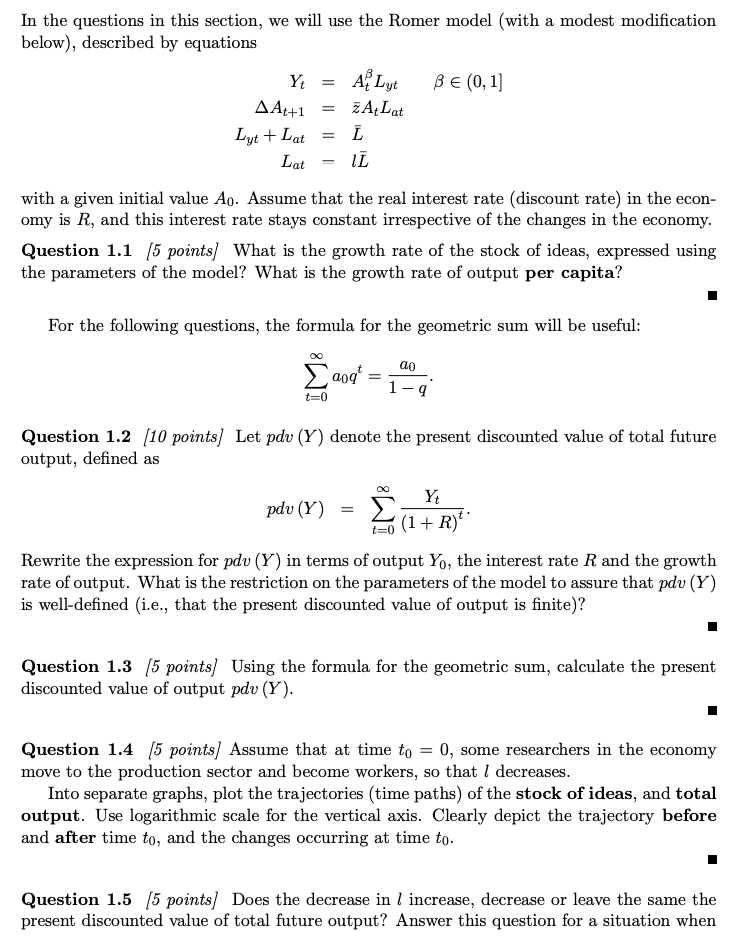
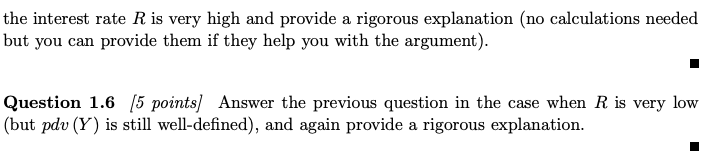
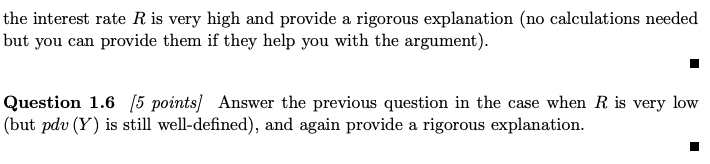
In the questions in this section, we will use the Romer model {with a modest modication below), described by equations Y. = AfLy; 36(1),\" AAt+1 = 511th Ly: + Lat = E L0. = 11'. with a given initial value A0. Assume that the real interest rate (discount rate) in the econ- omy is R, and this interest rate stays constant irrespective of the changes in the economy. Question 1.1 {5 pointsf What is the growth rate of the stock of ideas, expressed using the parameters of the model? What is the growth rate of output per capita? I For the following questions, the formula for the geometric sum will be useful: 00 2 coat = i. {=0 lq Question 1.2 [10 points] Let pdv (Y) denote the present discounted value of total future output, dened as 00 Y; N30,) = ;(1+R)t' Rewrite the expression for pdu (Y) in terms of output Y0, the interest rate R and the growth rate of output. What is the restriction on the parameters of the model to assure that pair: (Y) is well-dened (i.e., that the present discounted value of output is finite)? I Question 1.3 [5 points] Using the formula for the geometric sum, calculate the present discounted value of output pd!) (Y). I Question 1.4 [5 points} Assume that at time to = 0, some researchers in the economy move to the production sector and become workers, so that 1 decreases. Into separate graphs, plot the trajectories (time paths) of the stock of ideas, and total output. Use logarithmic scale for the vertical axis. Clearly depict the trajectory before and after time to, and the changes occurring at time to. I Question 1.5 [5 points] Does the decrease in I increase, decrease or leave the same the present discounted value of total future output? Answer this question for a situation when the interest rate R is very high and provide a rigorous explanation (no calculations needed but you can provide them if they help you with the argument]. Question 1.6 [5 points] Answer the previous question in the case when R is very low {but pdi: (Y) is still well-dened], and again provide a rigorous explanation
Step by Step Solution
There are 3 Steps involved in it

Get step-by-step solutions from verified subject matter experts
 Study Help