







Question: Please answer it in within 60 minutes , i will surely upvote your efforts please just answer to the point , it is very straight
Please answer it in within 60 minutes , i will surely upvote your efforts
please just answer to the point , it is very straight for all the parts
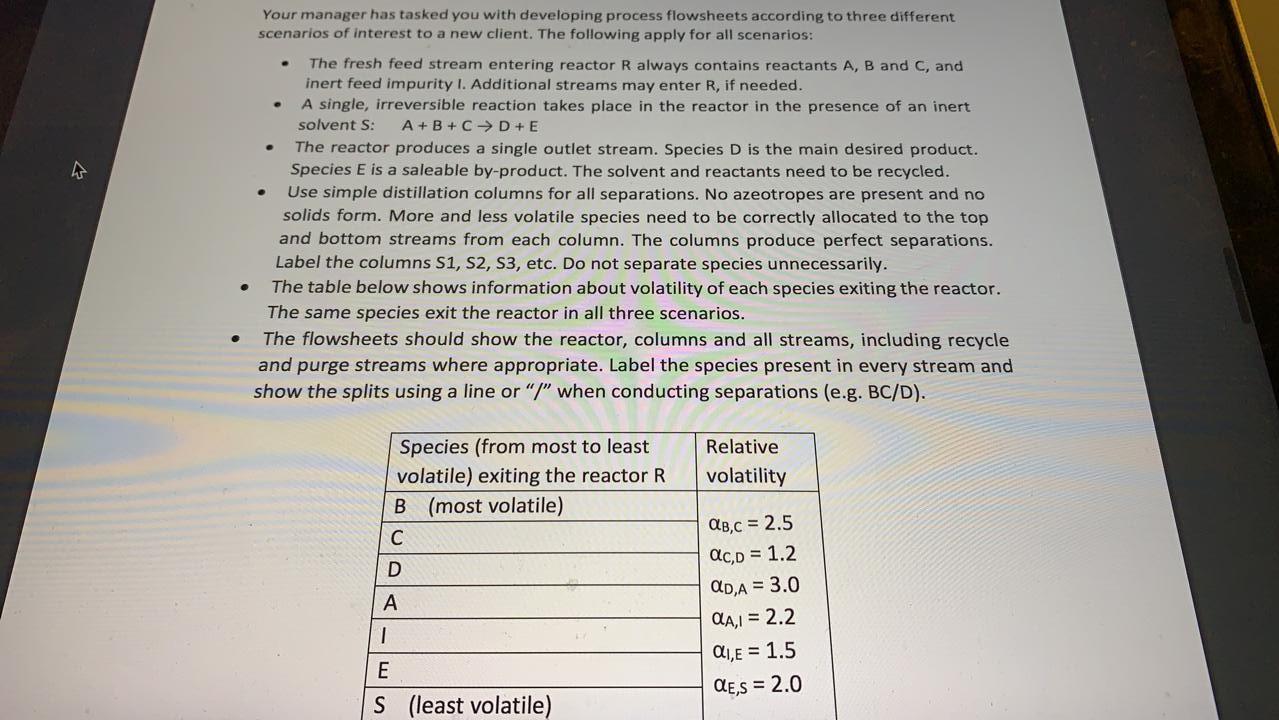
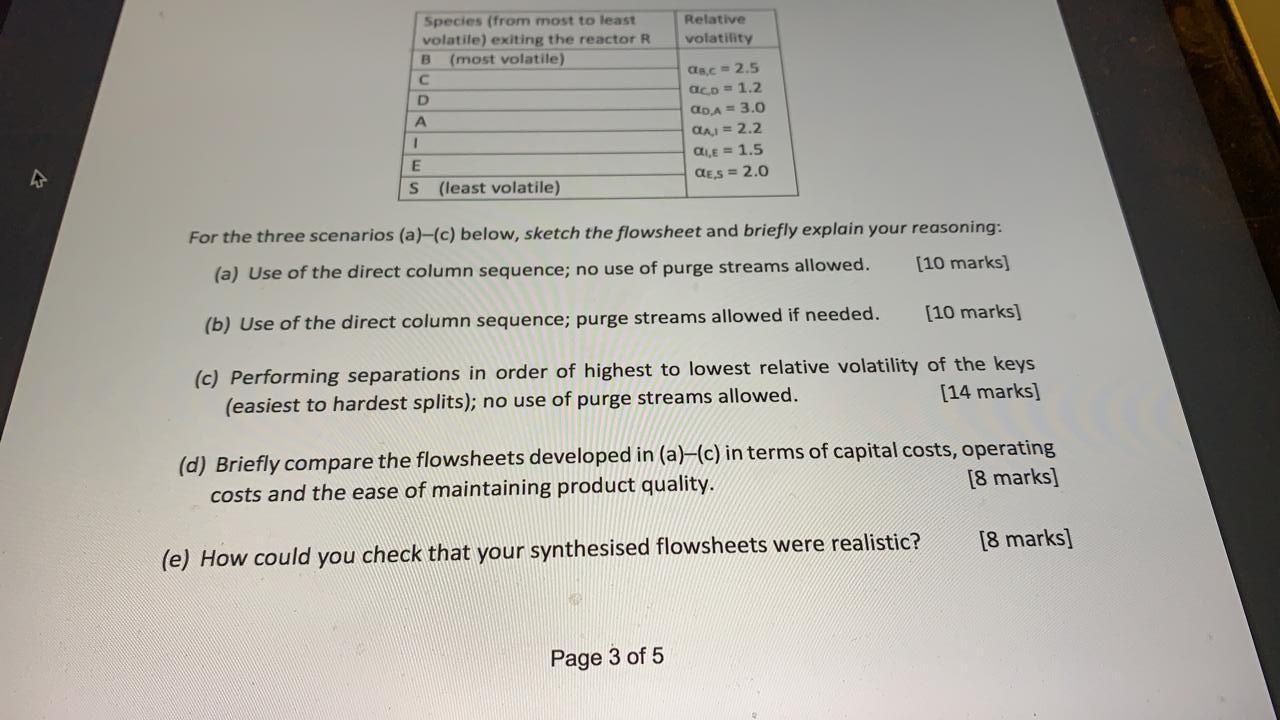
. Your manager has tasked you with developing process flowsheets according to three different scenarios of interest to a new client. The following apply for all scenarios: The fresh feed stream entering reactor R always contains reactants A, B and C, and inert feed impurity I. Additional streams may enter R, if needed. A single, irreversible reaction takes place in the reactor in the presence of an inert solvent S: A+B + C D + E The reactor produces a single outlet stream. Species D is the main desired product. Species E is a saleable by-product. The solvent and reactants need to be recycled. Use simple distillation columns for all separations. No azeotropes are present and no solids form. More and less volatile species need to be correctly allocated to the top and bottom streams from each column. The columns produce perfect separations. Label the columns S1, S2, S3, etc. Do not separate species unnecessarily. The table below shows information about volatility of each species exiting the reactor. The same species exit the reactor in all three scenarios. The flowsheets should show the reactor, columns and all streams, including recycle and purge streams where appropriate. Label the species present in every stream and show the splits using a line or "/" when conducting separations (e.g. BC/D). . Species (from most to least volatile) exiting the reactor R B (most volatile) C Relative volatility D A AB,C = 2.5 AC,D = 1.2 ADA = 3.0 AA, = 2.2 All,e = 1.5 DES = 2.0 1 E S (least volatile) Relative volatility Species (from most to least volatile) exiting the reactor R B (most volatile) D 1 E S (least volatile) a = 25 aco = 1.2 COA 3.0 CAJ = 2.2 CHE = 1.5 CLES = 2.0 For the three scenarios (a)-(c) below, sketch the flowsheet and briefly explain your reasoning: (a) Use of the direct column sequence; no use of purge streams allowed. [10 marks] [10 marks] (b) Use of the direct column sequence; purge streams allowed if needed. (c) Performing separations in order of highest to lowest relative volatility of the keys (easiest to hardest splits); no use of purge streams allowed. [14 marks] (d) Briefly compare the flowsheets developed in (a)-(c) in terms of capital costs, operating costs and the ease of maintaining product quality. [8 marks] [8 marks] (e) How could you check that your synthesised flowsheets were realistic? Page 3 of 5 . Your manager has tasked you with developing process flowsheets according to three different scenarios of interest to a new client. The following apply for all scenarios: The fresh feed stream entering reactor R always contains reactants A, B and C, and inert feed impurity I. Additional streams may enter R, if needed. A single, irreversible reaction takes place in the reactor in the presence of an inert solvent S: A+B + C D + E The reactor produces a single outlet stream. Species D is the main desired product. Species E is a saleable by-product. The solvent and reactants need to be recycled. Use simple distillation columns for all separations. No azeotropes are present and no solids form. More and less volatile species need to be correctly allocated to the top and bottom streams from each column. The columns produce perfect separations. Label the columns S1, S2, S3, etc. Do not separate species unnecessarily. The table below shows information about volatility of each species exiting the reactor. The same species exit the reactor in all three scenarios. The flowsheets should show the reactor, columns and all streams, including recycle and purge streams where appropriate. Label the species present in every stream and show the splits using a line or "/" when conducting separations (e.g. BC/D). . Species (from most to least volatile) exiting the reactor R B (most volatile) C Relative volatility D A AB,C = 2.5 AC,D = 1.2 ADA = 3.0 AA, = 2.2 All,e = 1.5 DES = 2.0 1 E S (least volatile) Relative volatility Species (from most to least volatile) exiting the reactor R B (most volatile) D 1 E S (least volatile) a = 25 aco = 1.2 COA 3.0 CAJ = 2.2 CHE = 1.5 CLES = 2.0 For the three scenarios (a)-(c) below, sketch the flowsheet and briefly explain your reasoning: (a) Use of the direct column sequence; no use of purge streams allowed. [10 marks] [10 marks] (b) Use of the direct column sequence; purge streams allowed if needed. (c) Performing separations in order of highest to lowest relative volatility of the keys (easiest to hardest splits); no use of purge streams allowed. [14 marks] (d) Briefly compare the flowsheets developed in (a)-(c) in terms of capital costs, operating costs and the ease of maintaining product quality. [8 marks] [8 marks] (e) How could you check that your synthesised flowsheets were realistic? Page 3 of 5
Step by Step Solution
There are 3 Steps involved in it

Get step-by-step solutions from verified subject matter experts
 Study Help