







Question: PLEASE ANSWER MY CASE STUDY QUESTIONS. I PLACED THE ARTICLE SO U COULD READ IT!!! 01 Introduction The Coca-Cola Company is truly global, and its
PLEASE ANSWER MY CASE STUDY QUESTIONS. I PLACED THE ARTICLE SO U COULD READ IT!!! 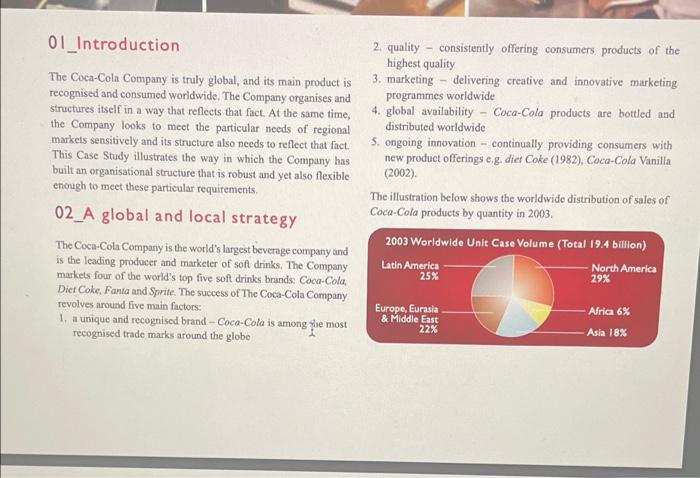
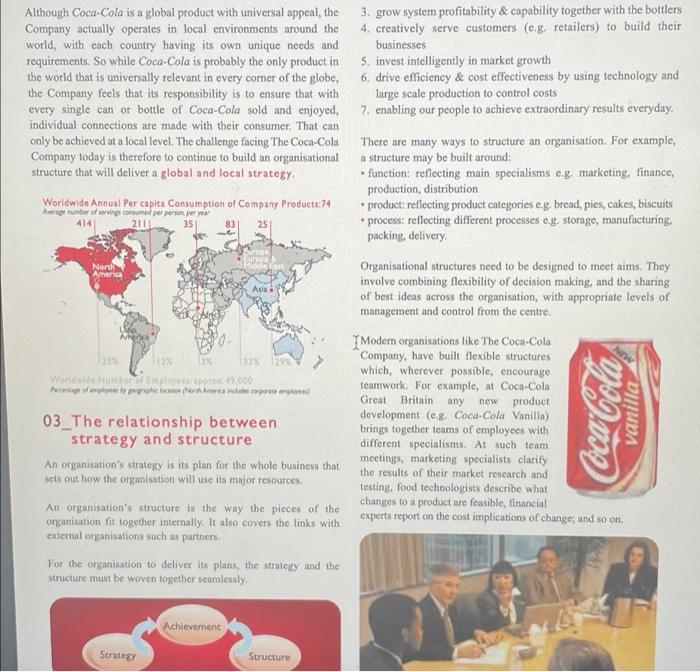
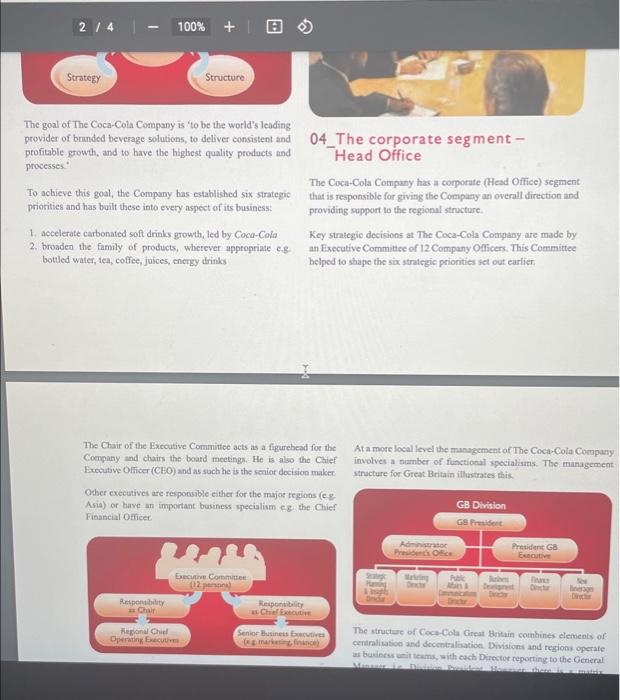
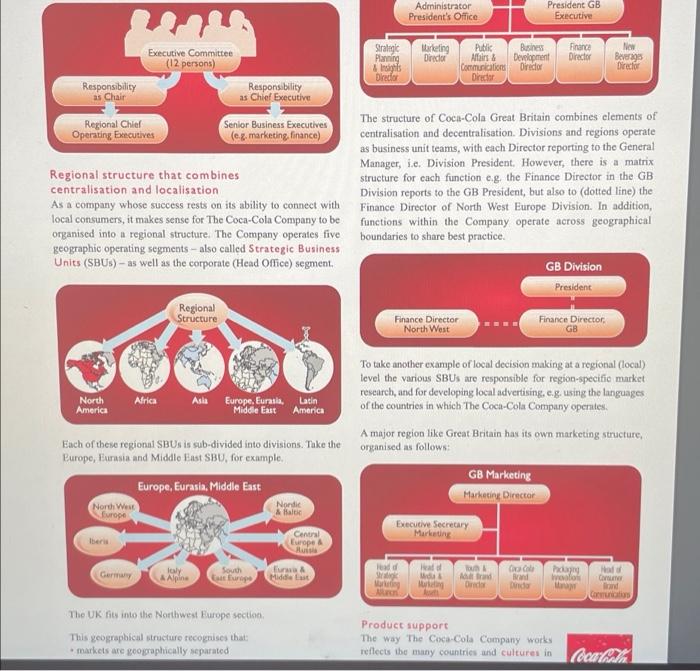
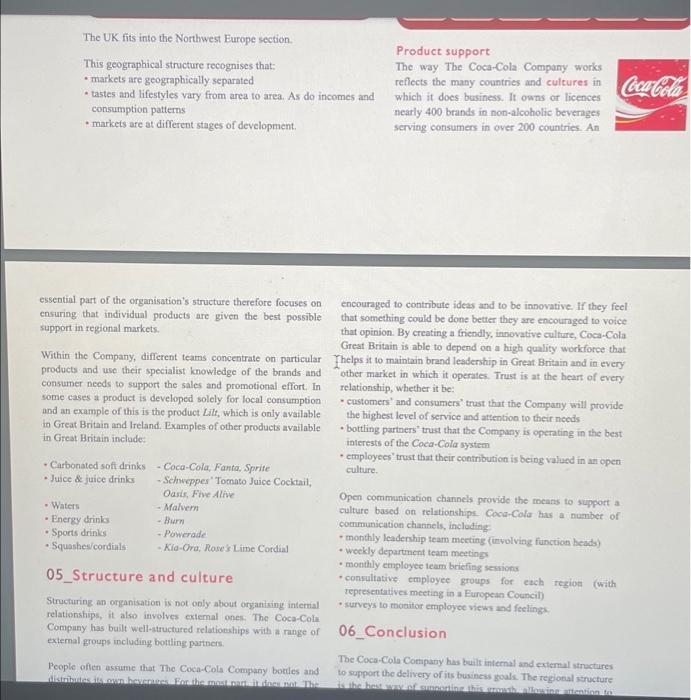
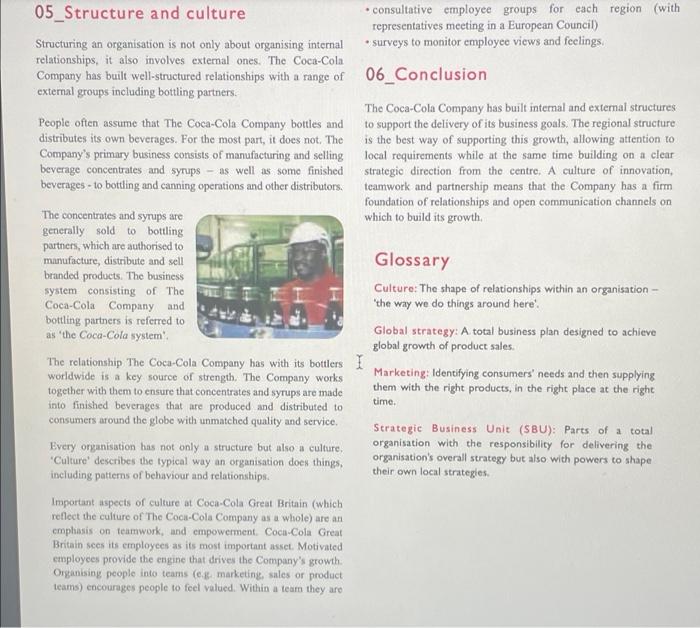
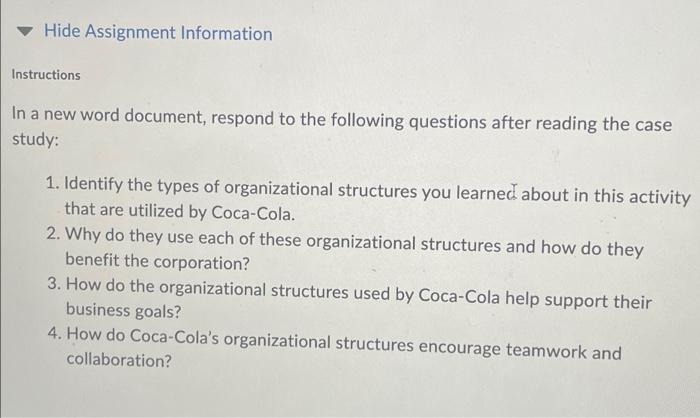
01 Introduction The Coca-Cola Company is truly global, and its main product is recognised and consumed worldwide. The Company organises and structures itself in a way that reflects that fact. At the same time, the Company looks to meet the particular needs of regional markets sensitively and its structure also needs to reflect that fact. This Case Study illustrates the way in which the Company has built an organisational structure that is robust and yet also flexible enough to meet these particular requirements. 02_A global and local strategy The Coca-Cola Company is the world's largest beverage company and is the leading producer and marketer of soft drinks. The Company markets four of the world's top five soft drinks brands: Coca-Cola, Diet Coke, Fanta and Sprite. The success of The Coca-Cola Company revolves around five main factors: 1. a unique and recognised brand-Coca-Cola is among the most recognised trade marks around the globe 2. quality consistently offering consumers products of the highest quality 3. marketing delivering creative and innovative marketing programmes worldwide 4. global availability Coca-Cola products are bottled and distributed worldwide 5. ongoing innovation continually providing consumers with new product offerings e.g. diet Coke (1982), Coca-Cola Vanilla (2002). The illustration below shows the worldwide distribution of sales of Coca-Cola products by quantity in 2003. 2003 Worldwide Unit Case Volume (Total 19.4 billion) Latin America 25% North America 29% Europe, Eurasia & Middle East 22% -Africa 6% Asia 18% Although Coca-Cola is a global product with universal appeal, the Company actually operates in local environments around the world, with each country having its own unique needs and requirements. So while Coca-Cola is probably the only product in the world that is universally relevant in every corner of the globe, the Company feels that its responsibility is to ensure that with every single can or bottle of Coca-Cola sold and enjoyed, individual connections are made with their consumer. That can only be achieved at a local level. The challenge facing The Coca-Cola Company today is therefore to continue to build an organisational structure that will deliver a global and local strategy. Worldwide Annual Per capita Consumption of Company Products:74 Average number of servings consumed per person, per year 211 35 Ve North America Asia 13% 33% Worldwide Number of Employees approx. 49.000 Percentage of employees by geographic icon (North America includes corporate employees) 03 The relationship between strategy and structure An organisation's strategy is its plan for the whole business that sets out how the organisation will use its major resources. An organisation's structure is the way the pieces of the organisation fit together internally. It also covers the links with external organisations such as partners. For the organisation to deliver its plans, the strategy and the structure must be woven together seamlessly. Achievement Strategy Structure PO- 3. grow system profitability & capability together with the bottlers 4. creatively serve customers (e.g. retailers) to build their businesses 5. invest intelligently in market growth 6. drive efficiency & cost effectiveness by using technology and large scale production to control costs 7. enabling our people to achieve extraordinary results everyday. There are many ways to structure an organisation. For example, a structure may be built around: function: reflecting main specialisms e.g. marketing, finance, production, distribution product: reflecting product categories e.g. bread, pies, cakes, biscuits process: reflecting different processes e.g. storage, manufacturing, packing, delivery. Organisational structures need to be designed to meet aims. They involve combining flexibility of decision making, and the sharing of best ideas across the organisation, with appropriate levels of management and control from the centre. Modern organisations like The Coca-Cola Company, have built flexible structures which, wherever possible, encourage teamwork. For example, at Coca-Cola Great Britain any new product development (e.g. Coca-Cola Vanilla) brings together teams of employees with different specialisms. At such team meetings, marketing specialists clarify the results of their market research and I testing, food technologists describe what changes to a product are feasible, financial experts report on the cost implications of change, and so on. Coca-Cola vanilla Ph 2/4 100% + - Strategy Structure The goal of The Coca-Cola Company is 'to be the world's leading provider of branded beverage solutions, to deliver consistent and profitable growth, and to have the highest quality products and processes. To achieve this goal, the Company has established six strategic priorities and has built these into every aspect of its business: 1. accelerate carbonated soft drinks growth, led by Coca-Cola 2. broaden the family of products, wherever appropriate e.g bottled water, tea, coffee, juices, energy drinks 04 The corporate segment - Head Office The Coca-Cola Company has a corporate (Head Office) segment that is responsible for giving the Company an overall direction and providing support to the regional structure. Key strategic decisions at The Coca-Cola Company are made by an Executive Committee of 12 Company Officers. This Committee helped to shape the six strategic priorities set out earlier. The Chair of the Executive Committee acts as a figurehead for the Company and chairs the board meetings. He is also the Chief Executive Officer (CEO) and as such he is the senior decision maker Other executives are responsible either for the major regions (e.g Asia) or have an important business specialism eg the Chief Financial Officer. Executive Committee (12 persons) Responsibility Responsibility Chief Executive Chair Regional Chief Operating Executives Senior Business Executives (e marketing, finance) At a more local level the management of The Coca-Cola Company involves a number of functional specialisms. The management structure for Great Britain illustrates this. GB Division GB President Administrator President's Office President GB Executive Fas Deeigne Eva The structure of Coca-Cola Great Britain combines elements of centrali ion and decentralisation Divisions and regions operate as business unit teams, with cach Director reporting to the General Executive Committee (12 persons) Responsibility as Chair Responsibility as Chief Executive Regional Chief Operating Executives Senior Business Executives (e.g. marketing, finance) Regional structure that combines centralisation and localisation As a company whose success rests on its ability to connect with local consumers, it makes sense for The Coca-Cola Company to be organised into a regional structure. The Company operates five geographic operating segments - also called Strategic Business Units (SBUS) - as well as the corporate (Head Office) segment. Regional Structure Africa Asia North America Europe, Eurasia, Latin Middle East America Each of these regional SBUS is sub-divided into divisions. Take the Europe, Eurasia and Middle East SBU, for example. Europe, Eurasia, Middle East North West Europe Nordic & Baltic Germany kaly & Alpine South East Europe The UK fits into the Northwest Europe section. This geographical structure recognises that: markets are geographically separated Iberis Central Europe & Ruisia Eura & Middle East President GB Executive New Strategic Planning Marketing Public Director Business Finance Development Director Beverages Affairs & Communications Director Director & Insights Director Director The structure of Coca-Cola Great Britain combines elements of centralisation and decentralisation. Divisions and regions operate as business unit teams, with each Director reporting to the General Manager, i.e. Division President. However, there is a matrix structure for each function e.g. the Finance Director in the GB Division reports to the GB President, but also to (dotted line) the Finance Director of North West Europe Division. In addition, functions within the Company operate across geographical boundaries to share best practice. GB Division President Finance Director North West Finance Director, GB To take another example of local decision making at a regional (local) level the various SBUs are responsible for region-specific market research, and for developing local advertising, e.g. using the languages of the countries in which The Coca-Cola Company operates. A major region like Great Britain has its own marketing structure, organised as follows: GB Marketing Marketing Director Executive Secretary Marketing Head of Head of Tw Arand Coca Cola Packaging Hod of waslos Mida & Consumer Strategic Marketing Marking Director Brand Dinda Manag Brand Communications Product support The way The Coca-Cola Company works reflects the many countries and cultures in Coca-Cola Administrator President's Office The UK fits into the Northwest Europe section. Product support The way The Coca-Cola Company works This geographical structure recognises that: markets are geographically separated reflects the many countries and cultures in Coca-Cola tastes and lifestyles vary from area to area. As do incomes and which it It owns or licences consumption patterns nearly 400 brands in non-alcoholic beverages serving consumers in over 200 countries. An . markets are at different stages of development. essential part of the organisation's structure therefore focuses on ensuring that individual products are given the best possible support in regional markets. encouraged to contribute ideas and to be innovative. If they feel that something could be done better they are encouraged to voice that opinion. By creating a friendly, innovative culture, Coca-Cola Great Britain is able to depend on a high quality workforce that Thelps it to maintain brand leadership in Great Britain and in every other market in which it operates. Trust is at the heart of every relationship, whether it be: Within the Company, different teams concentrate on particular products and use their specialist knowledge of the brands and consumer needs to support the sales and promotional effort. In some cases a product is developed solely for local consumption and an example of this is the product Lilt, which is only available in Great Britain and Ireland. Examples of other products available in Great Britain include: customers and consumers' trust that the Company will provide the highest level of service and attention to their needs bottling partners' trust that the Company is operating in the best interests of the Coca-Cola system employees' trust that their contribution is being valued in an open culture. Carbonated soft drinks Juice & juice drinks - Coca-Cola, Fanta, Sprite -Schweppes Tomato Juice Cocktail, Oasis, Five Alive . Waters - Malvern Open communication channels provide the means to support a culture based on relationships. Coca-Cola has a number of communication channels, including Energy drinks - Burn Sports drinks -Powerade monthly leadership team meeting (involving function beads) weekly department team meetings Squashes/cordials . -Kia-Ora, Roses Lime Cordial monthly employee team briefing sessions 05_Structure and culture " consultative employee groups for each region (with representatives meeting in a European Council) surveys to monitor employee views and feelings. Structuring an organisation is not only about organising internal relationships, it also involves external ones. The Coca-Cola Company has built well-structured relationships with a range of external groups including bottling partners. 06_Conclusion People often assume that The Coca-Cola Company bottles and distributes its own heverages For the most part it does not The The Coca-Cola Company has built internal and external structures to support the delivery of its business goals. The regional structure is the best way of supporting this growth allowing attention to 05_Structure and culture consultative employee groups for each region (with representatives meeting in a European Council) surveys to monitor employee views and feelings. Structuring an organisation is not only about organising internal relationships, it also involves external ones. The Coca-Cola Company has built well-structured relationships with a range of external groups including bottling partners. 06_Conclusion People often assume that The Coca-Cola Company bottles and distributes its own beverages. For the most part, it does not. The Company's primary business consists of manufacturing and selling beverage concentrates and syrups as well as some finished beverages - to bottling and canning operations and other distributors. The Coca-Cola Company has built internal and external structures to support the delivery of its business goals. The regional structure is the best way of supporting this growth, allowing attention to local requirements while at the same time building on a clear strategic direction from the centre. A culture of innovation, teamwork and partnership means that the Company has a firm foundation of relationships and open communication channels on which to build its growth. Glossary The concentrates and syrups are generally sold to bottling partners, which are authorised to manufacture, distribute and sell branded products. The business system consisting of The Coca-Cola Company and bottling partners is referred to as 'the Coca-Cola system". Culture: The shape of relationships within an organisation - 'the way we do things around here. Global strategy: A total business plan designed to achieve global growth of product sales. I The relationship The Coca-Cola Company has with its bottlers worldwide is a key source of strength. The Company works together with them to ensure that concentrates and syrups are made into finished beverages that are produced and distributed to consumers around the globe with unmatched quality and service. Marketing: Identifying consumers' needs and then supplying them with the right products, in the right place at the right time. Every organisation has not only a structure but also a culture. 'Culture' describes the typical way an organisation does things, including patterns of behaviour and relationships. Strategic Business Unit (SBU): Parts of a total organisation with the responsibility for delivering the organisation's overall strategy but also with powers to shape their own local strategies. Important aspects of culture at Coca-Cola Great Britain (which reflect the culture of The Coca-Cola Company as a whole) are an emphasis on teamwork, and empowerment. Coca-Cola Great Britain sees its employees as its most important asset. Motivated employees provide the engine that drives the Company's growth. Organising people into teams (e.g. marketing, sales or product teams) encourages people to feel valued. Within a team they are Hide Assignment Information Instructions In a new word document, respond to the following questions after reading the case study: 1. Identify the types of organizational structures you learned about in this activity that are utilized by Coca-Cola. 2. Why do they use each of these organizational structures and how do they benefit the corporation? 3. How do the organizational structures used by Coca-Cola help support their business goals? 4. How do Coca-Cola's organizational structures encourage teamwork and collaboration Step by Step Solution
There are 3 Steps involved in it
1 Expert Approved Answer
Step: 1 Unlock

Question Has Been Solved by an Expert!
Get step-by-step solutions from verified subject matter experts
Step: 2 Unlock
Step: 3 Unlock
 Study Help