Question: please answer my first question prepare a flowchart of the process a passenger's bag follow kiosk to destination carousel SELF TAG CHECK IN Alaska Airlines:
 please answer my first question prepare a flowchart of the process a passenger's bag follow kiosk to destination carousel
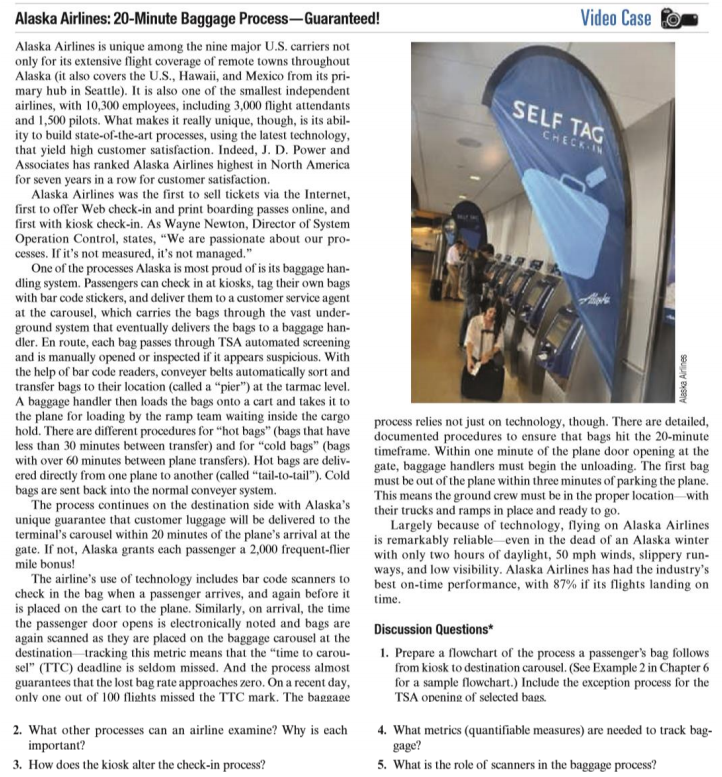
SELF TAG CHECK IN Alaska Airlines: 20-Minute Baggage ProcessGuaranteed! Video Cases Alaska Airlines is unique among the nine major U.S. carriers not only for its extensive flight coverage of remote towns throughout Alaska (it also covers the U.S., Hawaii, and Mexico from its pri- mary hub in Seattle). It is also one of the smallest independent airlines, with 10,300 employees, including 3,000 flight attendants and 1,500 pilots. What makes it really unique, though, is its abil- ity to build state-of-the-art processes, using the latest technology, that yield high customer satisfaction. Indeed, J. D. Power and Associates has ranked Alaska Airlines highest in North America for seven years in a row for customer satisfaction. Alaska Airlines was the first to sell tickets via the Internet, first to offer Web check-in and print boarding passes online, and first with kiosk check-in. As Wayne Newton, Director of System Operation Control, states, "We are passionate about our pro- cesses. If it's not measured, it's not managed." One of the processes Alaska is most proud of is its baggage han- dling system. Passengers can check in at kiosks, tag their own bags with bar code stickers, and deliver them to a customer service agent at the carousel, which carries the bags through the vast under- ground system that eventually delivers the bags to a baggage han- dler. En route, each bag passes through TSA automated screening and is manually opened or inspected if it appears suspicious. With the help of bar code readers, conveyer belts automatically sort and transfer bags to their location (called a "pier") at the tarmac level. A baggage handler then loads the bags onto a cart and takes it to the plane for loading by the ramp team waiting inside the cargo hold. There are different procedures for "hot bags" (bags that have process relies not just on technology, though. There are detailed, documented procedures to ensure that bags hit the 20-minute less than 30 minutes between transfer) and for "cold bags" (bags timeframe. Within one minute of the plane door opening at the with over 60 minutes between plane transfers). Hot bags are deliv- gate, baggage handlers must begin the unloading. The first bag ered directly from one plane to another (called "tail-to-tail"). Cold must be out of the plane within three minutes of parking the plane. bags are sent back into the normal conveyer system. The process continues on the destination side with Alaska's This means the ground crew must be in the proper location with unique guarantee that customer luggage will be delivered to the their trucks and ramps in place and ready to go. terminal's carousel within 20 minutes of the plane's arrival at the is remarkably reliable even in the dead of an Alaska winter Largely because of technology, flying on Alaska Airlines gate. If not, Alaska grants each passenger a 2,000 frequent-flier with only two hours of daylight, 50 mph winds, slippery run- mile bonus! ways, and low visibility. Alaska Airlines has had the industry's The airline's use of technology includes bar code scanners to best on-time performance, with 87% if its flights landing on check in the bag when a passenger arrives, and again before it is placed on the cart to the plane. Similarly, on arrival, the time time. the passenger door opens is electronically noted and bags are Discussion Questions* again scanned as they are placed on the baggage carousel at the destination tracking this metric means that the time to carou 1. Prepare a flowchart of the process a passenger's bag follows sel" (TTC) deadline is seldom missed. And the process almost from kiosk to destination carousel. (See Example 2 in Chapter 6 guarantees that the lost bag rate approaches zero. On a recent day, for a sample flowchart.) Include the exception process for the only one out of 100 flights missed the TTC mark. The baggage TSA opening of selected bags. 2. What other processes can an airline examine? Why is each 4. What metrics (quantifiable measures) are needed to track bag- important? gage? 3. How does the kiosk alter the check-in process? 5. What is the role of scanners in the baggage process? Alaska Airlines









 Study Help